

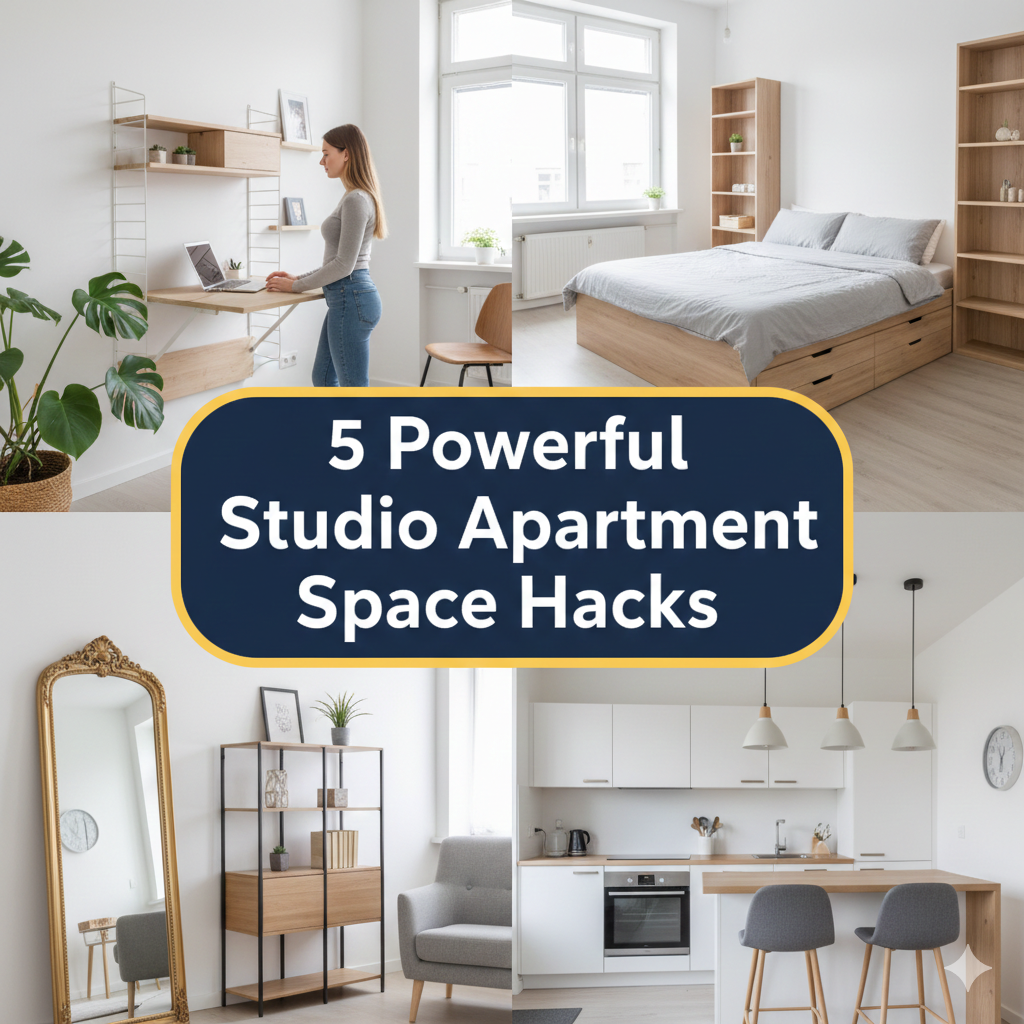
Living in a studio apartment has its charm. It’s cozy, affordable, and low-maintenance. But let’s be real — fitting your entire life into one room is a challenge nobody warned you about.
The kitchen, bedroom, living room, and workspace all share the same four walls. Things get cramped fast. And the moment you think about fixing it, someone mentions “renovation,” and suddenly you’re imagining noise, dust, permits, and a bill that makes your eyes water.
Here’s the good news: you don’t need any of that.
These studio apartment space hacks are 100% renovation-free. No drilling into walls. No calling a contractor. No losing your security deposit. Just smart, practical changes that make your small space feel twice as big — starting today.
Why Most Small Space Advice Gets It Wrong
Most articles tell you to “declutter” or “use light colors.” That’s fine advice, but it’s surface-level. Real transformation comes from rethinking how your space works, not just how it looks.
A studio apartment isn’t just small — it’s multifunctional. Every square foot has to serve more than one purpose. That’s the real challenge.
The hacks below tackle that challenge directly. They focus on function first, style second. And every single one can be done without touching a single wall.
Hack #1 — Make Your Furniture Do Double (or Triple) Duty
Stop Buying Single-Purpose Furniture
In a studio apartment, a bed is just a bed only if you let it be. The same goes for your couch, your coffee table, and your dresser.
Multi-functional furniture is the single biggest upgrade you can make in a small space. It cuts down on the number of pieces you need while keeping everything useful.
Here are some powerful swaps:
| Single-Purpose Piece | Multi-Functional Upgrade |
|---|---|
| Regular bed frame | Bed with built-in drawers underneath |
| Standard sofa | Sleeper sofa or sofa with storage arms |
| Coffee table | Lift-top coffee table with hidden storage |
| Dining table | Foldable wall-mounted drop-leaf table |
| Nightstand | Floating shelf with a built-in USB outlet strip |
| Ottoman | Storage ottoman that doubles as seating |
The Murphy Bed Game-Changer
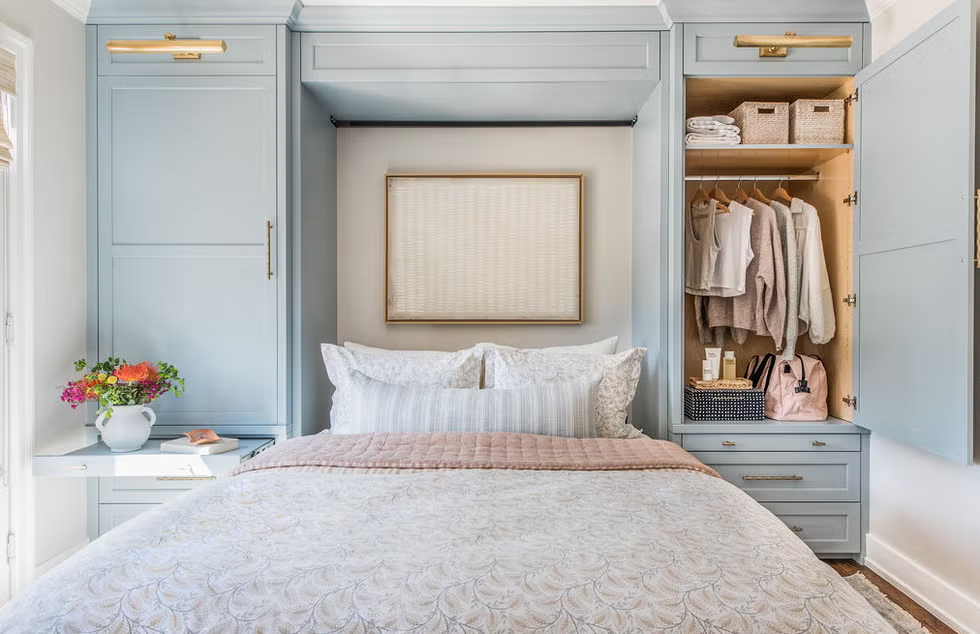
If you’re willing to invest in one piece of furniture, make it a Murphy bed — also called a wall bed. These fold flat against the wall during the day and pull down at night.
Modern Murphy beds now come with built-in shelving, desks, and even sofas attached. You flip it down to sleep, flip it back up, and suddenly your bedroom is your living room again.
No renovation required. Many Murphy bed systems are freestanding and attach to the wall with minimal hardware — simple enough to be considered temporary in most rental agreements.
The “Every Piece Earns Its Place” Rule
Go through every item of furniture in your apartment and ask: does this do more than one thing? If the answer is no, consider replacing it or removing it entirely.
This rule alone can free up more floor space than any renovation ever could.
Hack #2 — Use Vertical Space Like You Own the Ceiling
Most People Only Think Horizontally
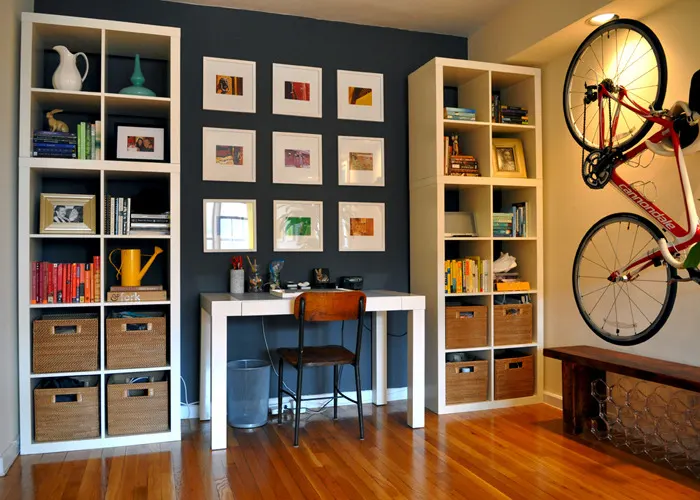
When floor space is limited, the floor isn’t where your storage should live. Look up. That wall space above your eye level? It’s basically empty real estate in most studio apartments.
Vertical storage is one of the most underused studio apartment space hacks out there. And the best part? Most vertical storage options require zero permanent changes to your walls.
Freestanding Shelving Units
Floor-to-ceiling bookshelves are your best friend. They look intentional, they hold a massive amount of stuff, and they can be taken with you when you move.
Use the top shelves for items you rarely need — seasonal items, backup supplies, decorative boxes. Use eye-level shelves for books, plants, or everyday items. Keep the bottom shelves for baskets or bins.
Over-the-Door Organizers
The back of every door in your apartment is wasted space. Fix that.
Over-the-door organizers come in dozens of styles:
- Shoe organizers — great for shoes, cleaning supplies, accessories
- Pocket organizers — perfect for a home office setup
- Hooks and bars — ideal for coats, bags, and towels
- Spice racks — surprisingly useful for the bathroom or kitchen
One over-the-door organizer on your main closet door can replace an entire dresser’s worth of small items.
Tension Rod Tricks
Tension rods are cheap, damage-free, and wildly versatile.
Install one under your kitchen sink to hang spray bottles. Add one inside a cabinet to create a second shelf. Use one in a closet to double your hanging space. Stack tension rods horizontally to organize pot lids or baking sheets.
The Vertical Space Snapshot
Think of your wall space in three zones:
Zone 1 — Eye Level and Below: Active storage and display. Things you use daily.
Zone 2 — Above Eye Level to 6 Feet: Less-accessed storage. Books, plants, decorative items.
Zone 3 — Above 6 Feet to Ceiling: Rarely accessed items only. Use labeled bins or baskets.
This zoning approach keeps your space functional without creating chaos.
Hack #3 — Define Your Zones Without Building a Single Wall
The Open Floor Plan Problem
A studio apartment is essentially one big open room. That sounds great in a real estate listing. In real life, it means your bed is three feet from your dinner table, your “office” is the corner of your couch, and you feel like you’re always living in every room at once.
The fix? Zone definition. You carve out separate areas for sleeping, working, eating, and relaxing — without actually building walls.
If you want to explore more layout ideas and zone setups that actually work in compact spaces, Studio Apartment Setup is a great resource worth bookmarking.
Use Rugs to Anchor Each Zone
Area rugs are one of the most powerful zoning tools available. They create a visual boundary that tells your brain “this area is different from that area.”
Place a rug under your bed and bedside tables — that’s your bedroom. Place a different rug under your sofa and coffee table — that’s your living room. The moment you do this, the space feels like it has rooms, even though it technically doesn’t.
Choose rugs that complement each other but aren’t identical. Different textures work well — a plush rug for the bedroom, a flat-weave for the living area.
Bookshelf Room Dividers
A tall, open bookshelf placed perpendicular to a wall (not flush against it) creates a visual partition between zones. It blocks the sightline between spaces without actually closing them off.
The best part? You get storage on both sides. Face the living room side outward with books and décor. Use the bedroom-facing side for personal items or a lamp.
Curtains as Walls
Ceiling-mounted curtain tracks (the kind that attach via tension or command strips) let you hang floor-to-ceiling curtains that section off sleeping areas, closets, or workspaces.
When you want privacy or a clear mental separation between “work mode” and “relax mode,” you close the curtain. When you want openness, you pull it back.
This is one of the most dramatic visual transformations possible in a studio — and it requires no permanent installation.
Lighting as a Zone Signal
Different lighting for different zones reinforces the separation. A warm, dim bedside lamp signals “sleep zone.” A brighter, cooler desk lamp signals “work zone.” A soft overhead or floor lamp signals “living zone.”
Smart bulbs make this effortless — you can preset different moods for different areas with a single tap.
Hack #4 — Master the Art of Hidden and Accessible Storage
The Storage Paradox
In small apartments, storage is simultaneously the biggest problem and the biggest opportunity. Most people think they don’t have enough storage. What they often lack is organized storage.
The goal isn’t more storage — it’s smarter storage. You want things you use often to be instantly accessible, and things you rarely use to be completely out of sight.
Under-Bed Storage: The Most Overlooked Space
The average queen-sized bed sits 12 to 16 inches off the ground. That’s a significant storage cavity most people completely ignore.
If your bed doesn’t have built-in drawers, use flat, rolling bins or vacuum storage bags. Vacuum bags are especially useful for bulky items like extra blankets, winter coats, or out-of-season clothing.
Label everything. If it’s out of sight, labeling is the difference between a functional storage system and a place where things go to be forgotten.
The “One In, One Out” System
Here’s a habit that beats any storage hack: every time something new comes into your apartment, something old has to leave.
Buy a new shirt? Donate an old one. Buy a new kitchen gadget? Get rid of one you use less. This keeps clutter from quietly multiplying and making even the best storage systems useless.
Furniture Gaps and Awkward Corners
Most studio apartments have at least one awkward corner or an odd gap between furniture pieces. These aren’t wasted spaces — they’re storage opportunities.
- Narrow pull-out pantry carts fit between the fridge and a wall
- Corner shelves turn dead angles into display or storage zones
- Slim rolling carts slide into bathroom gaps for toiletries
Closet Maximization Without Renovation
Your closet is likely working at maybe 40% capacity. Here’s how to change that:
Double your hanging space. Use a second hanging rod below your existing one for shorter items like shirts, jackets, and folded pants.
Add shelf dividers. Prevent stacks of clothes from toppling while creating clear sections.
Use the back of the closet door. As mentioned earlier, this is prime real estate.
Install a closet organizer system. Freestanding systems from retailers like IKEA or The Container Store require no permanent installation and are fully customizable.
Quick Reference: Storage Hacks by Room Area
| Area | Hack | Estimated Gain |
|---|---|---|
| Under bed | Rolling bins or vacuum bags | 20–30 sq ft equivalent |
| Closet | Double rod + door organizer | Doubles capacity |
| Kitchen | Vertical plate racks, tension rods | 30% more cabinet space |
| Bathroom | Over-toilet shelf unit | Full cabinet equivalent |
| Living area | Storage ottoman | Removes need for extra furniture |
Hack #5 — Trick the Eye Into Seeing More Space
How Perception Shapes Reality in Small Spaces
Your apartment doesn’t just need to be bigger. It needs to feel bigger. And that’s actually the easier problem to solve.
Interior designers have used visual tricks for decades to make rooms feel more spacious. These tricks work on your brain’s natural perception — the way your eyes interpret depth, height, and openness.
None of them require renovation. They just require intentional choices.
Mirrors: The Classic That Actually Works
A large mirror on one wall creates the illusion of depth. Your brain reads it as another section of the room.
The best placements for mirrors in a studio:
- Opposite a window — reflects natural light and makes the room feel sunlit and open
- Behind furniture — creates the impression of more space behind a sofa or dresser
- Full-length on a wall or door — elongates the room visually
Avoid placing mirrors opposite cluttered areas. They double what they reflect — the good and the bad.
Color Strategy: Light, Consistent, Continuous
Dark colors absorb light and make walls feel closer. Light colors reflect light and push walls back visually.
This doesn’t mean everything must be white. It means:
- Keep walls in light, neutral tones (white, soft grey, warm beige, pale sage)
- Avoid high contrast between walls, ceiling, and trim — it creates visual “stops”
- Use the same or similar tones across furniture and soft furnishings for a flowing look
One bold color can work as an accent — but let it be in a rug, a pillow, or an art piece, not an entire wall.
Low Furniture = Higher Ceilings
Furniture that sits lower to the ground — low-profile sofas, platform beds, low coffee tables — makes ceilings look taller. Taller ceilings make rooms feel larger.
This is a simple swap with a big visual impact. Compare a standard sofa with legs to a low-profile sectional. The room changes dramatically.
According to Architectural Digest’s small space design guide, low-slung furniture is one of the top recommendations interior designers consistently give for compact living spaces — and for good reason.
Curtains Hung High and Wide
This is one of the most powerful visual hacks in any room. Hang your curtain rod as close to the ceiling as possible, and extend it well beyond the edges of the window on both sides.
When the curtains are open, they frame the window without blocking any light. The eye follows the curtains up to the ceiling, making the room feel taller. The wide span makes the window look bigger.
This one change costs almost nothing and looks like a professional interior design decision.
Keeping the Floor Visible
The more floor you can see, the bigger the room feels. This means:
- Using furniture with visible legs (not pieces that sit flush to the floor)
- Avoiding clutter on the floor entirely
- Choosing a rug that’s appropriately sized — not one that covers every inch of floor
The gap between furniture legs and the floor creates a visual “breathing room” that signals spaciousness.
Putting It All Together: A Simple Weekend Plan
You don’t have to tackle all five hacks at once. Here’s a practical approach:
Day 1 — Audit and Clear Walk through your apartment. Remove anything that doesn’t belong or isn’t used. Identify your zones.
Day 2 — Furniture Evaluation Identify one or two pieces of furniture that could be replaced with multi-functional alternatives. Research options online.
Day 3 — Vertical Storage Setup Install a freestanding shelf unit. Add over-the-door organizers. Look at your closet and add a second rod.
Day 4 — Zone Definition Arrange your rugs, position your bookshelf divider, or hang your curtain track. Set up different lighting for each zone.
Day 5 — Visual Tricks Reposition your mirror. Review your color choices. Adjust curtain placement. Step back and see the difference.
FAQs About Studio Apartment Space Hacks
Q: Can I really transform a studio apartment without spending a lot of money? Yes. Many of the most effective changes — rearranging furniture, using over-the-door organizers, rehanging curtains, or adding a mirror — cost very little. Some cost nothing at all.
Q: Will my landlord have a problem with any of these changes? The hacks in this article are specifically chosen to be non-permanent. No drilling, no painting, no structural changes. Always check your lease, but most of these are completely renter-friendly.
Q: What’s the single most impactful studio apartment space hack? Zone definition using rugs and lighting tends to have the most dramatic effect. It changes the way the entire space feels to live in — not just how it looks.
Q: How do I make a studio apartment feel less like a bedroom? Separate your sleeping area visually. Use a bookshelf divider or curtain to give the bed its own zone. During the day, keep bed linens minimal and tidy so the sleeping area recedes visually.
Q: Is a Murphy bed worth it in a studio apartment? Absolutely. If you can afford the investment, a Murphy bed system is a game-changer. It literally gives you your floor plan back every single morning.
Q: How do I deal with storage when I have a lot of stuff? Start by decluttering honestly. Then go vertical. Then look at under-bed storage and closet maximization. Most people are surprised by how much space they gain before needing to buy a single storage product.
Q: Can I use these hacks in a very tiny studio — like under 400 square feet? Yes — in fact, these hacks are more impactful in very small studios because every square inch saved is proportionally more significant.
Final Thoughts
A studio apartment doesn’t have to feel like a compromise. With the right approach, it can feel intentional, clever, and genuinely comfortable — even without a single renovation.
The five studio apartment space hacks covered here — multi-functional furniture, vertical storage, zone definition, smart hidden storage, and visual perception tricks — work together to transform how your space functions and feels.
You don’t need more square footage. You need to use the square footage you already have, better.
Start with one hack this weekend. See how different your apartment feels. Then build from there. The results will surprise you.