

Do Big Ideas for Your Small Space
When you live in a studio, it can be like piecing together a puzzle every day.
Where does the couch go? How do you hide the laundry? What can I do to make this feel more like home and less like a storage unit with a mattress?
The good news? Millions of people live comfortably — even happily — in studios. And they have one thing in common: they ceased fighting the space and began working with it.
This article is for you — here are 9 secret studio apartment space hacks that really work. This is not a list of vague tips like “declutter more.” Here are very specific, doable strategies that will change the way your apartment looks, feels, and works — as soon as right now.
Whether you’re a student, a young person entering the workforce, or downsizing for the first time, these hacks are for real life. No fancy budget required.
Hack #1 — Give Your Furniture Two (or Three) Jobs

The #1 mistake people make in a studio apartment is buying furniture that does one thing only.
A regular bed just sleeps. A coffee table holds only your remote. A simple bookshelf only holds books.
In a studio, that kind of thinking is a waste of valuable square footage.
Go All-In on Multi-Functional Pieces
Here are the most impactful multi-functional furniture swaps:
Bed with storage drawers underneath — Skip the flat platform bed and get one with built-in drawers. You immediately have space to store seasonal clothing, spare bedding, and shoes — no dresser necessary.
Ottoman with hidden storage — This single piece does the job of a coffee table, extra seating, footrest, AND storage box. Opt for a flat-top version and you can accompany it with a tray to give it a table-like feel.
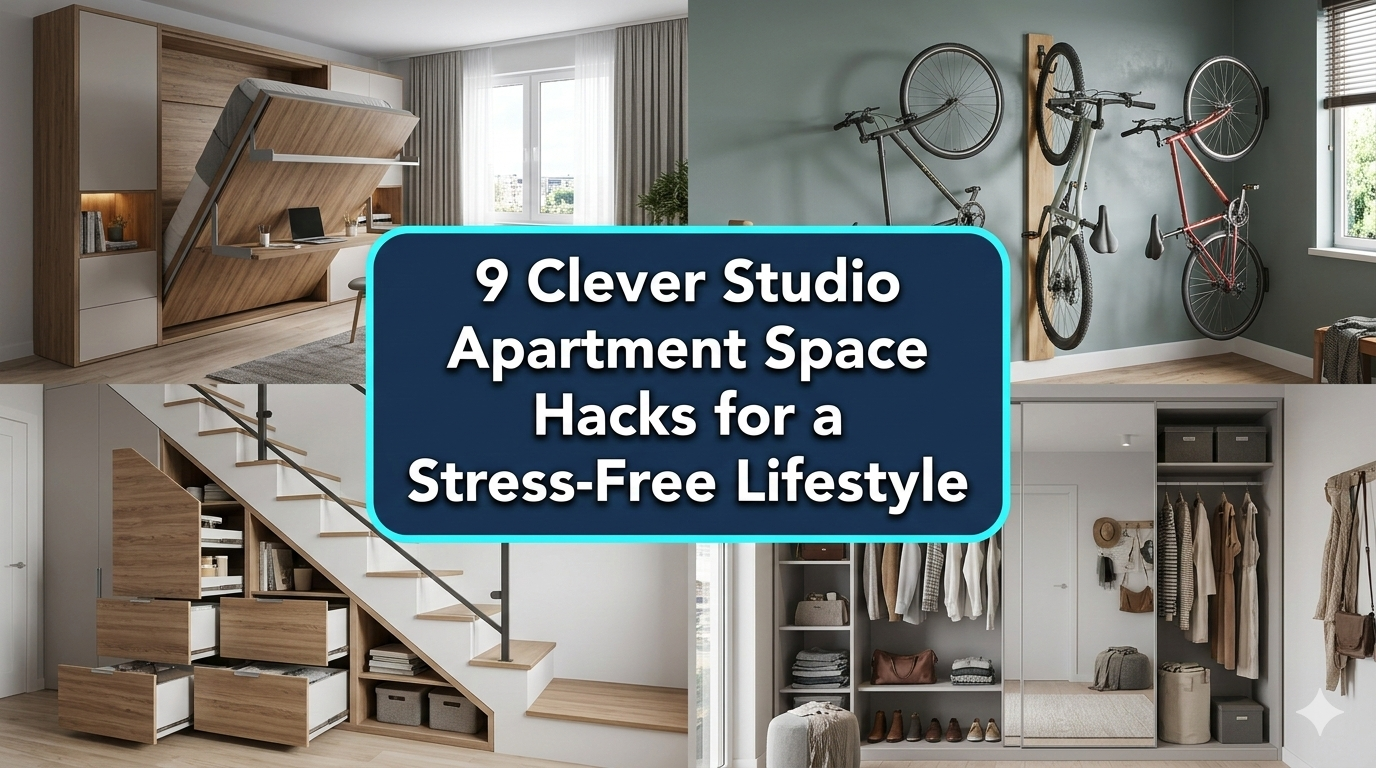
Convertible sofa or Murphy bed — A wall-mounted Murphy bed (the kind that folds up) gives you your floor back when sleep isn’t needed, while letting you have a proper living area during the day.
Dining table that folds up against the wall — A flip-down wall table occupies nearly no space when it’s not in use. Fold it down to use for food, work, or hobbies. Fold it up and the room reveals itself again.
Bench at the foot of the bed — Replace a regular bench with a storage one. Stuff in extra pillows, blankets, or gym gear.
| Furniture Piece | Single Function | Multi-Function Upgrade |
|---|---|---|
| Regular Bed | Sleeping | Sleeping + storage drawers |
| Coffee Table | Surface | Surface + seating + storage |
| Dining Chair | Sitting | Sitting + foldable/stackable |
| Bookshelf | Books | Books + room divider + display |
| Nightstand | Lamp + phone | Lamp + phone + charging station + drawer |
Hack #2 — Train Your Eyes to Look Up
The average person uses about 4 feet of wall height. Everything else — from waist height to ceiling — just sits there.
In a studio apartment, that blank wall space above your eye line is prime real estate.
Use Vertical Space Like a Pro
Floor-to-ceiling shelving is one of the most potent studio hacks available. A tall, narrow bookshelf draws the eye upward and holds much more than a short, wide one. IKEA’s KALLAX and Billy series are popular choices that bring a trendy feel without emptying your wallet.
Wall-mounted floating shelves over desks, sofas, and kitchen counters clear workspace below. Use them for books, plants, kitchen essentials, or décor.
A hanging pot rack in the kitchen frees up cabinet and counter space. It gives the kitchen an intentional, styled appearance rather than a cramped one.
Hanging your curtains high on the wall is a designer secret that works magic in small rooms. Install the rod as high as possible, even over a smaller window. The curtain draws the eye up, making the ceiling seem higher.
Pegboards on kitchen or office walls allow you to neatly hang tools, utensils, and craft supplies. They look great and banish drawer clutter overnight.
Hack #3 — Split Up Without Walls
Life in a studio can be stressful because it often feels like everything is happening in one space. Your bed is next to your desk, which is next to your kitchen. It all blurs together.
You can’t add walls. But you can still give the sense of separate rooms without any building.
The Smartest Ways to Zone Your Studio
Rugs are your best friend here. Set one rug beneath the sofa and coffee table to demarcate the “living room.” Try a different rug — or no rug — in the sleeping area. Suddenly your brain treats those as two separate spaces.
A tall bookshelf or open shelving unit oriented perpendicular to the wall serves as a visual divider between sleeping and living areas without blocking light.
Curtains as room dividers are inexpensive, adaptable, and surprisingly efficient. Install a ceiling-mounted curtain track between your bed and living area. When you want privacy or want to “close” the bedroom, slide the curtain. This is especially effective when you’re expecting guests or need to focus for work.
Plants as natural dividers — A row of tall indoor plants (such as snake plants or bamboo palms) forms a soft, organic divider between zones. Not only does this add life to your space, but it adds color too.
Lighting zones also do the work. Use a warm lamp close to the bed and a brighter, cooler light near your desk or sofa. Our brains connect different lighting to different activities — rest vs. work vs. eating — even when they happen in the same room.
For more ideas on how to set up and style your studio, visit Studio Apartment Setup — a great resource packed with practical inspiration for small space living.
Hack #4 — The Secret Benefits of Mirrors
Want to make your studio look twice its size — for less than $50?
Get mirrors.
It’s not a new trick, but most people underuse it. One small mirror on a wall does very little. But strategic mirror placement can really make a tight room feel open and airy.
Where to Place Mirrors for Maximum Impact
- Across from a window — The mirror bounces natural light back into the room, illuminating every nook.
- On a closet door or wardrobe — Full-length mirrored doors on your closet give the wall the illusion of depth.
- A full-length mirror leaned against the wall — This is the simplest and least expensive solution. A tall mirror leaning in the corner of a room immediately opens up the space.
- Above a console table or narrow shelf — This creates the illusion of a much deeper wall and makes a cramped entryway or hallway feel less tight.
One rule: Don’t put mirrors where they reflect cluttered spaces. You don’t want to see your messy desk twice.
Hack #5 — Use Color to Create the Sense of Space
The colors you choose for your walls, furniture, and textiles directly affect how large or small a room feels.
You don’t have to be an interior designer to use this to your advantage.
The Only Real Color Rules You Should Follow
Light-colored walls make rooms feel larger. Whites, soft grays, creamy beiges, and light greens reflect light and visually push walls outward. Dark colors absorb light and close a room in.
A single color running through everything prevents the eye from stopping at every surface change. When your walls, trim, and ceiling are all the same soft white, the room reads as one seamless, larger space.
An accent wall (one wall painted in a darker tone) can add depth and character without making the room feel smaller. If possible, paint the wall farthest from the entry — it will make the room seem longer.
Matching your furniture color to the walls is a trick designers love. If your sofa is a similar hue to your wall color, the room reads as more open because your eye isn’t hit with hard contrasts that signal “small box.”
Use color blocking for zones. A slightly different color on one wall (say, a soft sage behind your bed) demarcates the sleeping area without any physical separation.
Hack #6 — Become a Hidden Storage Expert
The studio apartments that feel messy are almost always the ones where everything is visible.
The ones that feel peaceful and orderly? They have the same amount of stuff. They just hide it better.
Spaces Most People Totally Overlook for Storage
Under the bed — If you have a bed without built-in drawers, get flat storage bins on wheels. You can fit an enormous amount under a standard bed frame.
Above kitchen cabinets — The gap between upper cabinets and the ceiling is wasted space. Use it for rarely-used appliances (a slow cooker, waffle maker) or decorative baskets that conceal their contents.
Inside your ottoman, bench, and sofa — Many sofas have under-cushion storage compartments. If yours doesn’t, consider switching to one that does.
Behind the bathroom door — Hang an over-the-door organizer for toiletries, towels, or cleaning products.
Inside hollow furniture — Side tables with drawers, beds with headboard shelves, TV stands with cabinet doors. Each piece of furniture should ideally hold something inside.
Staircase risers (for loft-style studios) — If your sleeping area is on a raised loft, the space under the stairs is a perfect spot for pull-out drawers or shelving.
Hack #7 — Let Natural Light Do the Work
Good lighting is one of the most underrated tools in a small-space arsenal.
A poorly lit studio feels like a cave even when it’s beautifully organized. A well-lit studio looks larger, cleaner, and more inviting — immediately.
Lighting Habits That Change Everything
Keep windows clear. Never place large furniture directly in front of windows. Even a misplaced sofa blocks light from spreading through the room.
Use sheer curtains instead of blackout curtains during the day. Sheer panels let light in while still providing privacy. If you need blackout curtains to sleep, pick ones that slide fully to the side rather than hanging across the window.
Layer your lighting. Don’t rely on a single overhead light. Use a combination of:
- Ambient lighting (ceiling fixture or floor lamp) for general light
- Task lighting (desk lamp, under-cabinet lights) for work and cooking
- Accent lighting (string lights, LED strips, table lamps) for mood and warmth
Warm-toned bulbs (2700K–3000K) give a studio an intimate, residential feel. Cool-toned bulbs are great for workspaces but can make an entire apartment feel clinical.
Mirrors + light = magic. As previously noted, placing mirrors to reflect natural light multiplies your light sources without adding a single fixture.
According to the American Society of Interior Designers (ASID), lighting is one of the most important — and most overlooked — elements in small space design. Getting it right can completely transform how a room feels.
Hack #8 — Edit Your Stuff Ruthlessly (But Kindly)
The truth is, no amount of furniture hacks will save a studio apartment that has too much stuff in it.
Studio apartment living requires a lighter approach to ownership.
That doesn’t mean you need to become a minimalist monk. It means being deliberate about what deserves a place in your limited space.
A Simple System for Deciding What Stays
Ask three questions about every item:
- Do I use this regularly? (Monthly or more often counts)
- Do I feel good when I see this?
- If I didn’t own this, would I buy it today?
If the answer to all three is no — out it goes.
The one-in, one-out rule is so helpful in small spaces. Every time you bring something new into the apartment, something else leaves. It helps prevent clutter from gradually building up over time.
Digitize where possible. Books, CDs, documents, photos — everything has a digital alternative. Digitizing your media frees up massive physical space.
Seasonal rotation means keeping only what you currently need inside the apartment. Vacuum-seal clothes that are out of season and store them under your bed or in an external storage unit.
Hack #9 — Create a Morning and Night Routine to Reset the Space
This final hack is about neither furniture nor paint. It’s about habit — and it may be the most powerful one on this list.
Clutter accumulates quickly in a studio apartment. One bad day can leave dishes in the sink, clothes on the floor, and your desk buried under piles of mail and receipts. In a larger home, you can close the door and ignore it. In a studio, you live with the mess.
The answer is to build short daily resets into your routine.
The 10-Minute Reset Habit
Morning reset (5 minutes):
- Make the bed (this one habit changes how the entire studio feels)
- Clear any dishes left over from the night before
- Toss anything out of place back where it belongs
Night reset (5 minutes):
- Clear everything off your desk or table surface
- Put away any clothes or bags left out
- Do a quick kitchen wipe-down
Ten minutes total. Practiced consistently, this habit makes sure your studio rarely gets out of control. It also lowers daily stress levels — studies consistently find a link between cluttered environments and elevated cortisol (the stress hormone).
At a Glance: All 9 Hacks
| # | Hack | Core Benefit |
|---|---|---|
| 1 | Multi-functional furniture | More storage, less clutter |
| 2 | Vertical space usage | More storage without occupying floor area |
| 3 | Zone your studio | Better mental separation between activities |
| 4 | Strategic mirrors | Room feels bigger and brighter |
| 5 | Color strategy | Visually expands the space |
| 6 | Hidden storage | Calm, organized appearance |
| 7 | Layered lighting | Warm, spacious feel |
| 8 | Ruthless editing | Less stuff = more space |
| 9 | Daily reset routine | Consistent calm and cleanliness |
Real Talk: What Actually Makes Studio Living Enjoyable
People who love their studio apartments tend to share a few attitudes in common.
They no longer compare their space to larger homes. They love the simplicity — less to clean, less to look after, lower rent. They make do with their space rather than feeling resentful of its limits.
These studio apartment space hacks work best when paired with this mindset shift. The hacks give you the tools. The mindset provides the motivation to put them into action.
Small space living, done purposefully, can be genuinely liberating. Your home is easier to clean. Your bills are lower. You own fewer things that own your time and attention.
That’s not a consolation prize. For many, that is the true goal.
The Most Common Questions About Studio Apartment Space Hacks
Q: What’s the single best hack for a studio apartment? A: Multi-functional furniture gives you the most for your money. A storage bed and a multi-function ottoman that acts as both table and storage box can replace two or three single-purpose pieces.
Q: How do I make a studio apartment not feel like one big room? A: Define zones using rugs, curtains, lighting, and plants. Throw a rug under your sofa area and another under your bed, and it instantly tricks your brain into reading those as different rooms.
Q: Do I need to break the bank to optimize my studio space? A: No. Some of the most powerful hacks — mirrors, paint color, curtain height, and daily reset habits — cost very little or nothing. Start with what you have before purchasing anything new.
Q: What can I do to create privacy in a studio apartment without walls? A: The most flexible option is a ceiling-mounted curtain track. A curtain can be pulled across to partition the sleeping area from the rest of the apartment whenever needed. Tall bookshelves and large plants also work well.
Q: What colors make a small studio seem larger? A: Light, neutral colors such as white, off-white, light gray, and soft beige work best. Using the same color for walls, trim, and ceiling creates a seamless look that visually expands the space.
Q: Can I have a home office in a studio apartment? A: Yes. A wall-mounted, fold-down desk is the best solution — it occupies virtually no space when not in use. Combine that with good task lighting and a pegboard above it to keep everything organized.
Q: How frequently should I declutter a studio apartment? A: A 10-minute daily reset prevents buildup. A deeper declutter every 3 to 6 months keeps your belongings aligned with what you actually need and use.
The Bottom Line
Living in a studio apartment isn’t settling. It’s a skill.
And, like any skill, it becomes easier — and more enjoyable — the more you practice it.
These 9 studio apartment space hacks give you a real, practical foundation. Replace single-use furniture with multi-functional pieces. Claim your vertical wall space. Break your room into zones that feel purposeful. Use mirrors, color, and light to make the space feel bigger than it is. Hide your storage cleverly. Edit your belongings regularly. And build a simple daily habit to keep it all from falling apart.
Pick one hack to put into practice this week. Just one. See how it changes the feel of your apartment.
Then come back for the next one.
Small spaces, well used, can hold an immensely full life.