

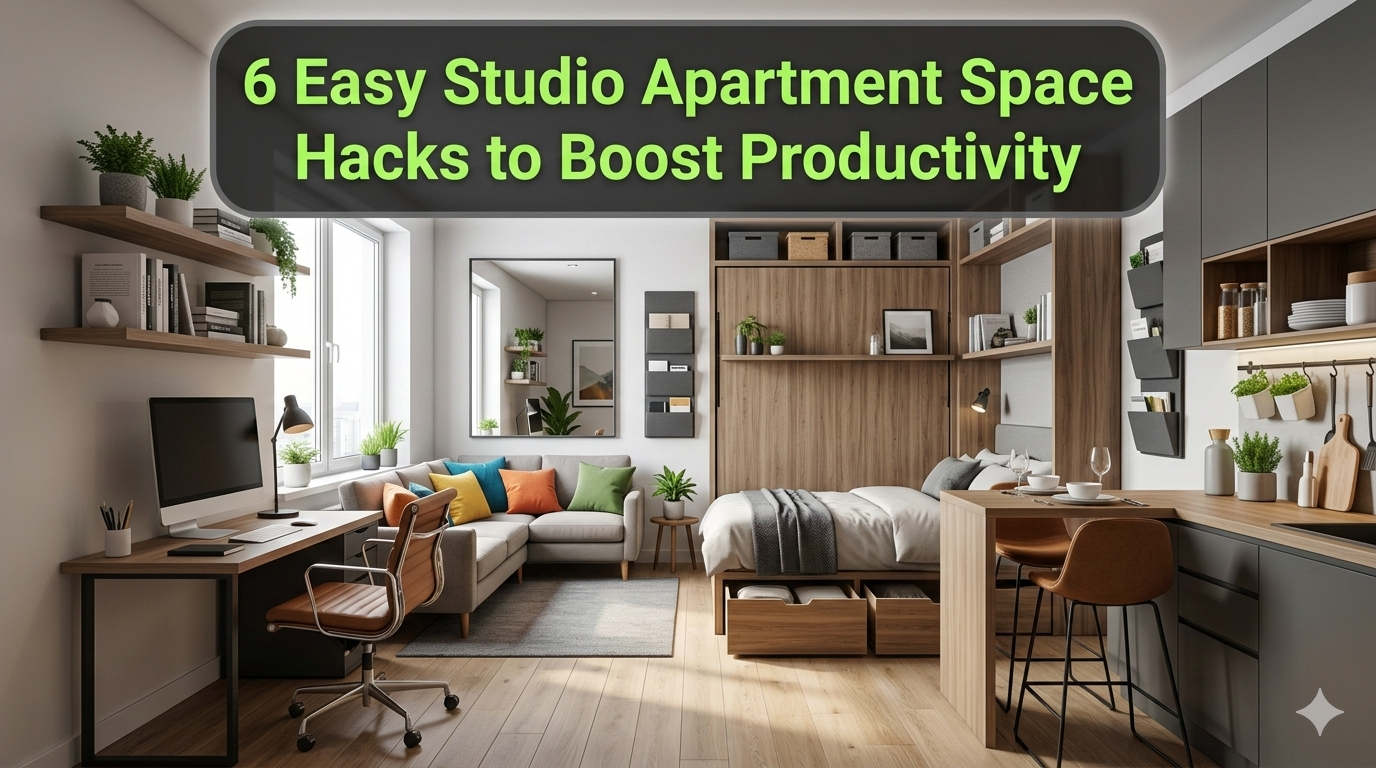
For a studio apartment, these adjustments are the best to get focused and work efficiently.
It is challenging to work from a studio apartment. Your bedroom is your office. Your kitchen table is also a meeting room. And your couch? That’s basically your boardroom.
But, here’s the thing — limited space doesn’t have to equal low output. Even the smallest of rooms can be a place where real work gets done with the right studio apartment space hacks.
In this article, we walk you through 6 practical, money-saving hacks that real people actually use to work smarter within small spaces. No fancy renovations. No expensive furniture. Just savvy, simple shifts that create a major impact.
This Is Why the Layout of Your Studio Apartment Determines How Focused You Are
Before we dive into the hacks, it’s helpful to understand why space matters for productivity.
Science backs this up. Researchers in a study published by the Journal of Environmental Psychology found that messy, chaotic environments raised cortisol levels — a form of stress hormone. More stress equals less focus, more distraction, and reduced output.
Your brain is constantly processing your environment. If your space is cluttered and chaotic, your brain has to work twice as hard just to filter out the noise. That means less mental energy for producing work.
Conversely, an organized and purpose-driven space gives your brain a signal: focus time.
That’s precisely what these studio apartment space hacks aim to accomplish.
Hack #1: Carve Out a Work Zone (Even If You Don’t Have a Separate Room)
The “Zone Trick” That Changes Everything
The No. 1 killer of productivity in a studio apartment is boundary blurring. When it all takes place in a single room, your brain never fully switches into work mode.
The fix? Create a dedicated work zone.
That doesn’t mean you have to furnish a full home office. It means creating one designated corner, or wall, that is strictly for work. No scrolling. No snacking. No Netflix. Just work.
When you sit in that spot, your brain learns: this is the place where focus happens.
How to Create Your Work Zone on a Budget
- Try to choose a corner close to any available window. Natural light increases alertness and helps reduce eye strain.
- Use a small desk — even a foldable IKEA one works perfectly.
- Include a comfortable chair with back support. Working in bed is a productivity trap.
- This zone must only contain work items. Laptop, notebook, pens — that’s all.
- A small area rug can help delineate the work zone from the rest of the room.
Visual Separation Matters More Than You May Think
You don’t need walls to set boundaries. Visual cues are enough.
Even a bookshelf used as a room divider works perfectly. So does a curtain rod with some light curtains. Even simply a new paint color or a wall-mounted pegboard can communicate to your brain: this space is about work.
If you’re starting from scratch, Studio Apartment Setup is a great resource for layout ideas, furniture picks, and workspace inspiration built specifically for small-space living.
| Work Zone Element | Budget Option | Purpose |
|---|---|---|
| Desk | Foldable wall-mounted desk | Saves floor space |
| Chair | Secondhand ergonomic chair | Supports posture |
| Lighting | LED clip-on desk lamp | Reduces eye strain |
| Divider | Curtain or bookshelf | Creates visual boundary |
| Organisation | Pegboard or wall hooks | Keeps desk clutter-free |
Hack #2: Go Vertical — Your Walls Are Wasted Real Estate
Stop Thinking Horizontally
For small-space issues, most people attempt solutions in the horizontal plane — moving furniture around on the floor. That’s thinking too small — literally.
Your walls are your secret weapon. Vertical space in a studio apartment is practically never fully utilized. A floor-to-ceiling wall provides you with multiple additional “shelves” of storage and organization.
Going vertical frees up precious floor space while simultaneously keeping things neat and close at hand.
Best Vertical Storage Ideas for Studio Apartments
Floating shelves are the traditional play. Mount them over your desk for books, binders, and supplies. Stack them all the way up to the ceiling for the most efficient storage.
Wall-mounted pegboards will change the way you work as a creative or remote worker. You can hang up headphones, chargers, sticky notes, and small tools all in one place. IKEA’s SKÅDIS pegboard is a popular choice.
Over-the-door organizers are often overlooked. The back of your front door, closet door, or bathroom door can hold shoes, files, cleaning supplies, and even pantry items.
Tall bookshelves (floor-to-ceiling) store way more than regular ones and draw the eye upward, making your room appear taller.
A Quick Rule of Thumb
If it’s on the floor and really shouldn’t be there — move it up.
Just that simple mindset change will free up your studio and allow space to move, breathe, and think.
Hack #3: Use Multi-Functional Furniture Like a Pro
One Piece, Five Jobs
In a studio apartment, everything has to earn its keep. If a piece of furniture does only one thing, it’s taking up too much space.
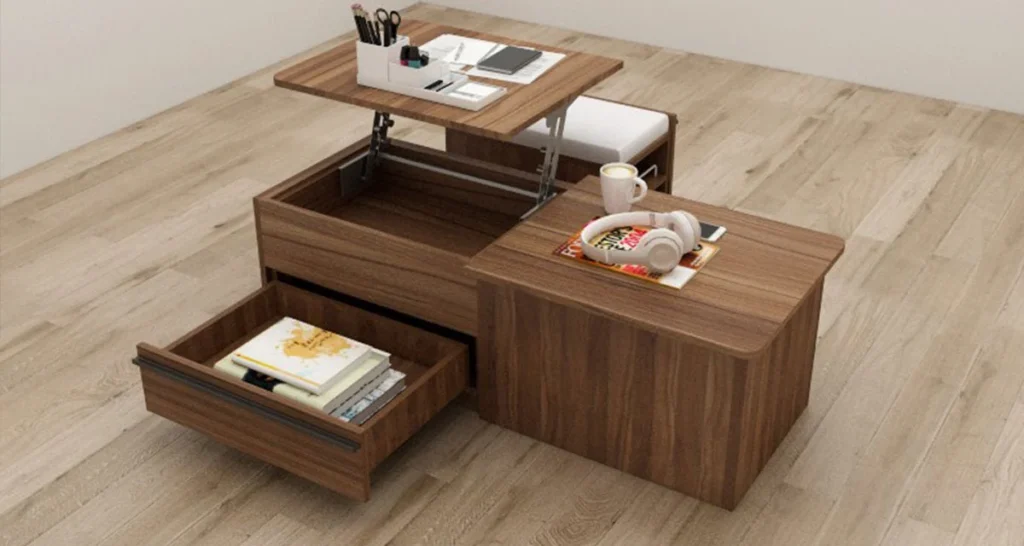
Multi-functional furniture is one of the most powerful studio apartment space hacks out there. These items address several problems simultaneously, meaning you need fewer things overall.
Less stuff = less clutter = more focus = better productivity.
Top Multi-Functional Furniture Picks
Murphy bed with desk: The holy grail for studio apartment workers. Fold up the bed to reveal a full-sized desk during the day. At night, fold it back down. Ori and Resource Furniture make gorgeous versions, but budget options are available on Amazon and Wayfair.
Storage ottoman: Use it as a coffee table, extra seating, footrest, and storage chest. Toss your blankets, files, or equipment inside.
Convertible sofa/daybed: Functions as a couch during work hours, turns into a bed overnight. It also helps reinforce the mental break between work time and rest time.
Drop-leaf table: A small table that expands when you need more surface. Great for people who sometimes want a bigger workspace.
Nesting tables: Three small tables that slide into one another. Pull one out when you need a surface, stack the rest up to save space.
The Productivity Connection
Here’s something people don’t talk about enough: the more your space is cluttered with single-use furniture, the more mental bandwidth it takes away from you. You’re constantly navigating around things. You lose items. You feel cramped.
Multi-functional furniture cuts that chaos. When everything has a place and a purpose, your brain spends less time on logistics and more time on actual work.
Hack #4: Get the Lighting Right
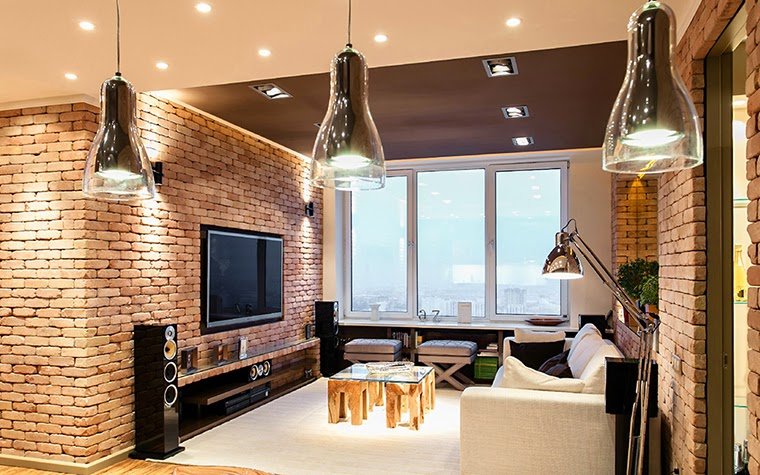
Lighting Is a Productivity Tool, Not Just Decoration
Poor lighting is one of the most underappreciated reasons that many people feel tired, unmotivated, or unfocused when working from home.
Dim lighting tells your brain to slow down (like sunset). Harsh overhead lighting causes eye strain and headaches. Neither is good for productivity.
The right lighting setup, by contrast, keeps you alert, reduces fatigue, and can even give your mood a boost throughout the day.
The 3-Layer Lighting Formula for Studio Apartments
Layer 1 — Ambient Light (General Illumination) This is your base lighting. In a studio, it typically comes from ceiling fixtures. Use a warm-white or daylight LED bulb (5000K color temperature is ideal for daytime work).
Layer 2 — Task Lighting This is your desk lamp. It illuminates your exact workspace without lighting the entire room. Investing in a decent desk lamp with adjustable brightness is money well spent. Choose ones with color temperature control so you can shift from cool light (focus) to warm light (evening wind-down).
Layer 3 — Accent Lighting This is the finishing touch. LED strip lights behind your monitor reduce eye strain from screen contrast. A small reading nook lamp adds coziness without wasting energy.
Natural Light: The Free Productivity Enhancer
If your studio has windows, optimize them. Keep curtains light and sheer during work hours. Place your desk so it faces or sits next to the window — not with your back to it (that leads to glare on your screen).
According to research from Northwestern University, employees with greater access to natural light slept better and reported a higher quality of life — both key components of work performance.
| Time of Day | Suggested Lighting | Why |
|---|---|---|
| Morning (7–10am) | Bright daylight (5000–6500K) | Wake-up signal, boosts alertness |
| Midday (10am–3pm) | Natural window light + task lamp | Sustains focus |
| Afternoon (3–6pm) | Warm white (3000–4000K) | Reduces late-day fatigue |
| Evening (6pm+) | Warm, dim ambient light | Signals wind-down for sleep |
Hack #5: Be Ruthless About Decluttering and Go Digital When Possible
Clutter Is the Enemy of Focus
You know clutter is not good. But in a studio apartment, clutter doesn’t merely dampen your mood — it physically occupies the already limited square footage you have.
Every unnecessary item in your studio is robbing space from you. Space that could be devoted to movement, creativity, and focus.
The remedy is a two-pronged approach: physical decluttering and going digital.
The 3-Box Declutter Method
This clear system is quick and easy:
- Box 1: Keep — Items you use at least once a week
- Box 2: Store/Donate — Items you use infrequently or could do without
- Box 3: Trash — Broken, expired, or truly useless items
Use a room-by-room approach (you have zones even in a studio). Allow yourself 20 minutes per zone. Don’t overthink it.
When you are done, reload the Keep items in a neat, organized way. Box 2 gets donated or put away in a labeled bin. Box 3 goes out.
Doing this once a month means clutter never gets a chance to pile up.
Go Digital to Free Up Physical Space
Paper is one of the biggest space hogs in a home office setup. Notebooks, printouts, manuals, receipts — it all adds up quickly.
Here’s how to go digital and reclaim that space:
- Use a free app such as Adobe Scan or CamScanner to scan documents. Store them in Google Drive or Dropbox.
- Switch to digital notebooks — apps like Notion, Evernote, or Apple Notes replace physical notebooks entirely.
- Use cloud storage for files instead of external hard drives (although one slim backup drive is worth keeping).
- Cancel paper subscriptions and switch to digital versions.
- Download manuals and instruction booklets instead of keeping the paper versions.
Moving to digital does more than conserve space. It also makes everything easier to find, which saves time and lessens the frustration of sifting through piles of stuff.
Hack #6: Build a Smart Daily Routine That Works for Your Space
Your Space Influences Your Habits — And Your Habits Shape Your Day
This last hack is a little different. It’s not about furniture or storage. It’s about the way you use your space throughout the day.
As functional as the best-designed studio apartment can be, it won’t advance productivity if your daily schedule is a mess. A smart routine gets the best out of your physical setup and gives you mental structure.
In a studio, with no physical boundary between rooms, the routine you build acts as that barrier between work, rest, and play.
The “Anchor Habits” Strategy
Anchor habits are small, repeatable actions that signal a change of state. In a studio apartment, they’re particularly powerful because they replace the spatial cues you would usually get from walking into a different room.
Morning anchor: Make your bed immediately after waking up. It signals that “sleep mode” has ended and “active mode” begins. It also makes your space instantly neater.
Work start anchor: Sit down at your desk, open your laptop, and take 5 minutes to write out the three tasks you absolutely need to complete that day. This sends your brain the message: work has begun.
Lunch break anchor: Get up from your desk. Go outside if possible. Eat somewhere else in your apartment — not at your desk. This breaks the mental cycle and gives your brain an actual rest.
Work end anchor: Shut your laptop, clean off your desk (5 minutes max), and change out of any clothes you wore to “work.” This signals: work is over.
Evening anchor: Dim the lights, place your phone somewhere else, and do something away from screens for 30 minutes. This tells your brain it’s time to wind down.
Time Blocking for Studio Apartment Workers
Time blocking pairs perfectly with anchor habits. Rather than tasks bleeding into each other all day, you assign specific time slots to certain activities.
Here’s a simple example schedule:
| Time Block | Activity | Location in Studio |
|---|---|---|
| 7:00–8:00am | Morning routine + breakfast | Kitchen/bathroom |
| 8:00–8:15am | Desk setup + daily planning | Work zone |
| 8:15–11:00am | Deep work (no interruptions) | Work zone |
| 11:00–11:15am | Break + stretch | Living area |
| 11:15am–1:00pm | Meetings or collaborative work | Work zone |
| 1:00–2:00pm | Lunch + full break | Kitchen/outside |
| 2:00–4:30pm | Focused work session | Work zone |
| 4:30–5:00pm | Admin, emails, wrap-up | Work zone |
| 5:00pm | Work end anchor | Anywhere |
Make this whatever fits your schedule, but the important part is consistency. Your studio apartment begins to feel like it has separate rooms when your routine creates those invisible divisions.
Putting It All Together: Your Studio Transformation Checklist
A quick recap of everything covered:
- ✅ Create a defined work zone with visual separation
- ✅ Go vertical with shelves, pegboards, and over-door organizers
- ✅ Replace single-use furniture with multi-functional pieces
- ✅ Set up a three-layer lighting system and maximize natural light
- ✅ Declutter monthly using the 3-box method and go digital where possible
- ✅ Build anchor habits and use time blocking to create daily structure
You don’t have to do all six at once. Pick one or two to start and build from there. Even small changes add up over time.
FAQs: Studio Apartment Space Hacks for Productivity
Q: How can I separate work and sleep in a studio apartment? Visual dividers such as curtains, bookshelves, or rugs can help create different zones. Anchor habits (like changing your clothes and closing your laptop at a set time) will also help your brain switch between modes even without physical walls.
Q: What’s the best desk for a small studio apartment? The most space-efficient option is a wall-mounted fold-down desk. If you want a freestanding option, look for corner desks or narrow writing desks less than 40 inches wide.
Q: Can I stay productive in a studio apartment long-term? Absolutely. Many remote workers and freelancers thrive in studio apartments. The key is intentional design, a consistent routine, and regular decluttering to keep the space functional.
Q: How much does it cost to set up a productive studio apartment workspace? You can set up an excellent work environment for under $200. A foldable desk, a secondhand chair, a decent LED lamp, and some wall-mounted shelves are all you need to get started.
Q: What color should I paint my studio apartment to boost productivity? Soft blues and greens are said to encourage focus and calm. Light neutrals, such as off-white and warm grey, help the space feel open without being distracting. Steer clear of deep, dark colors in small spaces as they can make rooms feel smaller and heavier.
Q: Does having plants in a studio apartment help with productivity? Yes! Research shows that indoor plants lower stress levels, purify the air, and enhance concentration. Low-maintenance plants such as pothos, snake plants, or succulents are perfect for studio apartments.
Final Thoughts: Small Space, Major Output
Living and working in a studio apartment should not be seen as a hindrance — it’s a design challenge. And like any good challenge, it rewards smart thinking.
The 6 studio apartment space hacks covered here — creating a work zone, going vertical, using multi-functional furniture, optimizing lighting, decluttering, and building a smart daily routine — all work together to create an environment where focus can actually happen.
You don’t need more square footage. You need a smarter setup.
Pick one hack this week. Move your desk near a window. Put up one floating shelf. Build one anchor habit. Incremental steps lead to real transformation.
Your studio apartment can be your most productive workspace ever. You just have to set it up that way.