

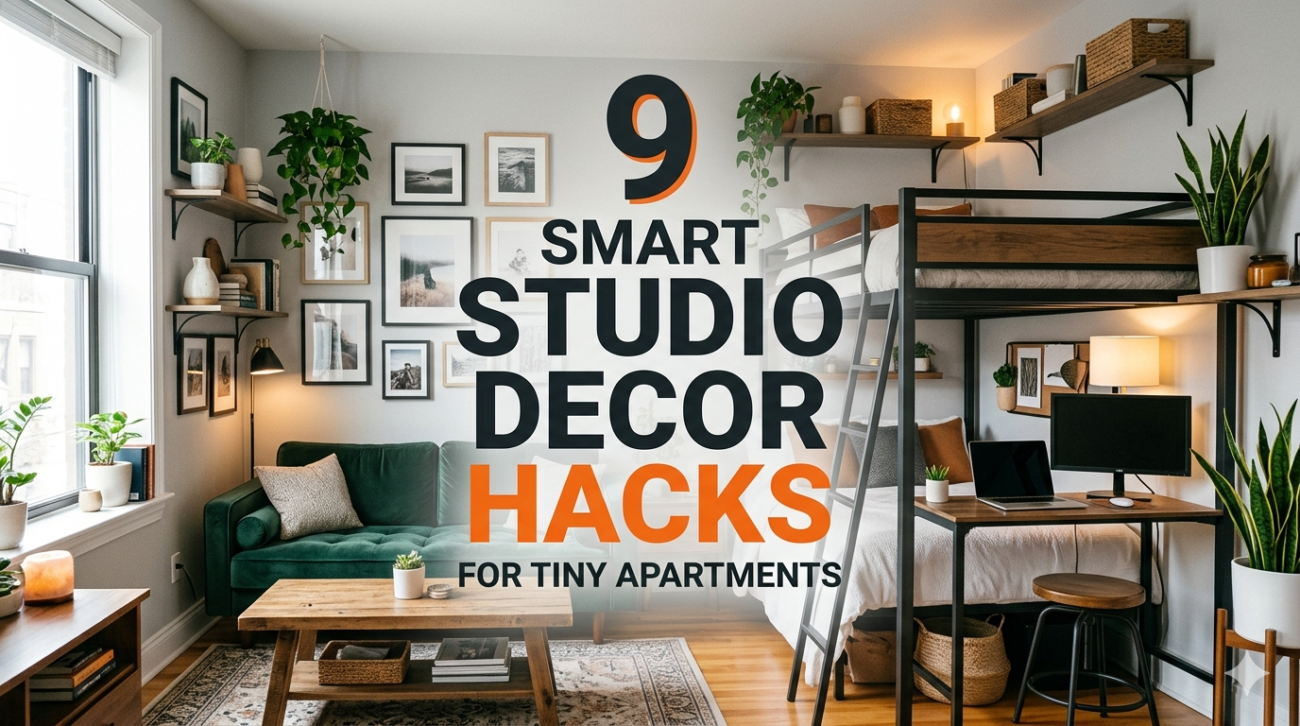
Living in a tiny studio apartment often feels like solving a daily puzzle. You want comfort, style, storage, and personality—all inside a single open room. The challenge isn’t just fitting things in; it’s making the space feel intentional, breathable, and visually larger than it actually is.
The good news is that small spaces respond incredibly well to smart design decisions. A few well-planned decor hacks can completely change how your studio looks and feels, without requiring expensive renovations or professional help.
This guide breaks down nine practical studio decor hacks that go beyond surface-level styling. Each idea is designed to improve function and aesthetics at the same time, with real strategies, comparison tables, and layout insights you can actually apply.
hack 1: design vertical space like a storage system
When floor space is limited, walls become your most valuable asset. Most tiny apartments underuse vertical space, leaving storage potential completely untouched.
Instead of thinking left to right, think bottom to top.
vertical layering strategy:
| Level | Purpose | Examples |
|---|---|---|
| Floor level | Heavy storage | Cabinets, bins, ottoman |
| Mid level | Daily access | Desk, shelves, seating |
| Upper level | Rare use + decor | High shelves, art |
smart vertical upgrades:
- install floating shelves above doorways
- use tall bookcases instead of wide furniture
- mount hooks on unused wall strips
- stack storage vertically instead of spreading it out
A key mindset shift: empty wall space is wasted square footage in a studio.
When done right, vertical design makes your apartment feel taller and more structured, almost like a boutique loft.
hack 2: use furniture that works harder than you do
In a tiny studio, every piece of furniture should justify its presence. If something only does one job, it’s taking up valuable space that could be optimized.
multi-functional furniture examples:
| Furniture | Hidden Function |
|---|---|
| Storage bed | Clothing + bedding storage |
| Ottoman | Seat + storage box |
| Foldable table | Dining + desk |
| Sofa bed | Living room + sleeping area |
efficiency comparison:
| Setup Type | Furniture Count | Functionality |
|---|---|---|
| Traditional | 8–10 pieces | Single-purpose |
| Optimized | 4–6 pieces | Multi-purpose |
Instead of filling your studio with more items, focus on smarter items. One well-designed sofa bed can replace an entire guest setup, reading chair, and part of your storage system.
hack 3: create invisible zones without building walls
One of the biggest mistakes in studio apartments is treating the space as one undefined room. Without zones, everything blends together visually, which creates clutter—even if the room is clean.
You don’t need walls. You need separation cues.
zone creation methods:
- rugs
- lighting changes
- furniture orientation
- open shelving dividers
- curtains or fabric panels
simple zoning map:
living zone → sofa + rug + coffee table
sleep zone → bed + soft lighting + headboard wall
work zone → desk + focused light + wall shelf
zoning impact chart:
| Without Zones | With Zones |
|---|---|
| Visually chaotic | Organized layout |
| No focal points | Clear structure |
| Smaller feel | Expanded perception |
When your brain can identify separate areas, the apartment automatically feels larger and more functional.
hack 4: control visual noise with a “hidden clutter system”
Clutter doesn’t always mean mess—it can also mean too many visible objects competing for attention.
Tiny apartments require a “visual editing system.”
hidden clutter strategy:
| Item Type | Storage Solution |
|---|---|
| Daily essentials | Decorative trays |
| Cables | Cable boxes or clips |
| Misc items | Labeled bins |
| Cleaning supplies | Closed cabinet |
visual noise reduction rules:
- keep surfaces 70% empty
- group items instead of scattering them
- hide anything visually irregular
Before vs after impact:
| Condition | Visual Effect |
|---|---|
| Scattered items | Tight, messy feel |
| Grouped storage | Calm, intentional look |
A studio feels expensive not because it has fewer things—but because it hides them well.
hack 5: use mirrors as architecture, not decoration
Most people treat mirrors as accessories. In tiny apartments, mirrors should be treated as structural design tools.
proper mirror placement transforms:
- lighting distribution
- depth perception
- visual width of the room
strategic placement guide:
| Placement | Effect |
|---|---|
| Opposite window | Doubles natural light |
| Behind sofa | Expands living area |
| Narrow hallway | Removes tunnel effect |
mirror types comparison:
| Type | Effect |
|---|---|
| Small decorative | Minimal impact |
| Medium framed | Moderate expansion |
| Full-length / large | Maximum spatial illusion |
A single oversized mirror often does more for your studio than multiple decor upgrades combined.
hack 6: prioritize lighting layers instead of overhead reliance
Flat lighting makes even a well-decorated studio look cheap. Expensive-looking interiors almost always rely on layered lighting.
lighting layers:
Lighting=Ambient+Task+Accent
lighting breakdown:
| Layer | Purpose | Example |
|---|---|---|
| Ambient | General brightness | Ceiling light |
| Task | Function areas | Desk lamp |
| Accent | Mood creation | LED strips, candles |
lighting temperature guide:
| Temperature | Effect |
|---|---|
| 2700K–3000K | Warm, cozy, premium |
| 3500K–4000K | Neutral, balanced |
| 5000K+ | Harsh, office-like |
soft warm lighting instantly upgrades a tiny apartment’s emotional tone.
hack 7: scale everything properly (the hidden design rule)
One of the most common studio mistakes is using furniture that is too small. People assume small space = small furniture, but that often creates fragmentation.
Instead, use fewer but properly scaled pieces.
scale comparison:
| Item | Poor Choice | Better Choice |
|---|---|---|
| Sofa | Tiny 2-seater | Full compact sofa |
| Rug | Small accent rug | Large area rug |
| Table | Narrow side table | Full coffee table |
scale effect chart:
| Proper Scale | Result |
|---|---|
| Large rug under furniture | Anchored space |
| Oversized art | Focal point created |
| Balanced sofa size | Room feels intentional |
Bigger, well-scaled pieces actually make a small room feel larger because they reduce visual fragmentation.
hack 8: introduce texture layering instead of extra decor
Tiny apartments often suffer from over-decoration. The better approach is layering textures instead of adding more items.
texture categories:
- soft (fabric, cushions, rugs)
- hard (wood, metal, glass)
- natural (plants, stone, woven materials)
texture balance table:
| Area | Recommended Mix |
|---|---|
| Living room | Sofa fabric + wood table + rug |
| Bedroom | Linen bedding + soft lighting + curtain texture |
| Work area | Metal lamp + wood desk + neutral wall |
why texture works:
- adds depth without clutter
- creates luxury feel
- improves visual warmth
Instead of adding more things, make existing things feel richer.
hack 9: keep a “visual breathing ratio” in every corner
A small studio becomes overwhelming when every surface is filled. High-end interiors maintain intentional emptiness.
visual breathing ratio rule:
| Space Type | Fill Level |
|---|---|
| Shelves | 60–70% filled |
| Walls | 30–50% decorated |
| Floors | 70–80% open |
space comparison:
| Full Decoration | Balanced Space |
|---|---|
| Heavy visual load | Calm composition |
| No focal point | Clear focal hierarchy |
| Feels smaller | Feels expanded |
Empty space is not wasted space—it is part of the design language.
summary chart: smart studio transformation system
| Hack | Core Benefit |
|---|---|
| Vertical design | More storage without footprint |
| Multi-functional furniture | Fewer items, more use |
| Invisible zoning | Better organization |
| Hidden clutter system | Cleaner visual flow |
| Mirrors | Spatial expansion |
| Layered lighting | Mood + depth |
| Proper scaling | Balanced proportions |
| Texture layering | Luxury feel |
| Visual breathing | Reduced overwhelm |
final thoughts
Tiny studio apartments are not limited spaces—they are highly responsive design environments. Every adjustment has a visible impact. That’s what makes them powerful to work with.
Instead of trying to “fit everything in,” the real goal is to design what deserves to stay visible. When you control scale, light, texture, and zoning, even a very small space begins to feel intentional and surprisingly spacious.
Good studio design is less about decoration and more about editing. The more thoughtful the edit, the more expensive and comfortable the space feels.
frequently asked questions
- how do i make a tiny studio feel bigger without renovations?
Focus on mirrors, lighting layers, vertical storage, and reducing clutter. These changes improve perception without structural work. - what type of furniture is best for small studios?
Multi-functional furniture such as sofa beds, storage ottomans, and foldable tables works best because it reduces item count. - should i use dark colors in a tiny apartment?
Yes, but in controlled amounts. Dark tones work best as accents balanced with lighter walls and good lighting. - how many decor items should a studio have?
There’s no fixed number, but surfaces should not feel crowded. Aim for grouped decor rather than scattered items. - what is the biggest mistake in studio decorating?
Using too many small pieces instead of a few properly scaled items, which makes the space feel fragmented. - how can lighting change a small apartment’s look?
Layered warm lighting creates depth, reduces harsh shadows, and makes the space feel more inviting and premium.