

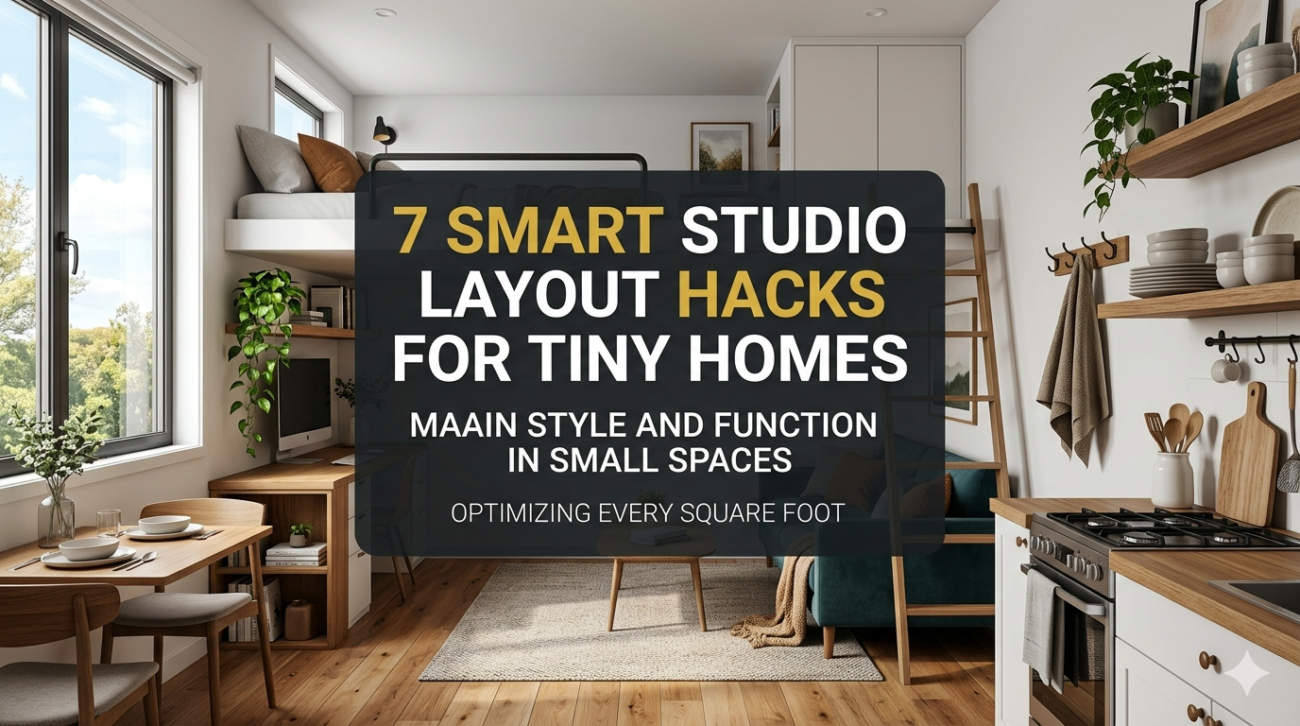
Introduction: why layout matters more than size
Tiny homes and studio apartments often suffer from the same misconception: that lack of space is the main problem. In reality, most small living spaces don’t fail because they are small—they fail because the layout doesn’t support how people actually live.
A smart layout is not about squeezing more things in. It’s about reducing wasted movement, eliminating visual chaos, and creating zones that guide behavior naturally.
When layout is done well, a 300 sq ft studio can feel more functional than a poorly planned 600 sq ft apartment.
This guide explores seven practical layout hacks that improve flow, expand usable space, and make tiny homes feel intentionally designed instead of improvised.
- Zone-based layout instead of open chaos planning
Most tiny homes start as one open box. The mistake people make is treating it like one room instead of multiple functional micro-zones.
Zoning turns a single space into a collection of purposeful areas without needing walls.
Common studio zones
- sleep zone
- work zone
- cooking zone
- relaxation zone
- storage zone
Even if they overlap physically, they should never overlap visually or functionally at the same time.
Zone effectiveness chart
Zone type Space requirement Flexibility Clutter risk Comfort impact
Sleep zone Medium Low Very low High
Work zone Small–medium Medium Medium High
Kitchen zone Small Low High Medium
Relax zone Medium High Medium High
Storage zone Small High Low Low
Why zoning works
The brain responds strongly to environmental cues. If a bed is visible while working, the brain stays partially in “rest mode.” If work tools are visible while relaxing, mental fatigue increases.
Zoning reduces these conflicts.
Simple implementation method
- use rugs to define areas
- change lighting per zone
- rotate furniture direction
- use shelving as soft dividers
Even without walls, zones create structure.
- Floating furniture arrangement for floor expansion
Most tiny homes suffer from “wall clutter syndrome”—furniture pushed against every wall, leaving a cramped central space.
Floating layout means pulling furniture away from walls to create movement paths and visual breathing space.
Comparison: wall-hugging vs floating layout
Feature Wall-hugging layout Floating layout
Perceived space Narrow Wider
Movement flow Linear Natural
Cleaning access Difficult Easy
Visual depth Flat Layered
Design quality Basic Advanced
How floating layouts improve tiny homes
When furniture is slightly detached from walls, the brain perceives depth. Even a 6–10 inch gap can change spatial perception significantly.
Practical floating ideas
- move sofa 6–12 inches away from wall
- place bed with side access instead of corner trapping
- center rug under main seating area
- float desk facing room instead of wall
This approach also creates hidden storage strips behind furniture.
- Multi-directional furniture orientation system
In most studios, all furniture faces one direction—usually toward a TV or wall. This creates a static, rigid feeling.
Multi-directional orientation breaks that pattern by allowing furniture to serve multiple focal points.
Orientation strategy table
Furniture piece Default orientation Better layout option Benefit
Sofa Facing wall Floating center + angled Flexible social use
Bed Corner placement Center wall or partial float Better access flow
Desk Wall-facing Room-facing or window-facing Improved mental energy
Table Fixed rotation Adjustable angle Multi-use functionality
Why orientation matters
Direction influences behavior. A desk facing a wall encourages passive work. A desk facing a room encourages awareness and flexibility.
In tiny homes, orientation becomes a substitute for square footage—you are essentially “creating space through direction.”
- Invisible traffic flow mapping
One of the most overlooked layout mistakes is ignoring how people actually move through the space.
Tiny homes need “movement corridors,” even if they are invisible.
Think of your home as a path system, not a static room.
Traffic flow types
- linear flow (straight path movement)
- circular flow (loop movement)
- zone hopping (short transitions between clusters)
Flow efficiency chart
Flow type Efficiency Congestion risk Comfort level
Linear Medium Medium Low–medium
Circular High Low High
Zone hopping Very high Low Very high
How to design flow properly
- identify entrance point
- map daily movement steps (bed → kitchen → work → exit)
- remove obstacles in those paths
- avoid placing furniture in diagonal walk lines
Rule of thumb: if you bump into something twice a day, it is in the wrong place.
- Hidden vertical stacking system
Most people think vertically only in terms of shelves. But true vertical stacking includes how activities are layered in height order.
Instead of spreading items across the floor, they are stacked conceptually.
Vertical stack model
Top layer (ceiling height)
- storage bins
- seasonal items
Mid layer (eye level)
- daily tools
- frequently used objects
Lower layer (floor level)
- heavy furniture
- concealed storage
Vertical efficiency table
Layer Access frequency Weight allowance Visual impact
Top Low Light Minimal
Mid High Medium High
Bottom Medium Heavy Low
Why stacking improves layout
Stacking reduces horizontal spread. This allows the same footprint to support more activities without cluttering movement paths.
Example:
A kitchen corner can include:
- wall spice rack (top layer)
- prep counter (mid layer)
- pull-out bins (bottom layer)
All in one vertical column.
- Convertible “time-based” layout design
Tiny homes are not static environments. They function differently at different times of day.
Time-based layout design means the same space transforms depending on activity cycles.
Daily transformation model
Time period Primary function Layout behavior
Morning Cooking + preparation Open, active
Day Work + productivity Structured, focused
Evening Relaxation Soft, open flow
Night Sleep Minimal, closed feel
How to implement time-based layouts
- foldable desks for work hours only
- extendable tables for meal times
- retractable lighting for night mode
- movable seating instead of fixed chairs
Comparison: static vs time-based layout
Feature Static layout Time-based layout
Efficiency Low High
Adaptability None Very high
Comfort Medium High
Space usage Fixed Dynamic
This method essentially turns one small space into multiple “versions” of itself.
- Anchor point anchoring system (visual stability hack)
Tiny homes often feel chaotic because there is no visual anchor—no single element that stabilizes the space.
Anchor points are fixed visual or structural elements that organize everything around them.
Types of anchor points
- large rug
- statement sofa
- bed frame
- central light fixture
- shelving wall
Anchor effectiveness chart
Anchor type Stability impact Design importance Flexibility
Rug Medium High High
Furniture High Very high Medium
Lighting Medium High High
Wall unit Very high Very high Low
Why anchors matter
Without anchors, the eye constantly jumps between objects, creating a sense of disorder even in clean rooms.
Anchors act like “visual gravity,” pulling the design together.
How to build a strong anchor system
- choose 1 primary anchor (usually bed or sofa)
- add 1 secondary anchor (rug or lighting)
- align other furniture relative to these points
- avoid competing focal points
Final integration: combining all 7 hacks
When combined, these layout strategies transform a tiny home into a structured system instead of a crowded box.
Summary table
Hack Core function Space benefit Mental effect
Zoning Functional separation Reduces overlap Clarity
Floating layout Floor expansion Improves flow Openness
Orientation system Direction control Better usability Flexibility
Traffic flow Movement design Less congestion Ease
Vertical stacking Height usage More capacity Efficiency
Time-based layout Dynamic space Multi-function Adaptability
Anchor system Visual structure Stability Calmness
Together, they turn limited square footage into a highly adaptive living system.
FAQs
- What is the most important layout hack for very small studios?
Zoning is usually the foundation because it defines how all other layout decisions should behave.
- Can these hacks work in homes under 200 sq ft?
Yes. In very small spaces, vertical stacking and time-based layouts become even more important than furniture size.
- Do I need to buy new furniture to apply these ideas?
Not necessarily. Many improvements come from repositioning furniture, adjusting flow, and redefining zones.
- What is the most common mistake in tiny home layouts?
Pushing all furniture against walls without considering movement flow or functional separation.
- How do I make my tiny home feel less cluttered instantly?
Start with anchor points and traffic flow correction—these two changes immediately improve visual clarity.
- Can lighting really change layout perception?
Yes. Lighting defines zones, creates depth, and changes how large or small a space feels without moving any furniture.