
Everyone talks about under-bed storage like it’s a magic fix for small spaces. Buy the flat bins, slide them in, problem solved. And honestly? Sometimes it is that simple. But most of the time, people end up with a dusty graveyard of things they forgot they owned, stuffed under a mattress that’s two inches off the floor with no real system, no real access, and no real benefit to their actual daily life.
I’ve walked into enough studio apartments, professionally and otherwise, to know that under-bed storage is one of the most misunderstood resources in a small space. Not because it’s complicated, but because people skip the one step that makes it work: figuring out what actually belongs there.
1. The Clearance Problem Nobody Checks First
Before you buy a single bin or bag, measure the clearance under your bed. Not a rough guess, an actual measurement from the floor to the bottom of the frame.
Most platform beds sit at 7 to 8 inches of clearance. Standard rolling storage bins, the most popular option, need at least 6.5 inches. Vacuum storage bags can compress down to 3 or 4 inches, which opens things up considerably. But the number that catches people off guard is this: many of the beds sold specifically as “storage beds,” the ones with built-in drawers or lift mechanisms, actually have less usable under-frame space than a regular bed with risers.
Bed risers change everything here. A good set of 3-inch risers brings a low platform frame from nearly unusable to genuinely functional, and they cost between $12 and $20. The studio storage hacks guide covers exactly how bed risers and rolling bins work together for studio spaces, and it’s worth reading before you spend anything.
The point is: measure first. You don’t want to come home with four beautiful flat-pack bins only to discover they’re a half-inch too tall.
2. What Actually Belongs Under a Bed (And What Doesn’t)
This is where most people go wrong, and it’s not about the containers. It’s about category selection.
Under a bed should hold things you need seasonally or infrequently, not things you reach for every other day. The logic is practical: pulling bins out from under a bed is a minor physical exercise. You crouch, you pull, sometimes you move other bins to get to the one in the back. It’s fine occasionally. It becomes genuinely annoying when you’re doing it twice a week.
Here’s a clear way to think about it:
| Category | Under-Bed: Yes or No | Why |
|---|---|---|
| Off-season clothing (heavy sweaters, parkas) | Yes | Accessed 2-4x per year |
| Extra bedding and duvet inserts | Yes | Swapped seasonally |
| Shoes you wear occasionally | Yes | Low access frequency works |
| Shoes worn 3+ times per week | No | Too inconvenient to retrieve |
| Daily wardrobe overflow | No | Creates friction every morning |
| Luggage and travel bags | Yes | Infrequent, bulky, no better home |
| Small appliances used weekly | No | Needs proper cabinet or shelf |
| Gift wrap, seasonal decor | Yes | Perfect candidate |
| Current reading books | No | You’ll stop reading them |
| Craft supplies used regularly | No | Builds frustration fast |
The pattern is consistent: under-bed storage rewards things with low retrieval frequency and high bulk. Seasonal clothing, spare bedding, luggage, extra pillows, holiday decorations that only come out twice a year. These items have earned their place under there.
What doesn’t work is anything you’d find yourself pulling out regularly. A client in a 420-square-foot studio once stored her yoga mat under her bed. She used it four times in three months after years of daily practice. The barrier of getting it out was small but, as she put it, just annoying enough that she didn’t bother. The mat moved to a hook near the door. She went back to daily yoga the following week.
For a deeper look at how under-bed storage fits within a full studio setup, the Studio Apartment Setup starting guide covers the specifics well.
3. The Container Question: Bins, Bags, and Boxes
Not all under-bed storage containers perform the same, and choosing the wrong one creates problems that are easy to avoid.
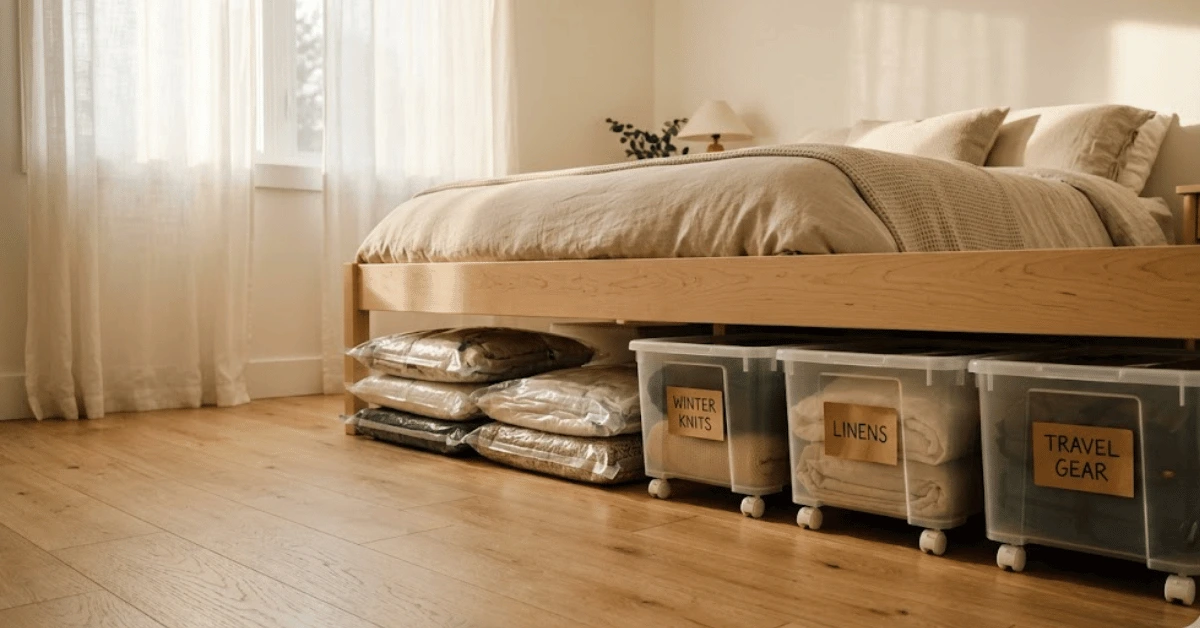
Flat rolling bins with lids are the workhorse option. They’re ideal for folded clothing, extra linens, and shoes. The lid keeps dust out, the wheels make retrieval straightforward, and because they’re rigid, they maintain their structure over time. Opt for the kind with a lid that stays attached rather than a separate lid you’d lose immediately. Clear or semi-transparent versions are worth it, you can see contents without pulling anything out.
Vacuum storage bags are specifically for bulk fabric items. Winter duvets, bulky sweaters, heavy blankets. They compress dramatically, which is genuinely useful when clearance is limited, but they’re not great for things you need to access more than a few times a year because re-packing them properly takes a few minutes each time.
Open-top bins work fine if your bed has a bed skirt that covers the underneath. Without that visual barrier, open bins under a bed tend to look chaotic and collect dust on whatever’s inside.
Woven baskets and fabric boxes are charming and absolutely wrong for under a bed. They don’t slide smoothly on most flooring, they sag over time, and the fabric absorbs dust. They’re better used on open shelves where they look the part.
One thing that makes a real difference: a thin non-woven fabric liner laid down under your bins on hardwood or tile. It protects the floor from scratches and makes heavy bins slide with a fraction of the usual resistance. It costs nothing, and the difference is noticeable.
4. The Bed Frame Itself: A Decision That Sets the Rules
Here’s what a lot of people don’t realize when setting up a studio from scratch or moving into a new place: the bed frame you choose dictates your entire under-bed storage strategy before you’ve bought a single container.
There are three real categories in a studio context.
Platform frames with under-bed drawers give you built-in, clean storage with no visible mess. The drawback is that the drawers are fixed in size and position, so you’re working within their dimensions. They also sit lower than a free-standing bed on risers, so you lose the option to store larger bulky items. What you gain is organization with no visible effort.
Standard frames (four legs, open underneath) give you the most flexibility. Add risers to increase clearance, choose your own container system, and adapt as your needs change. This is the best option for most studio renters because it’s adjustable.
Beds built directly onto platform-style bases with no clearance are common in furnished apartments and they offer exactly zero under-bed storage. If this is what you’re working with, the focus needs to shift entirely elsewhere, toward vertical storage, multi-functional furniture, and smart closet systems. Studio Apartment Setup has good guidance on those alternatives if that’s your situation.
One more thing worth saying: a storage bed with drawers that you never open because the drawer pulls are awkward, or because the drawers have stiff tracks, is not better than an empty platform. Usability is the whole point.
5. The Dust Problem and How to Actually Manage It
Under-bed storage has a reputation for being a dust trap. And it is, if you ignore it.
But most people either over-engineer the solution or ignore it entirely. The real answer is simpler. Lidded bins handle the bulk of the issue for contained items. For the floor surface itself, a flat bed skirt that brushes the floor reduces the air movement that carries dust underneath in the first place. Vacuuming or sweeping the area every two months, pulling the bins out completely to do it, takes about six minutes and solves the problem completely.
Where things go wrong is when people put soft items under the bed without any container at all. Loose sweaters, a stray extra pillow, a bag of things they meant to deal with later. These attract dust, develop an unpleasant smell over time, and because they’re uncontained, they shift around and eventually become that forgotten category of stuff you mentally block out. Lidded bins exist for a reason. Use them.
If you’re also working on getting the rest of your studio organized systematically, this breakdown of why studios feel chaotic is a good companion read, because under-bed storage is only effective when the broader storage system around it is working.
FAQs
Can I use under-bed storage if my mattress sits directly on a platform with no frame legs? Not in any practical way. Platform beds where the mattress rests directly on slats or a solid base have clearances that range from zero to about 4 inches, which rules out rolling bins and most standard containers. Vacuum storage bags might fit, but retrieval becomes genuinely difficult. Your best option is either adding bed risers if the platform design allows it, or redirecting your storage focus to other zones in the apartment entirely.
How do I stop things from getting dusty under my bed even with lidded bins? The lids handle the contents. For the floor itself and the exterior of the bins, a quarterly pull-out-and-wipe session is really all it takes. If your bed sits without a skirt or a frame that closes off the underneath, more ambient dust circulates. A bed skirt that skims the floor reduces that airflow considerably and is worth considering beyond just aesthetics.
What’s the maximum weight I should be storing under my bed? This depends on the frame. Standard metal frames on four legs handle weight well, typically 50 to 80 pounds distributed across the under-bed area is not a problem. What you want to avoid is stacking heavy items in a way that makes pulling bins difficult or creates a situation where you’re dragging rather than rolling. Keep each bin to a weight you can comfortably pull with one hand while crouching.
I want to use this space for shoes. Does that actually work? For shoes worn occasionally, yes. Shoes worn frequently, no. Flat, adjustable shoe containers designed specifically for under-bed storage are widely available and work well for boots, heels, or athletic shoes you use every few weeks. But if you’re reaching for shoes every morning, the inconvenience compounds fast and you’ll likely stop using the system within a month.
Does the type of flooring under my bed change what products I should buy? Yes, meaningfully. On hardwood or tile, wheeled bins slide easily, but without some protection underneath the whole setup will eventually scratch the floor. On carpet, wheels lose most of their advantage and fabric bins or flat rigid containers that slide on their base often work better. Check that whatever you buy is marketed for your floor type, or read actual user reviews from people with the same flooring.
The under-bed zone is not a dumping ground and it’s not a miracle. It’s a specific kind of storage that works brilliantly when you respect its limitations, choose the right containers for your clearance, and populate it with the right category of items. Get those three things right and it becomes one of the most efficient storage moves you can make in a studio. Get them wrong and it’s just more organized chaos that you’ll eventually stop engaging with. Start with a tape measure. Everything else follows from there.

One thought on “Under-Bed Storage in a Studio: What Fits and What Doesn’t”