
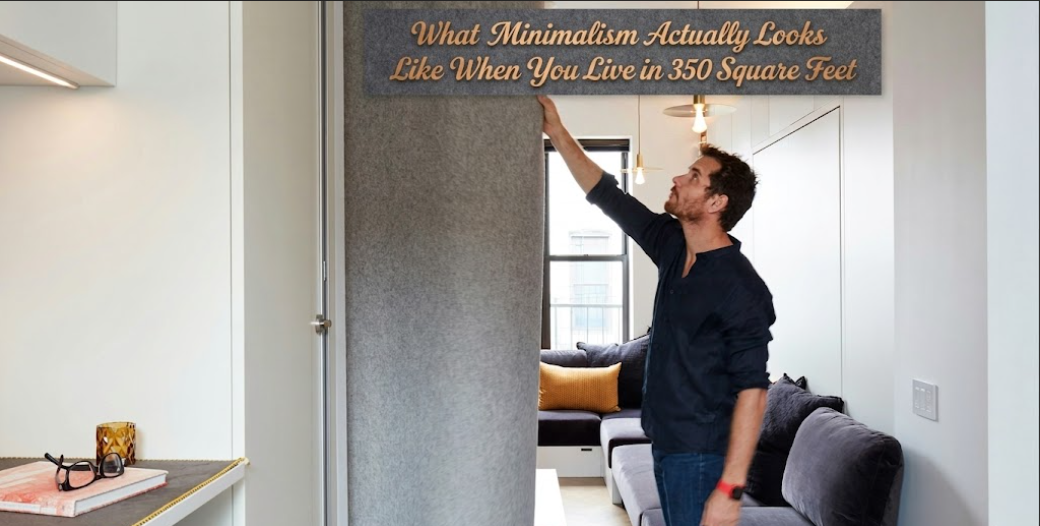
A few years ago, I got a call from a client who had just moved into a 340-square-foot studio in downtown Toronto. She’d done everything right by every minimalist standard she could find online. Sold two-thirds of her furniture. Donated three large bags of clothing. Left the walls intentionally bare. Bought a single low sofa in natural linen and a small walnut coffee table. The place looked exactly like the saved photos she’d brought to our first conversation.
She was calling because she was miserable.
Everything she needed to actually live — chargers, medicine, a printer she used twice a week for remote work, winter coats, spare bedding, her whole kitchen setup beyond three pans — had nowhere to go. She’d built an aesthetic. She hadn’t built a home. And what she described over that call is something I have heard in different forms from many people since: the realization that minimalism, the version that gets shared and saved online, and minimalism as a functional way to live in a small space are two different projects. And almost nobody tells you that upfront.
1. The Version of Minimalism That Keeps Failing People
The aspirational version circulates constantly: empty shelves, single pieces of art on bare walls, a kitchen counter holding exactly four items. It looks calm. It photographs beautifully. And it is genuinely difficult to sustain when you live in 350 square feet and have a life with texture and complication, which is to say, any actual life.
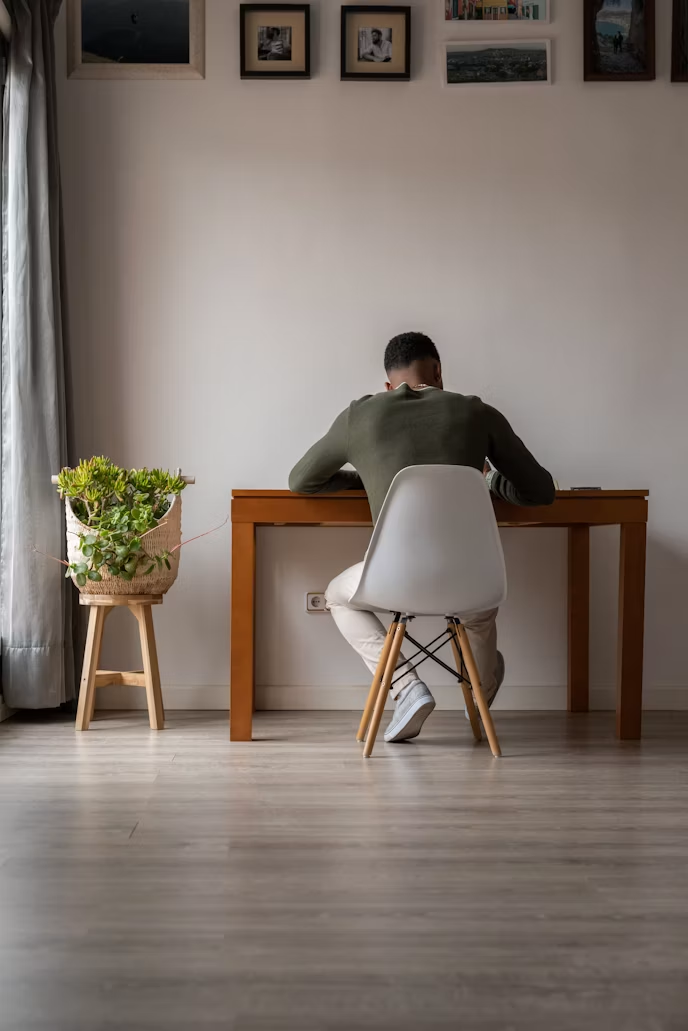
What I’ve observed, both in my own design work and in the stories that get shared on forums and in spaces like Studio Apartment Setup, is that most people arrive at minimalism through appearance rather than function. They feel overwhelmed by their studio’s smallness, decide the answer is less, and interpret less as: remove objects, clear surfaces, buy nothing new. For about three weeks this feels like clarity. Then the pile appears. The corner of the room where the objects with no assigned home collect. The charger on the floor next to the bed. The winter coats draped over the one chair nearest the door. The pile is not a failure of willpower or commitment. It is evidence that the space was simplified visually without being organized functionally, and those two things require completely different work.
The aesthetic of minimalism and the function of minimalism are separate skills. Most people practice one. The apartments that look genuinely, effortlessly minimal and also feel that way to live in are the ones where someone has practiced both, often in that order.
2. What the Myth Actually Gets Wrong
The central myth is this: minimalism means owning fewer things. This is wrong, or at least incomplete in a way that causes real problems in a studio context.
What minimalism in a small space actually requires is a specific relationship between what is visible and what is stored. A well-functioning minimal studio may contain everything a comparable non-minimal studio contains. The difference is not total object count. It is that one space has a deliberate system for what is on display and what is out of sight, and the other is just a room where things have landed wherever there was space. Visible simplicity and total simplicity are not the same. Conflating them is where most people make their first wrong turn.
Storage is not the enemy of a minimal aesthetic in a studio apartment. Storage is the mechanism that makes the aesthetic possible. Without it, you are not minimal, you’re just bare until you’re not, and when things come back it looks chaotic rather than curated. Using vertical space correctly is one of the most underutilized tools in this equation. Not because it’s a secret, but because people tend to approach it reactively, adding a shelf when they run out of room rather than designing a storage framework before filling the space.
The second myth: that minimalism is a destination. You do a purge, the apartment arrives at minimal, and it stays there. Every studio I’ve ever worked on tells a different story. Things come in. The space shifts. Accumulation is continuous, it doesn’t stop because you had a good edit three months ago. A studio that looks minimal without a maintenance habit is just a studio that had a good week. The function requires ongoing decisions, not a single event.
And the third myth, the one that may be the most stubborn: that the objects you own represent your moral relationship to minimalism. I’ve spoken with people who feel guilty about owning a spare set of sheets, a reasonable book collection, or a toolkit they actually use, as if these things disqualify them. That’s minimalism as performance, not minimalism as a practical system for living in a small space well. These are very different things, and the second one is the only one worth pursuing.
3. Where the Genuine Trouble Starts
The most predictable failure sequence in studio apartments attempting minimalism is this: edit first, storage second. People remove the bookshelf because it reads as heavy in a small room. They get rid of the dresser to open up floor space. They clear the extra table. And then they have no place for the books, no home for the clothes, no surface for the things that used to live on the table. The space looks lighter for about a week. Then the objects find new surfaces. Then it looks worse than it did before the edit started.
The correct sequence is inverted. Solve storage first. Make sure there is a specific, accessible home for every category of thing in the apartment. Then evaluate what is worth keeping. If you cannot identify where the winter coats will live before you sell the coat rack, you are not creating a minimal space. You are creating a temporary vacuum that will fill back in, with less organization than before.
I want to stay with this for a moment, because I think the ordering issue is responsible for more failed minimalism attempts than any other single factor. When I work with clients in studios, the first conversation is always about what needs to live in the apartment and where it will go. Not what we should get rid of. Not what the aesthetic direction is. Where does everything go. Once that question is answered, the visual simplicity tends to follow naturally, because when things have homes, they stop living on surfaces.
What happens when you go 30 days without buying anything new is a useful lens on this particular failure pattern. What that experiment tends to surface is that most accumulation isn’t driven by need, it’s driven by habit. And a lot of people, when they stop the incoming flow even temporarily, realize the storage problem they thought they had is actually a different problem: they don’t have a decision-making system for what stays.
The other thing that consistently goes wrong: people treat minimalism as an identity rather than a practice. They buy “minimal” furniture to signal a commitment to the aesthetic, rather than choosing pieces that solve the functional problems their studio has. A natural linen sofa with no storage function is lovely. An ottoman that opens for storage is also lovely. One of them is pulling its weight in 350 square feet and one is not. That distinction matters more in a small space than almost any aesthetic consideration.
4. What It Actually Looks Like to Live This Way
I want to be specific here because the abstract version of this conversation doesn’t help much when you’re standing in a studio trying to figure out what to do next.
A functional minimal studio, one where someone lives well on a Tuesday evening rather than just photographing it on a Sunday morning, tends to share most of the following characteristics. Not as a rigid checklist, but as a pattern I’ve noticed across the spaces that work:
FUNCTIONAL MINIMAL STUDIO: AT-A-GLANCE

FURNITURE
  [ ] Every piece has a storage function or a deliberate visual role
  [ ] No purely decorative surface furniture without a clear design purpose
  [ ] Bed has under-bed storage or a platform frame with integrated drawers
  [ ] Seating doubles as storage where the layout allows (ottoman, bench)

VISIBLE SURFACES
  [ ] Kitchen counter holds daily-use items only: coffee maker, dish rack, one cutting board
  [ ] No default "landing zones" where miscellaneous items collect
  [ ] Open shelving, if present, holds 3-5 objects maximum, chosen deliberately
  [ ] One surface maintained as a clear work area at all times

HIDDEN STORAGE
  [ ] Every category of owned item has a specific, accessible home
  [ ] Seasonal and infrequent items stored vertically or under-bed, not in main living circulation
  [ ] No permanent "to deal with later" piles anywhere in the apartment
  [ ] Closet organized by category with consistent hanger types

DAILY HABITS
  [ ] Objects returned to assigned places at end of day (10 minutes or less)
  [ ] One-in-one-out discipline maintained for new purchases
  [ ] Weekly 10-minute scan of surfaces and primary storage areas
  [ ] No open boxes, shopping bags, or unpacked items sitting longer than 48 hours
None of this is dramatic. That is the point. The daily reality of minimalism in a small space is small and mostly unglamorous. It is returning the scissors to the drawer after you use them. It is not letting the mail accumulate on the counter for five days. It is making a deliberate decision about something before it gets set down on a surface that will become its home by default, because in 350 square feet, every surface that becomes a default home for something is a surface that stops being usable for anything else.
Studio Apartment Setup has a useful frame for the early stages of this: the week-one essentials approach works not just as a move-in guide but as a reference point for what functional minimum actually looks like. If you know what you genuinely need, you have a clear benchmark for evaluating everything that comes after it.
5. What My Client Eventually Figured Out

The woman who called me from her too-bare studio, the one with the perfect linen sofa and no place for her winter coats, eventually arrived at something that worked. Not by adding things back in a way that undid the original intention. She added a low storage credenza in warm walnut, which absorbed most of what had been living on the floor and on that one chair. She had a proper hanging system put into her closet so the coats had a real home. She kept one basket near the door for daily-use items that needed a temporary landing spot before being returned to their places at the end of the day.
The apartment still looked minimal. More so, actually, because now what was visible was there on purpose rather than in spite of everything that had no place to go.
She said something I’ve thought about often since: that the version she’d started with felt like performing minimalism for an audience she’d invented. What she ended up with felt like it had been designed for her actual life. That distinction, between a space that reflects a lifestyle idea and a space that functions for a specific human on a specific weeknight, is where real minimalism begins. In 350 square feet, that is the only version worth building.
FAQs
My studio is packed. Where do I actually start? Storage before editing. Before removing a single piece of furniture or donating anything, map out where every category of item in your apartment will live if you keep it. Once you have a home for everything, you can evaluate what’s worth keeping versus what’s just occupying that home. Starting with a purge before you have a storage system just creates a temporarily empty space that fills back up faster than before.
Does a minimal studio still feel livable, or does it just look good in photos? The livable version and the photo version are different projects, and only one of them is worth building. A functional minimal studio, one where storage is solved and visible surfaces are deliberately edited, creates a genuine sense of space that affects how you feel in the room day to day. The performance version, where surfaces are bare because there’s nowhere else to put things, feels oppressive to live in. The difference is whether the simplicity is built or just borrowed.
Is there an object count I should aim for? No, and chasing one will make you miserable. What creates the experience of minimalism in a small space is your visible object count and the organization of what’s stored out of sight, not your total number of possessions. A studio with 600 well-organized items can feel more minimal than one with 200 items scattered across surfaces. Stop counting and start assigning places.
Should I buy minimal-looking furniture or just work with what I have? Work with what you have first, always. The aesthetic follows from organized storage and intentionally edited surfaces, not from a specific furniture style. A secondhand bookshelf with a clear, curated surface reads as more minimal than an expensive low-profile piece surrounded by visual noise. Buy new only when an existing piece genuinely can’t solve the storage problem you need solved.
How do I stop the slow creep of stuff over time without a constant purge? Build specific small habits rather than relying on periodic motivation. A weekly 10-minute surface scan. A one-in-one-out rule for anything new entering the apartment. A dedicated landing spot near the door for daily-use items that get returned to their actual homes at the end of each day. The chaos that returns in studios almost always traces back not to too many objects but to objects without assigned homes. Solve that, and the maintenance becomes manageable.