
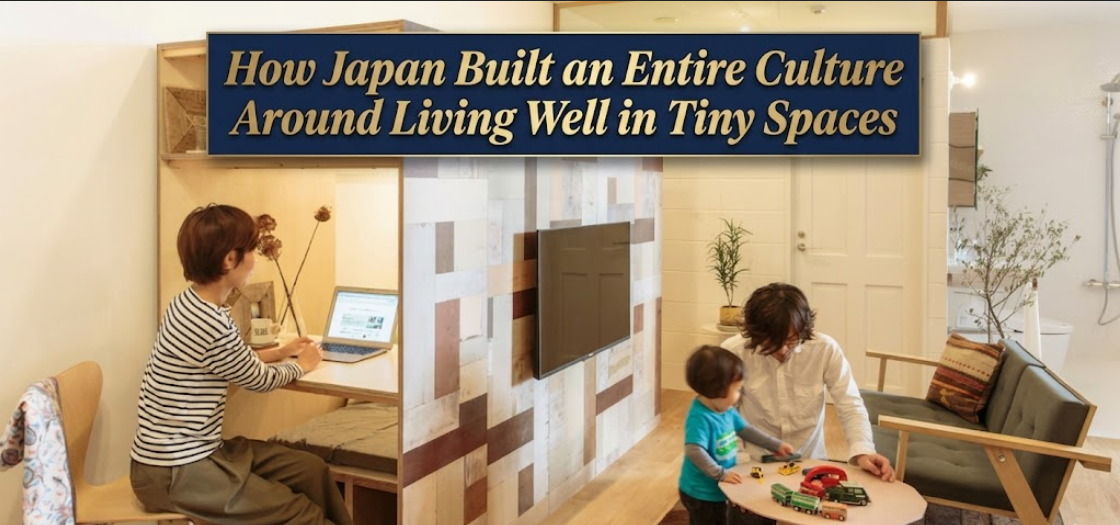
How Japan Built an Entire Culture Around Living Well in Tiny Spaces
The average Tokyo apartment runs about 270 square feet.
Not a studio in a dense urban building with high ceilings and a decent kitchen. A full residential apartment, the kind families live in, where a working couple might raise a child. 270 square feet. That number landed differently than I expected when I first looked into it seriously, because the assumption most Western designers bring to Japanese small-space living is that it’s a story about clever furniture and smart storage. And it is, partly. But the furniture is the last chapter, not the first.
The first chapter is a philosophy of space that Japan developed over centuries before IKEA existed, before Murphy beds, before anyone was writing articles about maximizing square footage.
1. The Deep History: Why Japanese Domestic Space Developed the Way It Did
Japan’s relationship with small domestic spaces isn’t a modern adaptation to urban density. It’s a design culture that grew from specific geographic, material, and philosophical conditions that go back well over a thousand years.
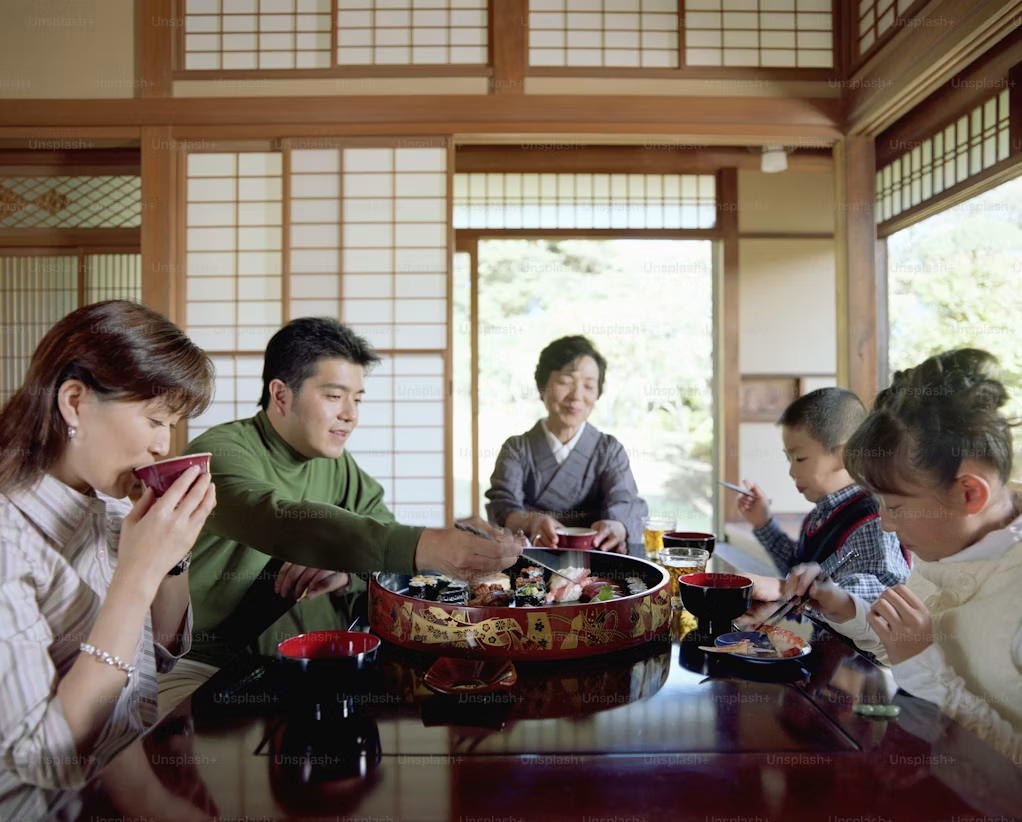
The most direct material cause was timber. Japan is a heavily forested archipelago, and traditional Japanese architecture, particularly residential architecture, relied almost entirely on wood. That created structures that were lighter, more flexible, and more modular than the stone and masonry buildings of European traditions. Walls in traditional Japanese homes weren’t fixed or load-bearing in the Western sense. The structural work was done by a post-and-beam skeleton, which meant the interior could be divided and reconfigured using sliding screens, called shoji when paper-covered and fusuma when opaque. A single room could become two or three smaller rooms by closing screens, and could return to one large room by opening them. This wasn’t an innovation to solve a space problem. It was the default technology of the architecture.
The consequence for spatial philosophy was significant. Japanese domestic design never built a strong cultural attachment to the fixed, purpose-specific room, the bedroom that is always a bedroom, the dining room that is always a dining room. Instead, spaces were expected to transform. A room used for sleeping at night, with a futon rolled out from a closet called an oshiire, would become a sitting room in the morning after the futon was stored away and a low table was placed at center. The same physical space served multiple functions in sequence rather than simultaneously, which is a fundamentally different spatial logic than Western domestic architecture defaulted to.
This is where the Western “tiny living” conversation gets the influence slightly wrong. People tend to extract the furniture solutions, the sliding doors, the platform storage, the fold-away beds, and treat them as tricks to apply to a Western spatial problem. But those solutions were developed for a spatial culture that had a different relationship to rooms from the start. The furniture follows the philosophy, not the other way around.
The philosophical underpinning has a name that gets cited frequently without being examined carefully: ma, a Japanese concept that translates roughly as negative space, pause, or the gap between things. In architecture and design, ma refers to the value of emptiness, the deliberate absence of objects in a space that gives the objects that are present more meaning. A tokonoma, the recessed alcove found in traditional Japanese reception rooms, would typically hold one hanging scroll and one seasonal arrangement. One. Not a collection, not a display of accumulated objects. One carefully chosen thing, changed with the season, given the entirety of the space to be seen in. The surrounding emptiness wasn’t a failure to fill the alcove. It was the point.
This principle of restraint wasn’t minimalism in the aesthetic sense that Western design has adopted in the last decade. It wasn’t about clean lines as a stylistic choice. It was a coherent position on how a living space should function: the room exists to support human activity, not to demonstrate accumulation or signal status through objects.
The tea ceremony tradition, chado, refined this into architectural form through the chashitsu, the tea room. Chashitsu were often extraordinarily small, sometimes under 10 square feet, specifically designed to dissolve social hierarchies and create a space of focused, present attention. Sen no Rikyu, the 16th-century tea master who formalized many chashitsu principles, reduced the space to its functional and experiential minimum. Low ceilings. A single entrance called a nijiriguchi so small that everyone, regardless of social rank, had to bow to enter. Natural, unfinished materials. No ornamentation that didn’t serve a direct function. The smallness was intentional and the smallness was considered dignified, not a compromise.
2. How These Principles Became Practical Systems
The philosophy described above isn’t abstract. It produced specific, concrete spatial practices that Japanese domestic design has used for centuries and that remain visible in contemporary Japanese apartment design.
The practice of futon culture is the clearest example of sequential space use. A traditional Japanese sleeping arrangement doesn’t involve a bed frame that permanently occupies floor space. The futon, a padded floor mattress, is stored in the oshiire during the day and laid out at night. The oshiire is a deep built-in closet designed specifically for this storage, typically with a shelf for the kakebuto (the comforter) and floor space for the shikibuton (the mattress pad). The room has no permanent bed. The floor space is available for the full sixteen to eighteen waking hours, and the sleeping arrangement emerges from storage each evening as needed. A Western observer calls this clever. A Japanese resident of a traditional home would more accurately call it the obvious way to use a room.
The multi-purpose low table, typically lacquered and sometimes called a chabudai, also emerged from this sequential space logic. Meals, work, socializing, and games all happen at the same surface because the surface is portable, the cushions are stackable, and the floor is always available as a seat. The furniture adapts to the activity rather than the activity adapting to a fixed furniture arrangement.
Contemporary Japanese apartments, particularly the 1K and 1DK categories (one room plus kitchen, or one room plus dining-kitchen) common in Tokyo and Osaka, inherit these practices even when they’re built with Western-style fixtures. A 270-square-foot 1K in a Tokyo apartment building typically includes a set of deep built-in closets designed for futon storage, a flexible floor plan that allows the main room to shift function across the day, and a careful separation of wet and dry areas that keeps the spatial experience cleaner than a comparable Western apartment of the same size.
What Western small-space design borrowed, mostly via Scandinavia and mid-century modern design, was the aesthetic vocabulary of Japanese spatial thinking: low furniture, neutral materials, restrained ornamentation, integration of storage into architecture rather than layering it on top. IKEA’s Swedish flat-pack culture has more in common with Japanese spatial pragmatism than it does with traditional European furnishing traditions, which defaulted to heavy, permanent, status-signaling furniture that was never meant to be moved.
The contemporary Japanese concept of danshari, which translates roughly as “refuse, dispose, separate,” brought the spatial philosophy into direct dialogue with modern consumer culture. Developed by Hideko Yamashita and popularized internationally through Marie Kondo’s adaptation of its principles, danshari argues that the problem of small-space living is primarily a problem of accumulation, not configuration. Before you reorganize, you stop acquiring things you don’t need, release things you’ve already accumulated that don’t serve you, and then organize what remains. The sequence matters: declutter first, organize second. Most Western storage advice inverts this, reaching for more containers before examining whether the contents justify their space.
Japanese Domestic Design: A Plain-Text Timeline of Key Developments
Heian Period (794-1185)
  Shinden-zukuri architecture: open, pavilion-style noble residences
  Spaces defined by screens and curtains rather than fixed walls
  Floor culture begins: tatami mats as primary surface for living

Muromachi Period (1336-1573)
  Shoin-zukuri style develops: formalized alcove (tokonoma), shelving
  Sliding screens (fusuma, shoji) standardized as room dividers
  Tea ceremony tradition formalizes small-space aesthetics

Momoyama and Edo Periods (1568-1868)
  Urban machiya (merchant townhouses) emerge: narrow, deep floor plans
  Vertical space use intensified due to street frontage economics
  Multi-function room culture becomes standard across classes

Meiji and Taisho Eras (1868-1926)
  Western architectural influence begins; mixed wa-yo (Japanese-Western) style
  Fixed beds and chairs appear alongside traditional floor-based living
  Urban density increases; small-space pragmatism intensifies

Post-WWII Reconstruction (1945-1970)
  Mass public housing (danchi) introduces Western-influenced small apartments
  1K and 1DK apartment categories emerge as standard rental formats
  Futon culture persists even in Westernized floor plans

Contemporary (1980-present)
  Capsule hotels (1979 Kisho Kurokawa design) demonstrate radical space compression
  Global export of Japanese spatial philosophy via design media
  Danshari and KonMari methods apply philosophical tradition to modern clutter problem
The timeline matters because it shows that Japanese small-space design isn’t a reaction to modern urban density. The principles were in development for over a millennium before Tokyo became one of the most densely populated cities on earth. The density confirmed what the philosophy had already worked out.
The mistake Western designers make when borrowing from this tradition is to treat the outputs as transplantable solutions without the underlying logic. Sliding doors work well in Japanese apartments because the entire floor plan assumes flexible space use. Installed in a Western apartment where every room has a fixed, single purpose, a sliding door is just a door that takes up less swing clearance. The hardware travels. The philosophy doesn’t automatically come with it.
For people applying these ideas to their own studio setup, the storage practices at Studio Apartment Setup take a similar approach to the Japanese principle of storing what isn’t in active use, keeping floor space available rather than permanently claimed.
What This Actually Means for Your Studio
Three things from the Japanese spatial tradition transfer directly into contemporary studio living, without requiring any cultural adoption or wholesale philosophical commitment.
The sequential use principle is the most valuable. The question to ask about any piece of furniture or object in your studio is not “where does this live?” but “when is this in use and when should it be stored?” A yoga mat that’s used for forty minutes a day doesn’t need to occupy floor space for the other twenty-three hours and twenty minutes. A folding dining table that seats two doesn’t need to sit open when you’re eating alone at the counter. Objects can be in use or in storage; the Japanese default is storage, and the Western default is deployment. Shifting that default even slightly produces more available floor space than most furniture rearrangements do.
The restraint principle applies directly to what Studio Apartment Setup covers in its decor section. The tokonoma’s one object, changed seasonally, is an extreme version of a genuinely useful approach: fewer objects on display, each one visible and chosen, rather than an accumulation of things that individually mean something but collectively create noise. In a studio, every visible surface competes for attention. The Japanese approach is to make fewer surfaces visible and to give each one more room to breathe.
And the danshari sequence matters practically. Before buying any storage solution for a studio, the first question should be whether the items needing storage should be stored at all or whether some of them should simply leave. The layout guides at Studio Apartment Setup approach studio organization from this direction: remove before you reorganize, reorganize before you redecorate. The Japanese figured this out several hundred years before anyone was selling storage bins.
FAQs
Does Japanese-style floor living (futons, low furniture) actually work in a North American studio context? It works practically, with some real trade-offs. Floor-level living reclaims significant vertical space (no bed frame, low sofa, low table) and keeps the room feeling open because your sightlines extend further horizontally. The difficulty for North Americans is largely habitual: getting up from the floor repeatedly across a day is more effort than rising from a chair or bed, and can be genuinely problematic for people with knee or hip issues. A partial adoption, a platform bed at a low height rather than full floor sleeping, a low-profile sofa rather than a floor cushion, captures most of the spatial benefit without the full adjustment.
What’s the actual difference between Japanese minimalism and Western minimalism as design approaches? Japanese spatial restraint developed from a philosophical position about the relationship between objects and meaning, specifically that fewer objects given more space carry more presence and significance. Western minimalism as a design movement, emerging primarily through Bauhaus and mid-century modernism, was largely an aesthetic and ideological reaction against Victorian excess and industrial ornamentation. Both produce similar-looking rooms, but Western minimalism treats emptiness as style, while the Japanese tradition treats emptiness as function. The practical difference shows up in how spaces are actually lived in: the Japanese approach assumes the space will be actively used and transformed throughout the day, while Western minimalism often produces spaces that look correct but feel inhibiting to actually occupy.
I have a 320-square-foot studio. Which Japanese spatial principle should I apply first? The sequential use principle gives the fastest visible result. Audit every item that has a permanent floor or surface position in your studio and ask whether it needs to be deployed during all waking hours or whether it could spend some time in storage. A folding desk that you use for two to three hours a day and then store vertically, a dining table that folds against the wall when not in use, a guest sleeping arrangement that lives in a closet rather than as a permanent daybed: each of these trades a constant footprint for an occasional one. The cumulative effect on available floor space is usually more significant than any furniture rearrangement.
Is the KonMari method actually Japanese in its origins, or is that a marketing angle? It’s genuinely rooted in Japanese tradition. Marie Kondo’s method is a popularized, accessible version of danshari, which itself draws from Shinto concepts of purity and the idea that objects carry energy that affects the people around them. The “spark joy” framework is a simplified version of the more rigorous danshari principle of examining one’s relationship to each object and consciously deciding whether it serves the present life rather than a past or imagined one. The cultural roots are real, though the commercial presentation of it as a lifestyle brand has layered some marketing distance between the method and its philosophical origins.
My lease doesn’t allow me to modify walls. Can I still apply Japanese spatial principles without sliding doors or built-ins? Most of the transferable principles don’t require wall modifications. Sequential use, restraint in what’s kept visible, storing items when not in use, choosing furniture that serves multiple functions in sequence rather than simultaneous functions: none of that requires drilling into a wall. The sliding screen tradition can be approximated with freestanding room dividers or curtain panels hung from freestanding frames, which are removable. The built-in closet storage of the oshiire can be approximated with a quality wardrobe armoire designed for deep storage. The philosophy travels without the hardware.
The thing that stays with me, after working through the actual history of this rather than the surface-level design borrowing, is that Japan didn’t develop a set of tricks for living small. It developed a set of values about what a living space is for. The tricks are downstream of that. And the values, stripped of their specific cultural context, are pretty transferable: a space is for living in, not displaying; emptiness is a feature, not a failure; everything that’s present should earn its presence; and the room should serve what you’re doing right now, not permanently anticipate everything you might ever do.
For anyone thinking through how to apply these ideas specifically to their own studio layout and storage choices, Studio Apartment Setup is a good place to keep working through the practical side of the same questions.