
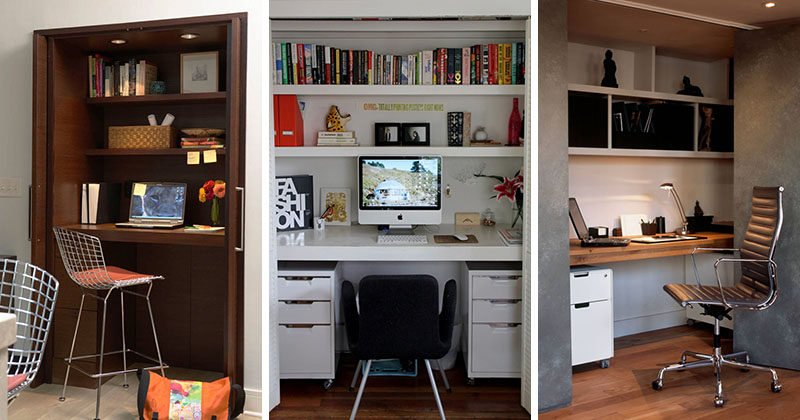
Early in my design career, I made a classic rookie mistake with a client’s studio. She worked from home three days a week and needed a proper workspace. I gave her a beautiful floating desk on the main wall, clean and intentional, right in her sightline from the bed. She loved it in the reveal. Hated it within two weeks.
The problem wasn’t the desk. The desk was fine. The problem was that in a single-room apartment, a visible workspace bleeds into every other part of your life. You wake up and your inbox is eight feet away, staring at you. You sit on the sofa to relax and the monitor is in your peripheral vision. You eat dinner and the spreadsheet you didn’t finish is visible from the table. The workspace had no off switch, because it had no door.
That project taught me something I’ve applied consistently since: in a studio, the best home office is the one that disappears when the workday ends. And the most underused solution for exactly that is the closet.
1. Why the Closet Converts So Well for This Purpose
Most studio apartments have at least one reach-in closet, typically 24 to 36 inches deep and anywhere from 36 to 60 inches wide. That’s a footprint of roughly 9 to 15 square feet, which is more than enough for a functional workstation. The dimensions that feel limiting for storing clothes actually work in your favor for a desk setup: 24 inches of depth accommodates a monitor, keyboard, and a small lamp without the desk feeling cavernous. The width gives you lateral surface space for a notepad, a small tray of supplies, or a second monitor if you need it.
But the real advantage isn’t the square footage. It’s the door.
When the workday ends, you close the door and the office doesn’t exist anymore. The visual signal that you’re done working is physical and immediate. This distinction matters more in a studio than anywhere else, because in a studio there’s no other room to go to. The closet home office gives you a psychological boundary that a desk in the open room simply cannot replicate, regardless of how beautifully it’s styled.
The other advantage is acoustic. Inside a closet, with the walls close on three sides, sound behaves differently than in an open room. The softness of hanging clothes or fabric organizers on the surrounding walls absorbs ambient noise. Video calls feel more contained. If you’ve ever noticed that you sound cleaner and more present on calls when you’re in a small, fabric-lined space, that’s basic acoustic absorption at work, the same principle used in recording booth design.
2. The Build-Out: What Actually Goes Into a Functional Closet Office
This is where the project either works well or produces a setup you abandon in three months, so the details here are worth being precise about.
The first decision is whether to remove the existing closet rod and shelf or work around them. In most cases, removal is the right call. The standard single rod and shelf configuration in a reach-in closet gives you neither the vertical clearance for a monitor at a comfortable height nor the horizontal surface area for a proper desk. Removing the rod and shelf typically takes twenty minutes with a screwdriver, and the rod brackets and shelf supports leave small holes that patch easily. If your lease is strict about modifications, a freestanding closet system that installs without wall penetration is a workable alternative, though you’ll sacrifice some depth.
The desk surface itself can be a simple shelf, cut to the full width of the closet and mounted at the right height. Standard desk height is 28 to 30 inches from the floor, but the more reliable method is to sit in your chair first, establish where your forearms rest comfortably parallel to the floor, and measure up to that point from the closet floor. That’s your mount height. A piece of 3/4-inch birch plywood cut to width and depth, edge-banded and sealed, costs under $60 at most lumber yards and outlasts any flat-pack desk you’d buy for three times that price. Mount it to the side walls of the closet using heavy-duty shelf brackets, two on each side, and it’ll hold a monitor, laptop, and anything else without flex.
Monitor placement in a closet workspace is slightly different than in an open room. The back wall is close, which means you can’t push the monitor as far back as you might on a large open desk. Position it so the screen sits roughly 20 to 24 inches from your face when seated, which is within the recommended range for most standard monitors. If the closet is shallow and that distance is hard to achieve, a monitor arm mounted to the back wall adds 4 to 6 inches of depth flexibility that a fixed stand doesn’t give you.
Lighting inside a closet is non-negotiable. A closet with the door open and only ambient room light behind you produces the worst possible video call setup: your face is backlit, your expression is unreadable, and the whole frame looks dim and unprofessional. A simple LED strip light or a compact LED panel mounted to the underside of the overhead shelf, pointed toward the desk surface and your face, changes the whole picture. Warm white (around 3000K) is flattering on video and less harsh for long working hours than cool white. The strip light ideally connects to a switch or a smart plug so you can control it without reaching into the closet.
Cable management is the difference between a closet office that looks considered and one that looks like a temporary fix. Run cables along the interior walls using adhesive cable clips, not down the center where they’re visible. If you have a power strip on the desk surface, route the main power cable up the side wall and out through the top of the closet to an outlet above, or down through the bottom of the closet to an outlet below. Keep the outlet cord from snaking across the desk surface in plain view on video calls. A small USB hub or power strip mounted on the underside of the desk surface keeps the cords short and contained.
3. The Clothing Problem: Where Does It All Go?
The objection I hear most often when I suggest a closet office conversion is: “But then where do I put my clothes?”
It’s a fair question. And the honest answer is that it forces a useful audit.
Most studio residents use somewhere between 20 and 40 percent of their closet space for items they actually wear regularly. The rest is off-season clothing, things they’ve kept out of obligation, duplicates, and items that technically fit but never get chosen. Converting the closet to a home office is a good moment to move the off-season clothing into under-bed flat bins or vacuum bags, donate the things that haven’t been worn in a year, and transfer the active wardrobe to a freestanding wardrobe or a clothing rack, which takes up less visual space than people expect and often works better in a studio than a deep closet anyway.
A quality clothing rack with a lower shelf, positioned thoughtfully in the apartment, isn’t a compromise. In Scandinavian design and in a lot of well-styled contemporary interiors, an open clothing display with a curated, seasonal wardrobe is a deliberate choice. The key is keeping it edited: ten to fifteen items visible, seasonally rotated, rather than everything you own crammed onto a single rod.
The Studio Apartment Setup storage section has good material on the under-bed and wardrobe alternatives that work alongside a closet office conversion. It’s worth reading that alongside this before you start pulling shelves out.
4. Closing the Office: The Feature That Makes Everything Else Worth It
The psychological benefit of closing the closet door at the end of the workday is real and it compounds over time. But it only works if the closed closet looks finished rather than like a closet with stuff behind it.
Bi-fold doors, the most common closet door style in apartment buildings, work fine for this. They’re inexpensive, easy to repaint if the color doesn’t suit the room, and close cleanly. The issue is that bi-fold doors tend to look utilitarian. A few ways to change that: replace the hardware (the pulls and hinges) with something more considered, paint the doors the same color as the surrounding wall so they read as a flat panel rather than an obvious door, or replace them entirely with curtain panels hung on a ceiling-mounted track for a softer, more intentional look.
The curtain approach is particularly good in studios because it softens the whole wall and doesn’t carry the visual weight of a door. A pair of linen curtain panels in a neutral tone, floor-length, completely conceals the office when closed and can be opened quickly with a single gesture. No folding mechanism, no hinge noise, no bi-fold overlap.
Here’s a quick comparison of the main door or covering options:
| Closure Type | Cost | Look | Ease of Access | Noise Containment |
|---|---|---|---|---|
| Original bi-fold doors | $0 (existing) | Utilitarian unless painted | Fast but slightly awkward | Moderate |
| Painted bi-fold (same as wall) | $20-40 for paint | Clean, near-invisible | Same as above | Moderate |
| Curtain panels on track | $80-180 installed | Soft, residential | Very fast, one gesture | Low |
| Sliding barn door (freestanding) | $200-500+ | Dramatic, high visual weight | Fast | Low |
| New hinged door (full replacement) | $150-400 installed | Finished, permanent | Standard | Best |
For renters, the curtain panel option is the cleanest: it requires only a ceiling hook or a tension rod (no wall damage), it’s fully reversible, and it looks intentional rather than improvised.
The other thing worth doing before closing the office each evening: clear the desk surface to a reset state. Not stripped completely bare, but cleared of the active work items: close the laptop, put the notebook away, move the coffee cup. You open the doors in the morning to a clean starting point, not to yesterday’s unfinished state. This is a small habit but it affects how the setup feels to use consistently over weeks and months.
5. The Setup Nobody Actually Has But Probably Should
The variation on the closet office that I’ve seen work especially well, and that almost nobody sets up by default, is the one where the desk faces out into the room rather than toward the back wall of the closet.
This sounds counterintuitive. A closet desk usually faces the back wall, which is fine for heads-down work but creates a slight cave feeling and puts the monitor between you and the room on video calls (bad background). The outward-facing version turns the desk so the working surface is at the mouth of the closet, the person sits in the closet space with their back to the deep wall, and they look out into the room rather than at the back wall.
The advantages: natural light hits the face from the front rather than from behind, the video call background becomes the room (which you control and style) rather than a closet interior, and the workspace feels more open during the day. The trade-off is that the sense of enclosure is reduced, since you’re effectively sitting with the closet around your back and sides rather than fully inside it. But the door still closes at the end of the day, and the off switch still works.
For anyone building this version, the desk surface mounts at the front of the closet opening rather than against the back wall, and the monitor sits at the front edge of the desk facing inward (toward the person, away from the room). Lighting mounts to the sides of the closet opening, pointed at the person’s face from both sides, which produces the clean, even light that video calls need.
The organizing section at Studio Apartment Setup has additional context on how to keep the studio side of the outward-facing setup tidy since it becomes the background for every call you take.
FAQs
My closet is only 18 inches deep. Is that enough for a desk setup? 18 inches is the minimum and it does work, with a monitor arm rather than a fixed stand (which saves 4 to 6 inches), a slim laptop setup rather than a full tower, and a narrow keyboard tray if needed. The main constraint is that a standard office chair won’t fit inside an 18-inch-deep closet, so you’d be working from a chair positioned outside the closet with your arms reaching in. That arrangement is less comfortable for extended work sessions but entirely functional for two to three hours at a stretch.
I have a walk-in closet in my studio. Does the same approach apply? A walk-in closet gives you more options and a few new considerations. You have the space for a larger desk, better lighting setup, and potentially a small bookshelf or printer. The challenge is that a walk-in closet used as an office typically needs more deliberate acoustic treatment, since the larger space doesn’t provide the same natural sound absorption as a tight reach-in closet. Adding a fabric panel or a few inches of acoustic foam to the back wall behind the desk makes a meaningful difference for call quality.
How do I handle the fact that the closet light switch is usually outside the closet? This is the most common wiring constraint. The simplest solution is a smart plug on the desk lamp or LED strip: set it to a schedule or control it from your phone without reaching for the wall switch. A battery-powered LED light with a touch switch, mounted directly on the desk surface or the underside of the shelf above, is the lowest-friction option for renters who don’t want to run any additional wiring at all. For a more permanent setup, a licensed electrician can add a switched outlet inside the closet in a few hours, and it’s worth the cost if you’re in the apartment long-term.
Will a closet office setup actually look professional on video calls, or will it just look like I’m calling from a closet? With the right lighting and a considered background, no. The two things that read as “calling from a closet” on video are dark or cluttered surroundings and backlit face. Fix the lighting (warm LED aimed at your face from the front) and keep the interior clean and the back wall simple. A coat of paint on the back wall in a neutral tone, or a small piece of art mounted there, gives the background a finished look. Most people on the other end of the call won’t register that they’re seeing the interior of a closet.
What’s the minimum closet width for this to be worth doing? 36 inches is the functional minimum for a comfortable workstation. At 36 inches you have enough width for a laptop, a small external monitor, a keyboard, and a lamp without things feeling crowded. Below 36 inches, the setup starts to feel cramped and the monitor positioning becomes a compromise. If your closet is 30 inches wide, a wall-mounted fold-down desk in the apartment’s main room, which closes flat against the wall when not in use, is a better solution than trying to squeeze into a closet that’s too narrow to be comfortable.
The closet office is one of those ideas that sounds like a compromise until you’ve actually lived with it for a month. Then it just sounds correct. The ability to close the door on work, physically and visually, is something that a beautifully designed open desk in a studio can’t replicate. And the setup cost, maybe a few hundred dollars for a desk surface, lighting, and a proper chair, is lower than most standing desk systems or dedicated office furniture.
If you’re also working through the broader storage situation that a closet conversion creates, the storage guides at Studio Apartment Setup cover the wardrobe and clothing alternatives in useful detail.