
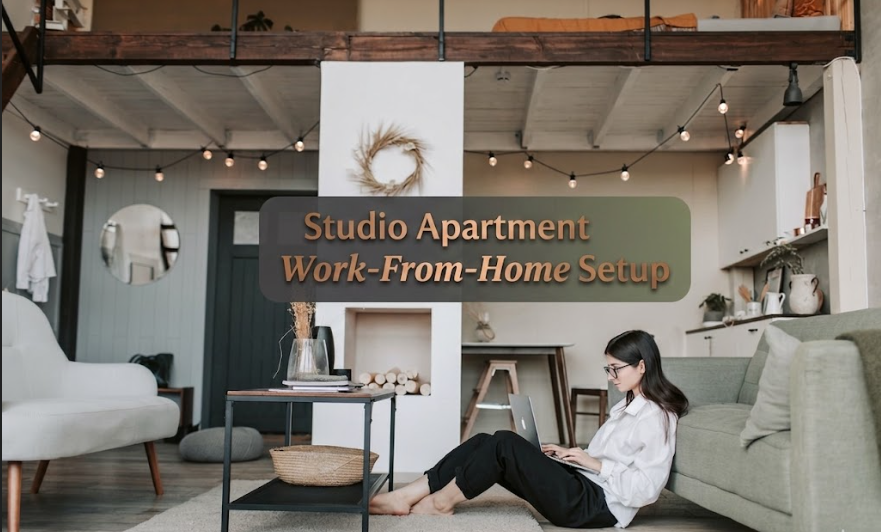
Someone emailed me a while back with a question I’ve heard in variations ever since remote work became the default for so many people: “I work from my bed because there’s nowhere else to put a desk. Is that actually a problem, or am I just being dramatic?”
Not dramatic. The problem is real, it’s documented in sleep research, and it’s one of the more stubborn spatial challenges in studio living because it isn’t just about square footage. It’s about what your brain associates with specific places in your home.
Your nervous system is, at its core, a context machine. It uses environmental cues to regulate your physiological state. When you sleep and work in the same 18 inches of mattress, those cues collapse into each other. You lie down at 11pm and your brain cycles through a work-and-rest association simultaneously, which is why so many remote workers in studios report difficulty switching off. The space won’t let them.
The fix is spatial, and it’s more achievable than most people think.
1. First: Get the Desk Off the Bed Entirely
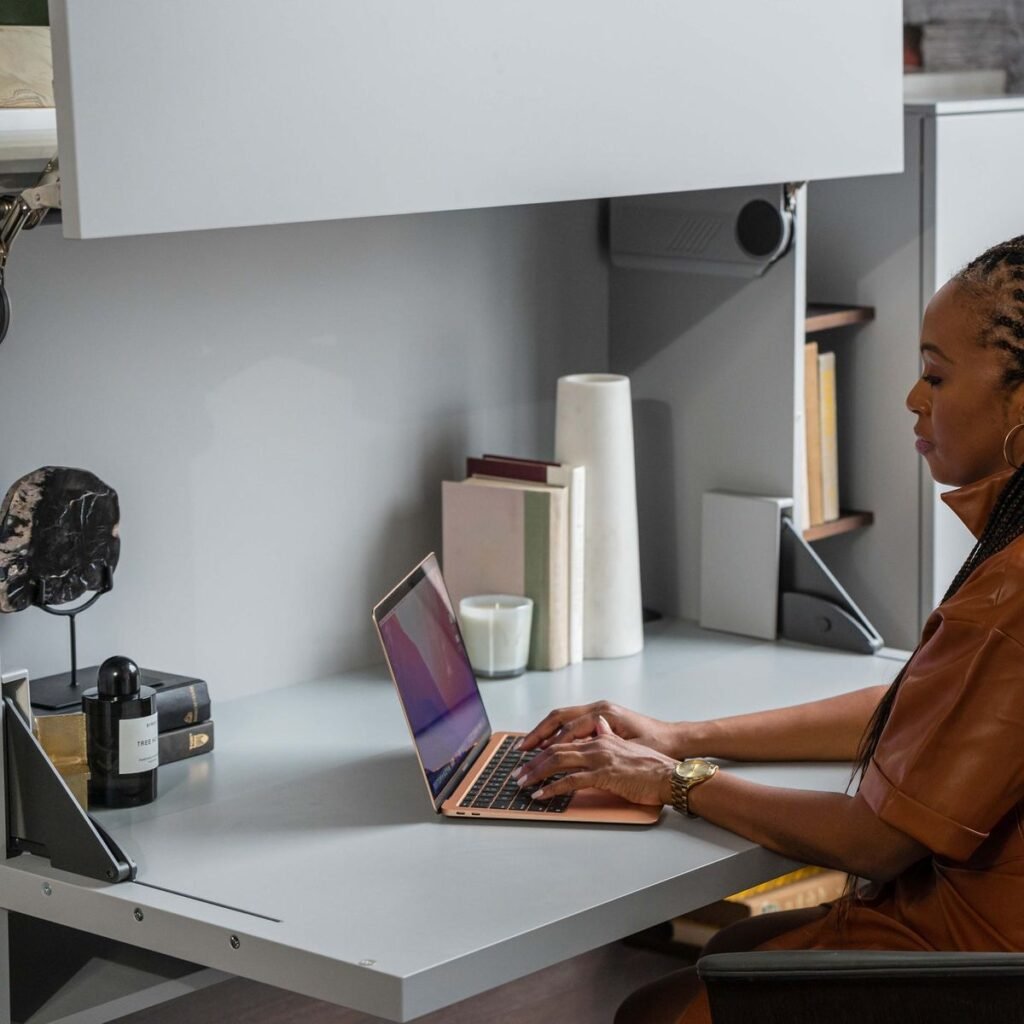
Non-negotiable. Working from bed is the one habit that, in my experience, does more damage to the livability of a studio than almost any furniture decision. The issue isn’t posture, though that matters. It’s that you’re training your brain to treat your sleep surface as an active workspace, and that association is genuinely hard to undo once it’s established.
A small desk, even a compact writing desk 80 to 100 cm wide, changes everything. It doesn’t need to be large. You’re not building a home office with filing cabinets and a printer station. You need a flat surface at chair height, a real chair that isn’t the bed, and a position in the room that is distinctly not the sleep zone.
Where that desk goes matters more than most people realize. The two best positions in a studio are against a wall that the bed doesn’t share, or angled into a corner so the desk faces away from the sleeping area entirely. If you sit at your desk and can see the bed in your direct line of sight, the zones are still bleeding. Not catastrophically, but the visual separation is part of what makes the psychological separation work.
2. Making the Work Zone Feel Like a Different Place
Once the desk has a location, the next step is giving the work zone its own identity. This is where a lot of people stop short. They put the desk in the room and call it done, then wonder why they still feel like they’re always at work.
The zone needs distinguishing features. A dedicated task lamp, separate from whatever you use for ambient lighting in the rest of the apartment, is the single most effective tool here. Turn it on when you start work. Turn it off when you stop. That ritual becomes a cue. Over time, even the act of switching the lamp on signals readiness to work, and switching it off signals something close to clocking out. I wrote about the role of layered lighting more broadly for Studio Apartment Setup’s piece on why one overhead light undermines a studio, and the same principle applies here in a more targeted way.
Beyond lighting, think about what’s on and immediately around the desk. A small corkboard or a shelf directly above with only work-related items. A plant on the desk surface if you like that kind of thing. The visual language of the work zone should be slightly different from the rest of the apartment, not dramatically, but enough that your eye registers the shift when you move between areas.
One thing to avoid: a desk positioned so that your back faces the room. This sounds like a minor thing but it creates a sense of unease that’s hard to name. You feel exposed, slightly surveilled by your own apartment. Face the wall or angle toward the corner. It concentrates focus and reduces the visual distraction of the rest of your living space while you’re working.
3. The Transition Rituals That Actually Work
Physical setup gets you most of the way there. The rest is behavioral, and I’d be doing a disservice to skip it because this is where people who’ve already done the furniture work still run into trouble.
The work-life boundary in a studio isn’t maintained by walls. It’s maintained by habits that substitute for those walls. A few that consistently work:
End-of-day pack-down. Close the laptop. Put notebooks away. If you use the desk surface for anything personal as well, like a cup of tea or a book, leave something personal there at the end of the workday as a visible signal that the work phase is done. The desk shouldn’t look like a workstation at 8pm.
A brief physical transition, even just walking to the kitchen to make something, leaving the work corner behind for two minutes, gives your nervous system a break in the pattern. Small. Deliberate. Effective.
The other habit worth building: don’t check work messages from the bed. This sounds obvious but it’s where the boundary most commonly erodes. Once the phone becomes the bridge between the sleep zone and the work zone, the physical separation you’ve created stops mattering.
4. When There Genuinely Is No Room for a Desk
Some studios are small enough that a permanent desk isn’t feasible without sacrificing something significant. This is a real constraint and it deserves a real answer rather than generic advice.
The closet office is underused and, when done well, genuinely functional. A reach-in closet can be converted into a compact work nook with a fold-down desk, proper task lighting, and a power strip. The doors close at 6pm and the workspace disappears. Studio Apartment Setup has covered the closet office setup in more detail, and the closet-concealment approach is probably the most effective psychological boundary a studio can create for remote workers who struggle to separate mentally.
A Murphy bed is the other option worth considering if floor plan is the core problem. When the bed folds up, the entire sleeping area vanishes and the floor space it occupied becomes available for a desk, a chair, and a work setup that occupies genuine square footage. The critical thing is that the Murphy bed approach works for this purpose only when you actually fold it up each morning. If it stays down all day, you’ve just got a bed in the room again. The honest assessment of Murphy beds for studios at Studio Apartment Setup is worth reading before committing to one, especially for people whose morning routines don’t naturally include making the bed disappear.
There’s a whole philosophy here about intentional small-space design that Japanese residential culture has been practising for generations, and honestly it’s instructive for this specific challenge. The idea that a space can serve completely different functions at different times of day, rather than trying to serve all functions simultaneously, is exactly the mindset shift that makes WFH in a studio click. That piece on how Japan approaches living well in small spaces is worth twenty minutes of your time if you’re in this situation.
5. Auditing Your Current Setup
Before making any purchases or rearranging anything, it’s worth being honest about where things currently stand. Here’s a plain-text checklist for assessing your studio’s WFH setup:
WORK-FROM-HOME ZONE AUDIT

Physical setup
[ ] I have a dedicated desk surface separate from the bed
[ ] My desk is not in direct sightline of the bed while I'm seated
[ ] I have a real chair at the desk (not a bar stool or dining chair used temporarily)
[ ] My work equipment stays at the desk when I'm not working

Boundary signals
[ ] The work zone has its own dedicated light source
[ ] I turn that light off at the end of the workday
[ ] My desk looks different at 8pm than it does at 9am
[ ] I do not check work messages from the bed

Transition habits
[ ] I have some kind of end-of-day ritual that moves me away from the desk
[ ] The time between closing my laptop and getting into bed involves at least one other activity
[ ] I don't take work calls from the sofa or bed

Psychological cues
[ ] Someone entering my studio could tell which area is for work and which isn't
[ ] The desk area has visual elements that are work-specific (lamp, corkboard, shelf)
[ ] The sleeping area has no work equipment visible at night
If five or more of those boxes are unchecked, the setup is working against you. Not in some abstract sense. In the practical sense that you’re making rest harder and focus harder simultaneously, which is the worst possible outcome for a small space.
Frequently Asked Questions
I work from my studio five days a week. How big does a dedicated desk actually need to be? Bigger than most people plan for, smaller than most people fear. A surface of 90 to 100 cm wide and 50 to 55 cm deep handles a 15-inch laptop, a small monitor, a notebook, and a cup of something without feeling cramped. Anything smaller than 80 cm starts to feel like a compromise every time you sit down, which erodes the psychological effect of having a dedicated zone.
My desk has to go right next to my bed because the layout doesn’t leave any other option. Is that a dealbreaker? Not a dealbreaker, but it requires more effort on the boundary signals. If the desk is adjacent to the bed, use the task lamp ritual religiously, keep the desk surface visually distinct (no personal items during work hours, no work items at night), and consider a small room divider or even a tall plant positioned between the two to create a visual break even without physical distance. It’s a harder version of the same problem, not an impossible one.
I live with a partner in a studio. We both work from home. Is a shared desk workable? Rarely, in my experience, unless your schedules are offset enough that you’re never both working at the same time. Two people needing concurrent desk space in a studio usually means one person ends up on the couch or the bed, which defeats the whole purpose. If you’re both full-time remote, the setup conversation needs to happen before you sign the lease, not after. There’s a useful look at this specific situation in Studio Apartment Setup’s coverage of sharing a studio as a couple.
I’ve set up the desk but I still find myself drifting back to work after hours. What’s the actual issue? Usually the phone. Physical setup handles the desk boundary, but if work notifications are reaching you in the sleep zone via your phone, the boundary is porous regardless of where the laptop lives. A separate work profile on your phone that you disable in the evening, or simply leaving the phone on the desk after you close the laptop, addresses this more directly than any furniture change.
Does the direction my desk faces actually matter for productivity? Yes, and the research on this aligns with practical experience. Facing a wall concentrates focus by limiting peripheral distraction. Facing outward into the room, especially toward a bed or a television, fragments attention in ways that are hard to consciously manage. If you have a window, a side-facing position (window to your left or right rather than behind or directly in front) tends to work well because it provides natural light without the glare or the visual pull of looking directly outside during video calls.