

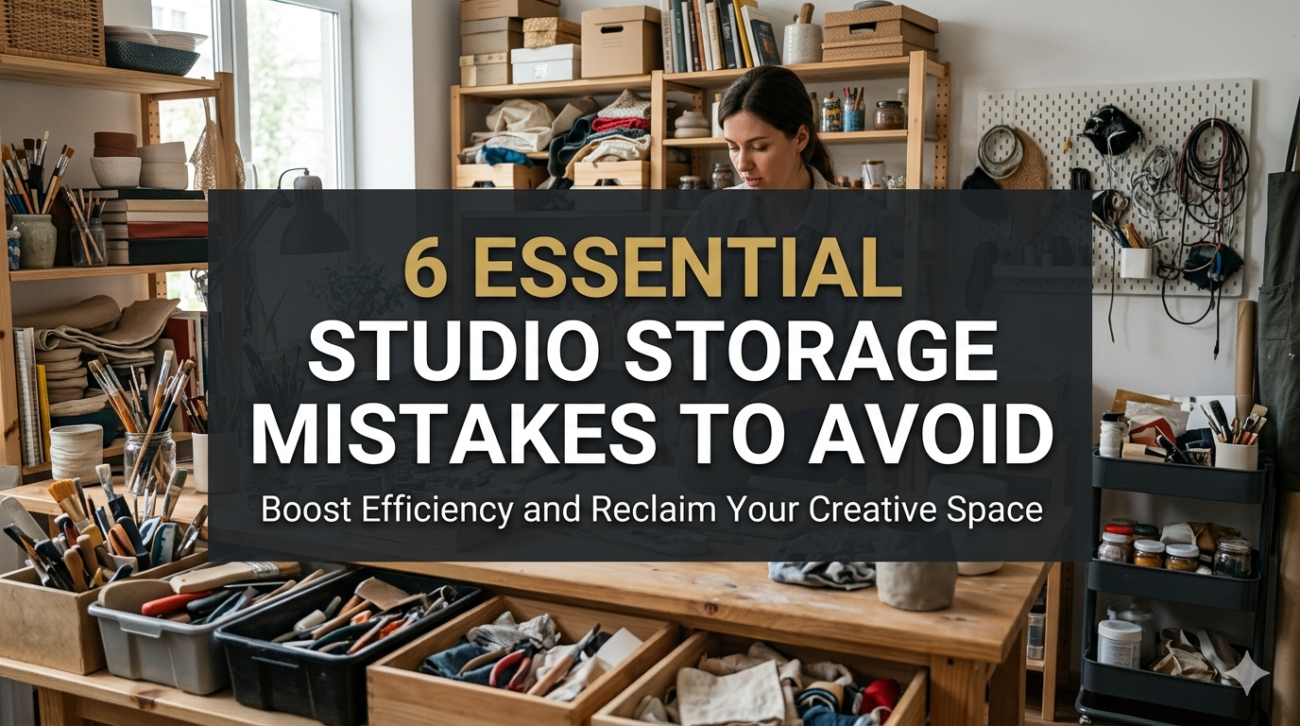
A studio apartment can feel like a design puzzle where every object has to justify its existence. Unlike larger homes, there’s no “extra room” for overflow storage, no spare closet to hide clutter, and no attic or basement to absorb excess belongings. Everything you own is always visible or immediately accessible.
That’s why storage in a studio is less about “where things go” and more about “how life flows.” When storage is done well, a small space feels calm, functional, and surprisingly spacious. When it’s done poorly, even a beautifully decorated studio can feel cramped, chaotic, and stressful.
The challenge is that most storage mistakes don’t look like mistakes at first. They build slowly over time—one extra box, one unnecessary shelf, one “temporary” pile that becomes permanent.
This article breaks down six essential studio storage mistakes that quietly destroy space efficiency, along with practical solutions, comparison tables, and real-world planning strategies to help you design a system that actually works long-term.
mistake 1: relying only on visible storage instead of hidden systems
One of the most common errors in studio living is depending too heavily on open or visible storage. It might look organized at first, but over time it creates visual noise and makes the space feel smaller than it actually is.
Visible storage includes:
- open shelves filled with items
- countertops used as catch-all spaces
- floor baskets without structure
- wall hooks overloaded with belongings
The problem is not visibility itself, but lack of control. When everything is visible, everything competes for attention.
why hidden storage matters
Hidden storage creates visual breathing room. The brain perceives empty surfaces as space, even if storage is still full behind closed doors.
table: visible vs hidden storage impact
| storage type | visual clutter | accessibility | space perception | long-term control |
|---|---|---|---|---|
| visible storage | high | high | low | medium |
| hidden storage | low | medium | high | high |
| hybrid system | balanced | high | high | high |
practical fix strategies
- use beds with drawers underneath instead of open bins
- replace open shelving with closed cabinets where possible
- store bulk items inside ottomans or benches
- use uniform boxes if open storage is unavoidable
a useful rule
If an item is not visually appealing or used daily, it should not be exposed.
mistake 2: underusing vertical space and overloading floors
In small studios, floor space is the most limited and most overused resource. Many people instinctively store things on the ground because it feels stable and convenient. However, this leads to overcrowding and reduced mobility.
Meanwhile, vertical space often remains completely underutilized.
what vertical underuse looks like:
- empty walls above eye level
- furniture that stops at waist height
- lack of overhead storage
- no wall-mounted systems
why this hurts storage efficiency
When everything stays on the floor, you compress functionality into a single plane. This creates congestion and limits movement paths.
chart: space efficiency based on storage direction
| storage direction | usable capacity | floor congestion | visual openness |
|---|---|---|---|
| floor only | low | high | low |
| mixed use | medium | medium | medium |
| vertical focused | high | low | high |
smart vertical storage solutions
- install floating shelves above desks or seating areas
- use tall, narrow cabinets instead of wide ones
- add wall-mounted hooks for everyday items
- stack storage upward rather than outward
design insight
Vertical organization doesn’t just save space—it changes perception. Eyes naturally move upward, making ceilings feel higher and rooms feel larger.
mistake 3: mixing storage zones without structure
A studio is a multi-purpose environment: bedroom, living room, kitchen, workspace. Without clear storage zones, items start migrating across areas, leading to confusion and clutter.
examples of poor zoning:
- work documents stored in kitchen drawers
- clothes mixed with living room storage
- cleaning supplies scattered across multiple areas
- electronics stored randomly in bedroom corners
why this becomes a problem
When storage zones overlap too much, retrieval becomes inefficient. You waste time searching and constantly reshuffling items.
table: zoned vs unzoned storage systems
| factor | unzoned storage | zoned storage |
|---|---|---|
| organization | inconsistent | structured |
| retrieval speed | slow | fast |
| clutter risk | high | low |
| mental clarity | low | high |
how to create storage zones in a studio
- bedroom zone: clothes, bedding, personal items
- kitchen zone: utensils, groceries, cooking tools
- work zone: documents, electronics, stationery
- living zone: entertainment, books, decor items
practical tip
Assign each category a “home area” and avoid cross-zone storage unless absolutely necessary.
mistake 4: ignoring multi-functional storage opportunities
One of the biggest missed opportunities in studio apartments is failing to use furniture that doubles as storage. Many people buy furniture for single purposes, which quickly leads to space inefficiency.
examples of single-use vs multi-use storage:
single-use:
- regular bed
- standard coffee table
- plain seating
- open shelving units
multi-use:
- storage bed
- lift-top coffee table
- ottoman with internal space
- modular shelving systems
table: storage efficiency comparison
| furniture type | storage capacity | space usage | versatility |
|---|---|---|---|
| single-use pieces | low | medium | low |
| multi-use pieces | high | low | high |
how multi-functional storage transforms studios
- reduces total number of furniture pieces
- increases hidden storage capacity
- improves layout flexibility
- minimizes clutter visibility
real-world example
A storage bed alone can replace:
- a wardrobe drawer section
- under-bed bins
- part of a dresser system
That’s multiple storage units consolidated into one footprint.
mistake 5: overcomplicating storage systems
Many people think better storage means more containers, more shelves, and more compartments. In reality, complexity is often the enemy of efficiency.
Overcomplicated storage systems include:
- too many labeled boxes
- multiple overlapping organizers
- excessive drawer dividers
- unnecessary storage furniture pieces
why complexity fails in small spaces
The more steps required to store something, the less likely it is to be stored properly. This leads to “temporary placement” becoming permanent clutter.
chart: storage complexity vs usage consistency
| complexity level | ease of use | maintenance effort | clutter risk |
|---|---|---|---|
| simple | high | low | low |
| moderate | medium | medium | medium |
| complex | low | high | high |
simplifying your storage system
- reduce categories instead of increasing containers
- use larger bins instead of many small ones
- standardize storage types across the apartment
- avoid unnecessary segmentation
design principle
A good storage system is one you can maintain even when you are tired.
mistake 6: not planning for future storage needs
One of the most overlooked issues in studio living is failing to think ahead. Storage needs are not static—they change over time as your lifestyle evolves.
common future storage issues:
- accumulation of seasonal items
- increased electronics or work equipment
- clothing expansion
- hobby-related storage growth
why this becomes a problem
Without planned flexibility, storage fills up quickly and forces reactive decisions like overcrowding or discarding useful items.
table: reactive vs planned storage approach
| factor | reactive storage | planned storage |
|---|---|---|
| adaptability | low | high |
| long-term comfort | low | high |
| clutter control | poor | strong |
| efficiency | inconsistent | stable |
how to plan ahead effectively
- leave 10–20% storage capacity unused intentionally
- choose modular storage that can expand
- prioritize adjustable shelving systems
- avoid filling all empty spaces immediately
forward-thinking strategy
Think of storage as a growing system, not a fixed setup. A little unused space today prevents major clutter tomorrow.
bringing everything together
Studio storage works best when it is invisible, structured, and flexible. The biggest mistakes are rarely about lack of space—they are about lack of planning, structure, and restraint.
summary table of all mistakes
| mistake | core issue | practical fix |
|---|---|---|
| visible-only storage | visual clutter | use hidden storage systems |
| no vertical usage | wasted wall space | build upward storage |
| unzoned storage | confusion & inefficiency | define functional zones |
| no multi-use furniture | wasted footprint | choose dual-purpose items |
| overcomplicated systems | maintenance failure | simplify storage design |
| no future planning | rapid clutter growth | leave expandable space |
final insight
A well-organized studio is not about having more storage—it’s about designing storage that disappears into the environment. When storage is invisible, structured, and easy to maintain, even a small apartment can feel open, calm, and surprisingly spacious.
faqs
- what is the most common storage mistake in studio apartments?
The most common mistake is relying too much on visible storage, which creates clutter and makes the space feel smaller than it is. - how do i maximize storage in a very small studio?
Use vertical space, multi-functional furniture, and hidden storage systems like under-bed drawers and storage ottomans. - is open shelving good for small studios?
It can be useful, but only if kept minimal and organized. Too much open shelving leads to visual clutter. - how do i avoid clutter in hidden storage?
Even hidden storage should be organized. Use simple categories and avoid overfilling containers. - what type of furniture helps the most with studio storage?
Storage beds, ottomans, modular shelves, and lift-top tables provide the highest storage efficiency. - how much empty space should I leave in my storage system?
Keeping 10–20% empty space helps maintain flexibility and prevents long-term overcrowding.