

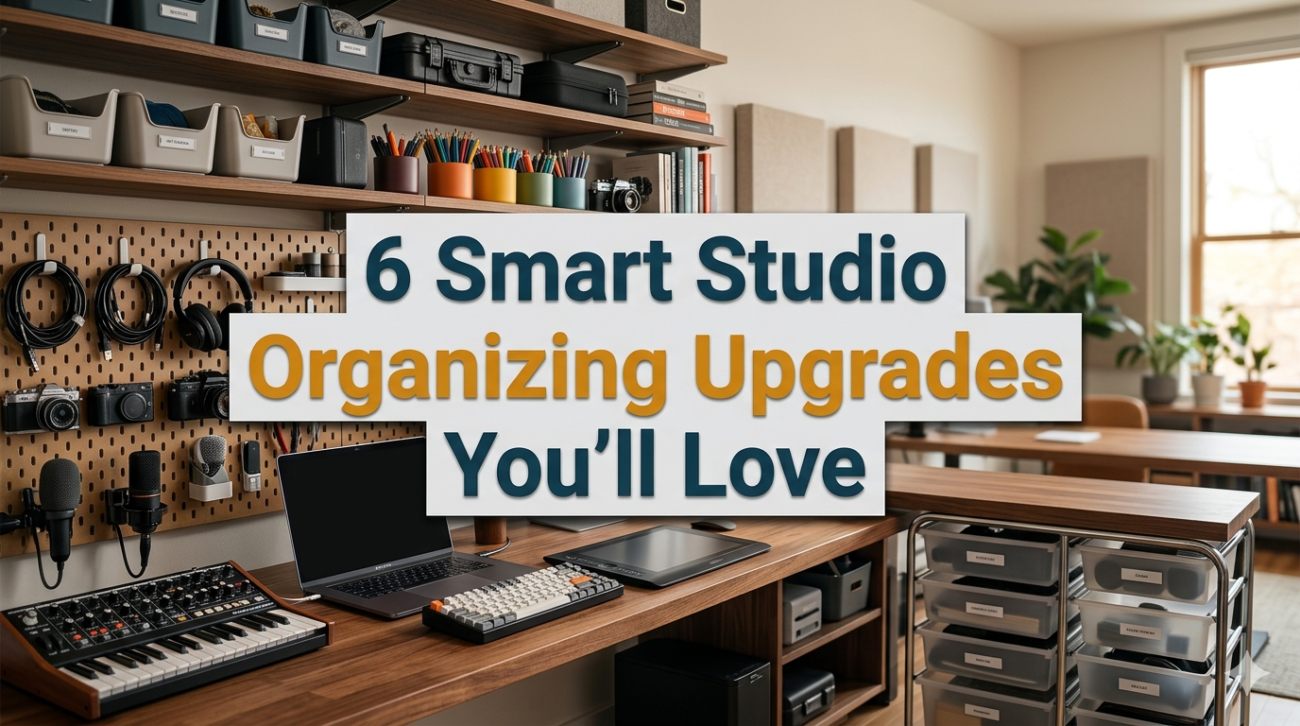
Introduction: why small studio upgrades change everything
Living in a studio often feels like a constant balancing act between comfort, function, and space. Every object competes for attention. Every surface seems to disappear under daily life. And somehow, even after cleaning, the space rarely feels truly “done.”
The difference between a studio that feels chaotic and one that feels calm is rarely about size. It’s about systems. Smart organizing upgrades are not about buying more storage bins or hiding clutter better. They are about rethinking how space is used at a structural level.
This article explores six practical studio organizing upgrades that can completely transform how your space functions. Each upgrade is designed to reduce friction in daily routines, maximize usable square footage, and create a sense of visual calm that feels intentional rather than improvised.
You’ll also find comparison tables, layout breakdowns, and real-world style planning charts so you can visualize how each upgrade works in practice.
Let’s begin with the first transformation.
- Vertical zoning systems that replace floor clutter
Most studio apartments suffer from one major issue: everything spreads outward instead of upward. Shoes line the floor. Books stack on tables. Storage creeps into walking paths.
Vertical zoning solves this by assigning height-based functions to your room instead of floor-based ones.
Instead of thinking “where can I put this?” you start thinking “how high should this live?”
Core idea of vertical zoning
You divide your wall space into three zones:
- low zone (floor to knee height): heavy storage, daily essentials
- mid zone (knee to eye level): frequently used items
- high zone (above eye level): seasonal or rarely used items
Vertical zoning breakdown table
Zone Height range Best uses Accessibility level Visual impact
Low zone 0–2.5 ft Shoes, bins, cleaning supplies Very high Low visual clutter if organized
Mid zone 2.5–5.5 ft Books, kitchen items, decor High Strong visual influence
High zone 5.5 ft+ Seasonal storage, luggage Low Minimal visual impact
Why this upgrade works
Most clutter problems are actually “misplacement problems.” Items end up in the wrong vertical zone, making the space feel messy even when it is technically organized.
When everything has a vertical home, floor space instantly opens up.
Simple implementation steps
- Install wall-mounted shelves up to ceiling height
- Use uniform bins for high storage (visual consistency matters)
- Keep floor items limited to no more than 3 functional categories
- Reserve mid-height space for daily-use essentials only
A small studio can feel 30–40% larger visually just by freeing the floor and shifting storage upward.
- Modular furniture that adapts instead of occupies
Traditional furniture is static. A sofa is always a sofa. A table is always a table. But studios require adaptability, not permanence.
Modular furniture allows one piece to serve multiple roles depending on time of day or activity.
Examples include:
- foldable dining tables
- storage ottomans
- sofa beds with hidden compartments
- nesting tables
- wall-mounted desks
Comparison: fixed vs modular furniture
Feature Fixed furniture Modular furniture
Space efficiency Low High
Flexibility None High
Cost efficiency over time Medium High
Suitability for studios Poor Excellent
Clutter control Indirect Direct
Why modular systems reduce clutter
Clutter often forms when furniture forces you to compensate. If you don’t have a desk, your dining table becomes one. If you don’t have seating storage, your floor becomes storage.
Modular systems eliminate “fallback surfaces.”
Practical upgrade strategy
Instead of replacing everything, start with one multifunctional anchor piece:
- bed with drawers OR lift storage
- convertible sofa bed
- extendable dining surface
Then build around it.
A useful rule: every furniture piece should perform at least two functions or justify why it exists.
- Invisible storage integration (hidden but accessible systems)
One of the biggest mistakes in studio organizing is over-reliance on visible storage. Open shelves look beautiful at first but quickly become visual noise if not carefully maintained.
Invisible storage means embedding storage into furniture and architecture rather than adding more containers.
Types of invisible storage
- under-bed drawers
- wall cavity shelves
- stair-step storage units (for loft setups)
- hollow benches
- behind-door organizers
Storage visibility impact chart
Storage type Visual clutter Ease of access Maintenance level Studio suitability
Open shelving High Very high High Medium
Closed cabinets Low Medium Low High
Hidden storage Very low Medium Very low Very high
Why invisible storage upgrades feel “luxurious”
Luxury spaces don’t necessarily have less stuff. They simply remove visual interruptions.
When storage disappears into the structure of the room, the brain reads the space as calm and spacious.
Implementation ideas
- Replace nightstands with storage cube stools
- Use bed risers with built-in drawers
- Install sliding panels under counters
- Add mirror cabinets in bathroom or entryway
The goal is not hiding things randomly, but designing invisibility into the room itself.
- The “one surface rule” for visual calm
Surfaces are the fastest way clutter accumulates in a studio. Tables, counters, and desks become temporary landing zones for everything.
The one surface rule is simple:
Each surface has only one active function at a time.
Surface usage breakdown
Surface Allowed function Clutter tolerance Reset frequency
Kitchen counter Cooking only Very low Daily
Desk Work only Low End of day
Coffee table Relaxation only Medium Every 2–3 days
Nightstand Sleep essentials only Very low Weekly reset
Why this works psychologically
When a surface has multiple “permissions,” it becomes a dumping zone. The brain doesn’t categorize items properly.
By assigning a single purpose per surface, decision fatigue disappears.
Daily reset system
Instead of deep cleaning, you perform a 5–10 minute surface reset:
- clear all non-essential items
- return objects to vertical or hidden storage
- restore original function of the surface
Over time, this prevents clutter buildup entirely.
- Micro-storage stations instead of large storage zones
Most people think storage should be centralized. One closet. One cabinet. One storage area.
In studios, this creates a problem: distance discourages usage.
Micro-storage stations solve this by distributing small storage points throughout the room.
Examples of micro-stations:
- entryway tray for keys, wallet, headphones
- bedside mini basket for charging cables
- bathroom wall pouch for daily toiletries
- desk drawer divider for small tech items
Comparison: centralized vs micro-storage
Feature Central storage Micro-storage stations
Convenience Low High
Clutter control Medium High
Behavioral compliance Low Very high
Space efficiency Medium High
Why micro-storage reduces mess
People don’t create clutter because they are messy. They create clutter because storage feels inconvenient.
Micro-stations remove that friction entirely.
Implementation rule
Every 5–8 feet in your studio should have a “drop and store” point for essential categories.
But each station must follow strict limits:
- only 3–5 item types
- no duplicate categories across stations
- easy visibility
- Lighting layers that double as organizing tools
Lighting is often treated as decoration, but in studios it functions as an organizational tool.
Different lighting layers influence how space is perceived and used.
Lighting layers breakdown
Layer Type Function Organizing effect
Ambient lighting General illumination Defines room zones
Task lighting Focused work areas Encourages surface discipline
Accent lighting Mood/visual separation Reduces visual clutter stress
Lighting impact on perceived space
Lighting style Spatial perception Clutter perception
Single overhead light Flat, compressed High clutter visibility
Layered lighting Open, dimensional Reduced clutter awareness
Directional lighting Structured Organized feel
Why lighting helps organizing
When lighting defines zones, objects naturally “belong” somewhere visually.
For example:
- warm light = relaxation zone
- bright white = work zone
- soft accent = storage/display zone
This reduces mental confusion about where things should go.
Simple upgrade plan
- Add LED strips under shelves
- Use warm lamps in relaxation areas
- Install task lights for desk and kitchen
- Avoid relying only on ceiling light
Final integration: how all 6 upgrades work together
Each upgrade alone improves organization. But combined, they create a system that maintains itself.
Integration overview table
Upgrade Primary benefit Secondary benefit
Vertical zoning Space expansion Visual clarity
Modular furniture Flexibility Reduced redundancy
Invisible storage Hidden order Luxury feel
One surface rule Daily discipline Stress reduction
Micro-storage stations Accessibility Habit formation
Lighting layers Spatial structure Emotional calm
When all six systems work together, the studio stops behaving like a small space and starts behaving like a designed environment.
FAQs
- What is the most important studio organizing upgrade to start with?
Vertical zoning is usually the most impactful starting point because it immediately frees floor space and changes how you perceive the room.
- Can these upgrades work in very small studios under 300 sq ft?
Yes. In fact, smaller studios benefit more because they rely heavily on vertical and modular systems to compensate for limited floor area.
- Do I need to buy new furniture to apply these ideas?
Not necessarily. Many upgrades can be implemented using rearrangement, wall storage, lighting changes, and better categorization systems.
- How long does it take to see results from these upgrades?
Some changes, like surface rules and lighting adjustments, show immediate results. Full system integration usually takes 1–2 weeks of consistent use.
- What if I share my studio with someone else?
These systems actually work better in shared spaces because they reduce overlap confusion and clearly define zones and responsibilities.
- Which upgrade gives the most “luxury feel” without high cost?
Invisible storage integration combined with layered lighting creates the strongest luxury perception at relatively low cost.