
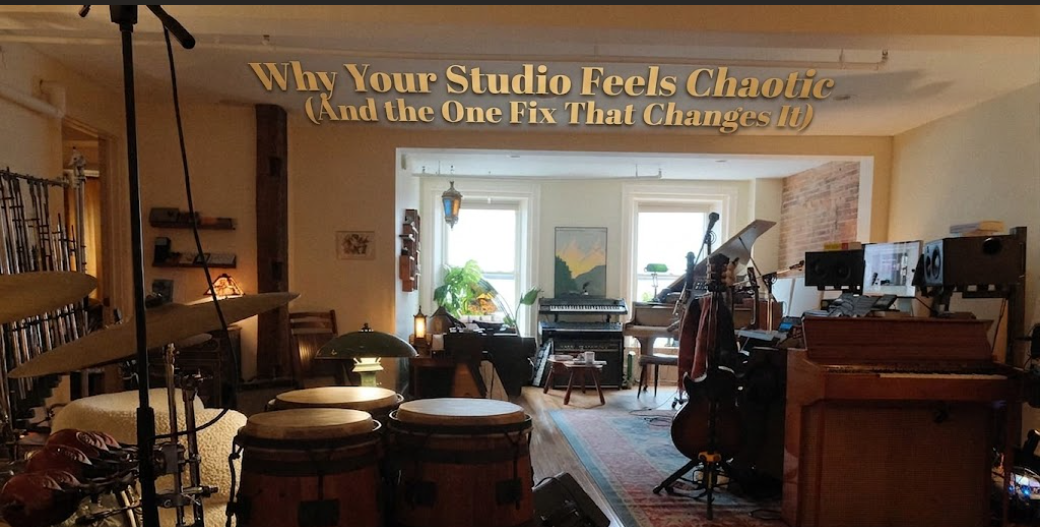
The studio doesn’t lie. Walk in after a long day and you know immediately whether the space is working for you or against you. Not because it’s messy, necessarily. But because nothing has a clear home, and so everything quietly competes for attention all at once.
That specific kind of overwhelm, the visual noise of a room that hasn’t been organized around how you actually live, is the most common problem I walk into with studio clients. They’ve bought the furniture. They’ve cleaned the place. They’ve tried rearranging twice. And yet it still feels like a waiting room crossed with a storage unit. They think the problem is the stuff. It almost never is.
The real problem is the absence of zones.
1. What “Chaotic” Actually Means in a Small Space
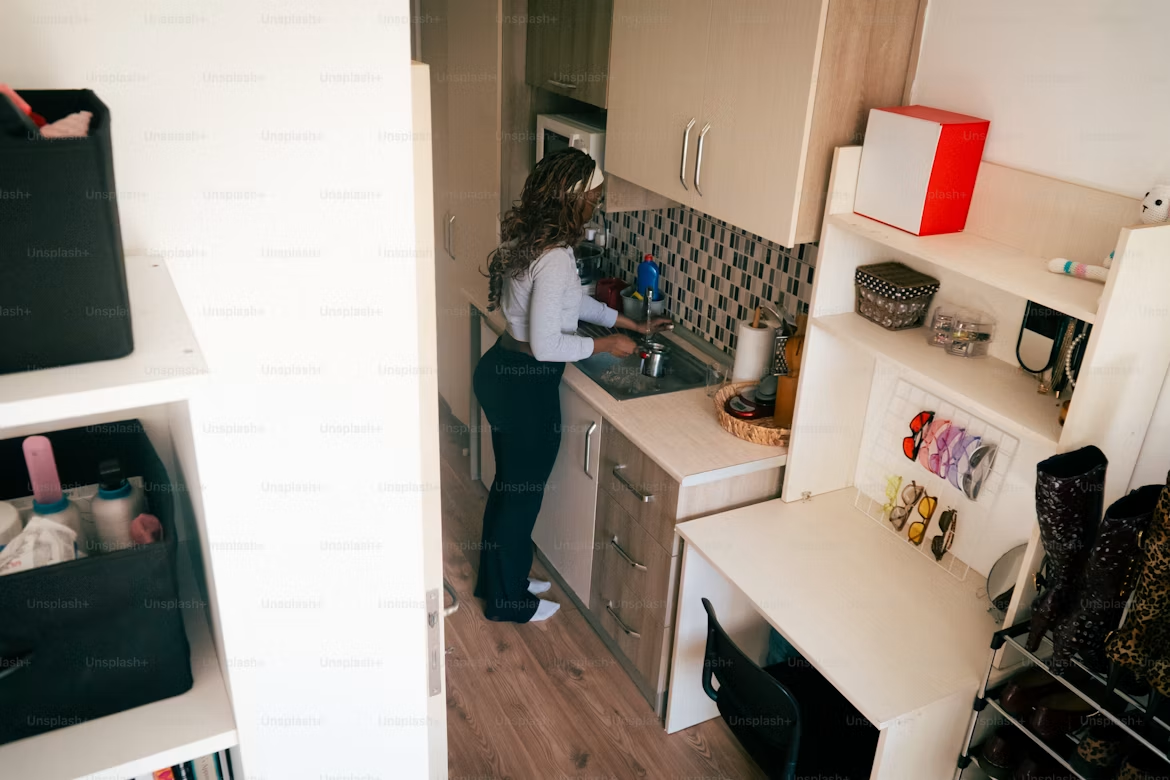
When a studio feels chaotic, people immediately assume they own too much. So they declutter. They donate the extra chair. They clear off the kitchen counter. And for about four days, it feels better, then the familiar tightness creeps back.
That’s because chaos in a studio isn’t usually a volume problem. It’s a clarity problem.
Your brain needs to understand, at a glance, what each part of the room is for. When the dining table also holds your laptop, your mail, and last week’s cardigan, it doesn’t register as any one thing. It registers as unresolved. And unresolved spaces feel chaotic even when they’re technically tidy.
What you’re missing isn’t storage. What you’re missing is definition.
In larger homes, walls and doorways do the work of separating functions. The kitchen is the kitchen because there’s a wall between it and the living room. In a studio, that separation has to come from design choices instead. Rug placement. Furniture angles. Lighting. The way you group objects. These are the tools that, used deliberately, turn a single open room into a place that reads like multiple rooms.
And once your brain can process the space that way, the chaos disappears. Not because anything changed physically, but because the room finally communicates a clear logic.
2. The One Fix: Intentional Zoning
Zoning is the single most transformative thing you can do in a studio. Not buying a new sofa. Not painting an accent wall, though that can help once the bones are right. Zoning.
The principle is simple: every activity in your life that happens in that apartment needs a dedicated spot. Sleeping, working, eating, relaxing, getting ready, they all deserve their own corner, even if those corners are only six feet wide. The moment each activity has a home, the ambient confusion evaporates.
Here’s how it typically breaks down in a well-functioning studio:
The sleep zone anchors one end of the room, usually against the far wall from the entry. A rug underneath the bed, a pendant or sconce on either side instead of floor lamps, a small bedside surface even if it’s just a wall-mounted shelf. These signals tell your brain: this is where rest happens.
The living zone is defined almost entirely by the rug. The sofa faces a focal point, whether that’s a TV, a fireplace wall, or even a large piece of art. The rug pulls it all together and keeps it from bleeding visually into the sleeping area.
The work zone is the one most people get wrong. They put their laptop on the dining table and call it a day. But when you work where you eat, neither activity feels fully intentional. Even a small desk tucked against the wall or angled into a corner, separated by a shelf unit or a change in lighting, does a tremendous amount of psychological work.
The dining zone, if you have one, needs to feel separate from the kitchen prep area. A pendant light directly overhead is the fastest way to anchor a dining table and give it its own identity in an open-plan space.
If you’re not sure where to start pulling these zones apart, the team at Studio Apartment Setup has written extensively on creating that kind of separation without walls, which is exactly the challenge every studio owner faces.
3. Where People Usually Get This Wrong

The most common mistake I see: anchoring everything to the walls and leaving the center of the room empty.
It feels intuitive. Walls equal storage, equals efficiency. But floating furniture away from the wall, even just 18 to 24 inches, creates depth and gives each zone its own breathing room. A sofa with its back subtly turned toward the sleeping area does more to define two zones than almost any divider you could buy.
The second mistake is treating light as uniform. One overhead fixture for the whole studio means every corner reads as the same space. Layered lighting, a warm table lamp in the reading nook, a task light at the desk, under-cabinet lighting in the kitchen, is what makes different zones feel genuinely distinct after sundown. This is something I talk about a lot with clients and something Studio Apartment Setup addresses well for people starting from scratch.
And the third mistake, this one is slightly harder to see but very real: matching too much.
When every piece of furniture is from the same collection, the room reads as flat. Monolithic. A mix of textures and materials, a wood side table next to an upholstered bench, a glass pendant above a matte-finish dining table, creates layers that help each zone feel distinct. Cohesion doesn’t come from identical pieces. It comes from a unified palette applied across variety.
4. The Zoning Tools That Actually Work (Honest Breakdown)
Not every zoning solution works the same way, and some popular ones have real limitations. Here’s a straightforward look at the main options:
| Zoning Tool | What It Does Well | Honest Limitation |
|---|---|---|
| Area rugs | Anchors a zone immediately, low commitment | Needs to be large enough; too small and it reads as decoration, not structure |
| Bookshelves as dividers | Adds storage and visual separation | Can block light if too tall; open-back shelves work better for airflow and brightness |
| Curtain panels | Flexible, easy to change, can create a sleep “room” | Can look cheap if the fabric is thin; needs proper track or ceiling mount |
| Lighting zones | Powerful psychological separator, no physical footprint | Requires some planning and potentially an electrician for new fixtures |
| Furniture angles | Subtle but very effective; creates conversation groupings | Takes practice to eye; easier to understand once you’ve seen it done |
| Room screens/dividers | Good for renters, no drilling needed | Can feel dated or visually busy; material and finish matter enormously |
Rugs and lighting are the starting point for most studios. They’re the lowest-barrier, highest-impact changes you can make. Everything else layers on top.
If storage is your concurrent concern, which it usually is once you start defining zones and realize certain areas need to absorb more than they currently do, this guide on vertical storage strategies is worth working through alongside the zoning process.
5. A Note on Furniture Scale (Because It Ties Everything Together)
Zoning only works if the furniture within each zone is proportional. A king-sized bed in a 450-square-foot studio isn’t a luxury. It’s a room eater. It collapses every other zone around it.
The sleep zone typically needs about a third of the floor plan in a studio. Not more. A queen bed on a well-sized rug, with nightstand surfaces that don’t extend further than the bed itself, reads as intentional. It leaves room for the other zones to breathe.
Same logic applies to sofas. A deep three-seater sectional in an open-plan studio almost never works, even when it technically fits according to the tape measure. Visually, it dominates. A compact two-seater or a settee-style sofa with clean lines does far more work in a small space because it doesn’t consume the middle zone the way oversized upholstered pieces do.
This is the part where I’m sometimes the bearer of uncomfortable news to a client who’s already in love with a piece. The furniture has to serve the zones, not the other way around. A beautiful sofa that takes over two zones isn’t beautiful in this context. It’s a problem with cushions.
For anyone weighing their options on sleep furniture specifically, the comparison of Murphy beds versus sofa beds at Studio Apartment Setup is a useful read, especially if reclaiming daytime floor space is part of your zoning plan.
Frequently Asked Questions
My studio is only about 380 square feet. Can zoning really work in a space that small? Yes, and it matters more in smaller spaces, not less. In a 380-square-foot studio, even slight changes in rug placement, lighting, and furniture orientation can completely transform how the room reads. The zones will be smaller, obviously, but the psychological clarity that comes from defining them is the same regardless of square footage.
I’m renting and can’t make permanent changes. What zoning options work without drilling or painting? Area rugs are your best friend. Beyond that, freestanding bookshelves, curtain panels hung on tension rods, floor lamps to create lighting zones, and furniture positioning are all renter-friendly tools that require zero commitment to the walls or ceiling. The effect can be just as strong as permanent changes when done thoughtfully.
How many zones should a studio actually have? For most people living alone in a studio, four is the practical number: sleep, living/lounge, work, and dining. If you don’t have a dedicated dining setup, three works. Some people carve out a fifth zone for a dressing area near the closet. More than five zones in a studio and you start fragmenting the space rather than organizing it.
I’ve tried rugs and it still feels like one big room. What am I missing? Rug size is usually the culprit. Most people choose rugs that are too small, which makes them look like a detail rather than an anchor. In a living zone, the front legs of all furniture should sit on the rug. In a sleep zone, the rug should extend at least two feet beyond both sides of the bed. If the rug fits neatly inside the furniture footprint, it’s too small.
Does the layout change if I work from home full-time? It should. A dedicated work zone becomes non-negotiable when you’re spending eight or more hours a day in the apartment. That means a real desk, a real chair, and ideally a visual cue that signals the end of the workday when you leave the area, whether that’s a curtain you can draw across it, a lamp you turn off, or simply a defined boundary that the rest of the layout respects. The line between work and rest needs to be spatial, not just mental, especially in a studio.