
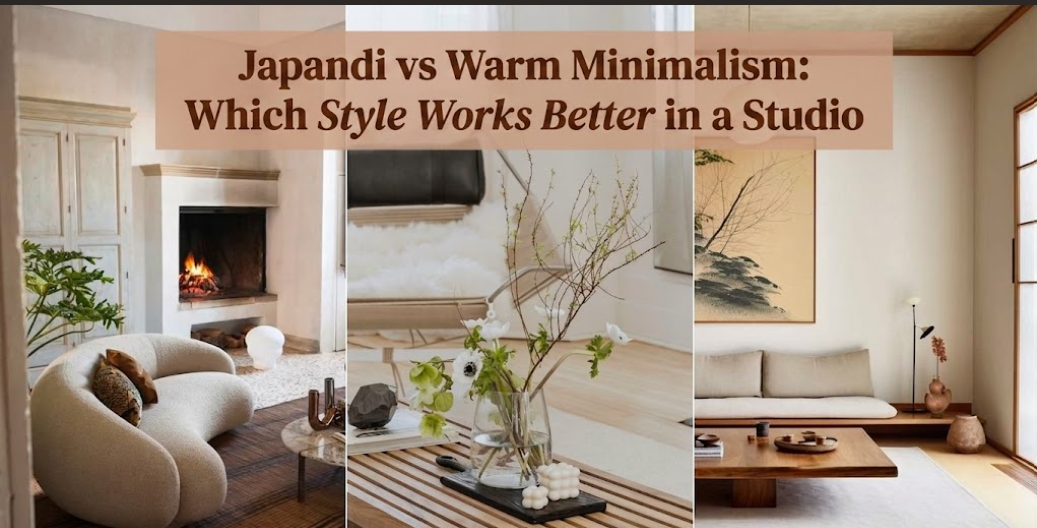
Most people use these two terms as synonyms. That is the first problem. Scroll through any design account right now and you will see Japandi and warm minimalism pinned, tagged, and captioned interchangeably, as though they are just two slightly different filters on the same neutral mood board. I have had clients walk into consultations with forty-plus saved images that mixed both aesthetics freely, convinced they had narrowed down a direction. They had not.
They are different philosophies with different outcomes. And in a studio apartment, where every design decision has twice the consequence of a full home, picking the wrong one shows up in how the room actually feels to live in, day after day, not just how it photographs on a Sunday morning.
1. What Japandi Actually Is (And It’s Not Just Beige Furniture With Good Lighting)
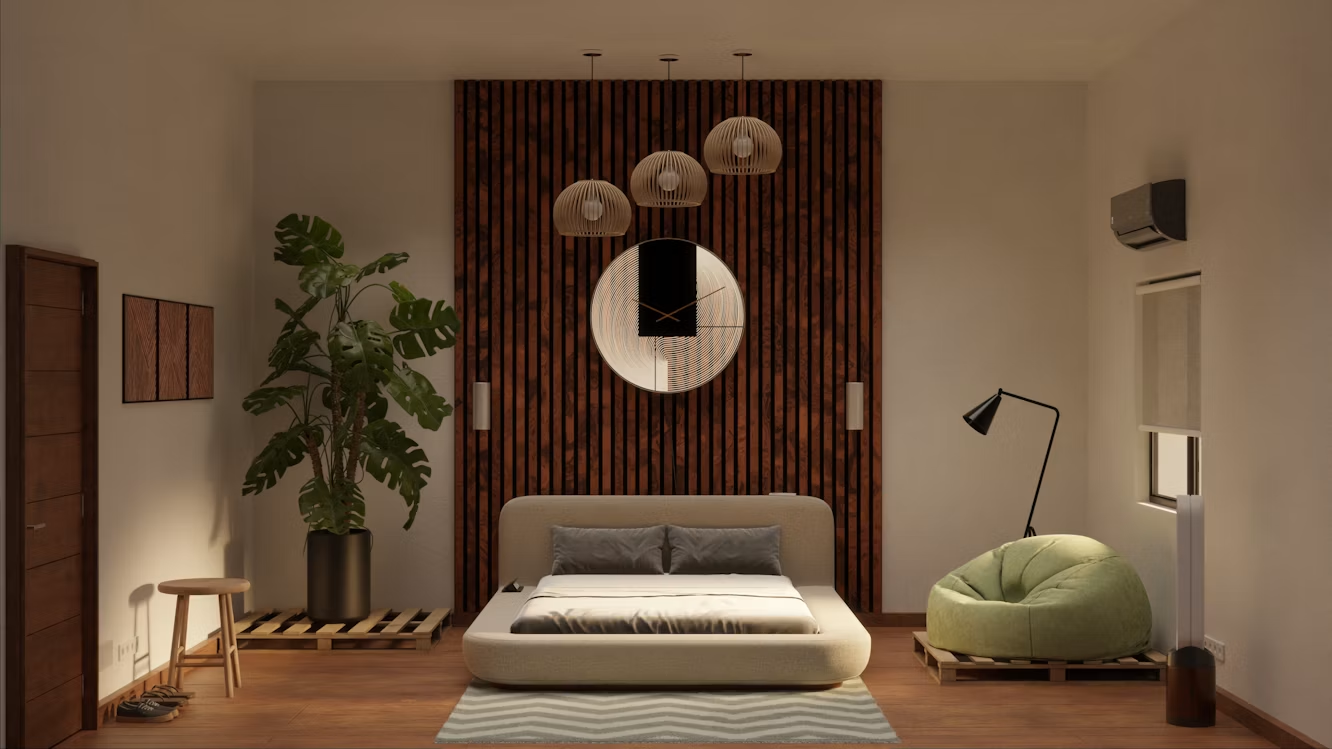
Japandi is a hybrid aesthetic, yes, but calling it a blend of “Japanese and Scandinavian design” without going deeper misses the point entirely. The philosophy underneath is what drives the visual result.
On the Japanese side, the concept of wabi-sabi sits at the center. It is an acceptance of imperfection, of materials that show their age, of objects that are handmade rather than factory-finished. A ceramic bowl with an uneven rim. A linen pillow that doesn’t quite match its pair. Nothing is trying to look brand new or showroom-ready. On the Scandinavian side, you have hygge, which is less about objects and more about a quality of comfort and presence. Japandi lands where those two ideas converge: intentional simplicity with emotional warmth layered into material choices rather than decorative accessories.
In real rooms, this translates to a very specific kind of restraint. Low furniture with clean lines and uncomplicated geometry. A tightly edited object count. Natural materials that show their texture rather than hiding it, unfinished oak, woven grass, matte ceramic, raw linen. And a palette that runs from warm grey to warm charcoal, with occasional moments of black and muted earthy green.
If you want to understand why this approach functions well in compact spaces rather than just photographs well, how Japan built an entire culture around living well in tiny spaces is worth reading carefully. The design philosophy was shaped by spatial constraint from the beginning, it wasn’t adapted to it later as a marketing exercise.
One thing people consistently get wrong: Japandi is not minimalism for its own sake. It’s minimalism because each object that remains has earned its place. That distinction is visible from across the room. A properly executed Japandi space has personality. An empty room with some oak shelves and a dried pampas grass arrangement does not.
2. What Warm Minimalism Actually Looks Like in Practice
Warm minimalism doesn’t carry the same historical or cultural depth as Japandi. It’s more of a practical design evolution, a response to a decade of cold, sterile interiors: all polished concrete, stark white walls, chrome hardware, and absolutely nothing sitting on any surface. That approach photographed beautifully and was genuinely unpleasant to live in. Warm minimalism corrected for that.
The structural principle stays the same. Fewer things. Intentional layouts. Visual clarity. But the execution is warmer at every layer. Walls shift toward sand and terracotta. Fabrics get thicker and more tactile. Lighting runs amber. And there is always, somewhere in the room, something soft. A chunky knit thrown over a reading chair, a jute rug, a piece of pottery that reads as handmade even if it was mass-produced.
Where Japandi is quiet and disciplined, warm minimalism is more generous with itself. The palette can stretch from deep ochre to muted sage to warm blush without breaking the concept. The furniture doesn’t need to sit low or follow any particular silhouette. And the rule on object count is looser, as long as coherence holds.
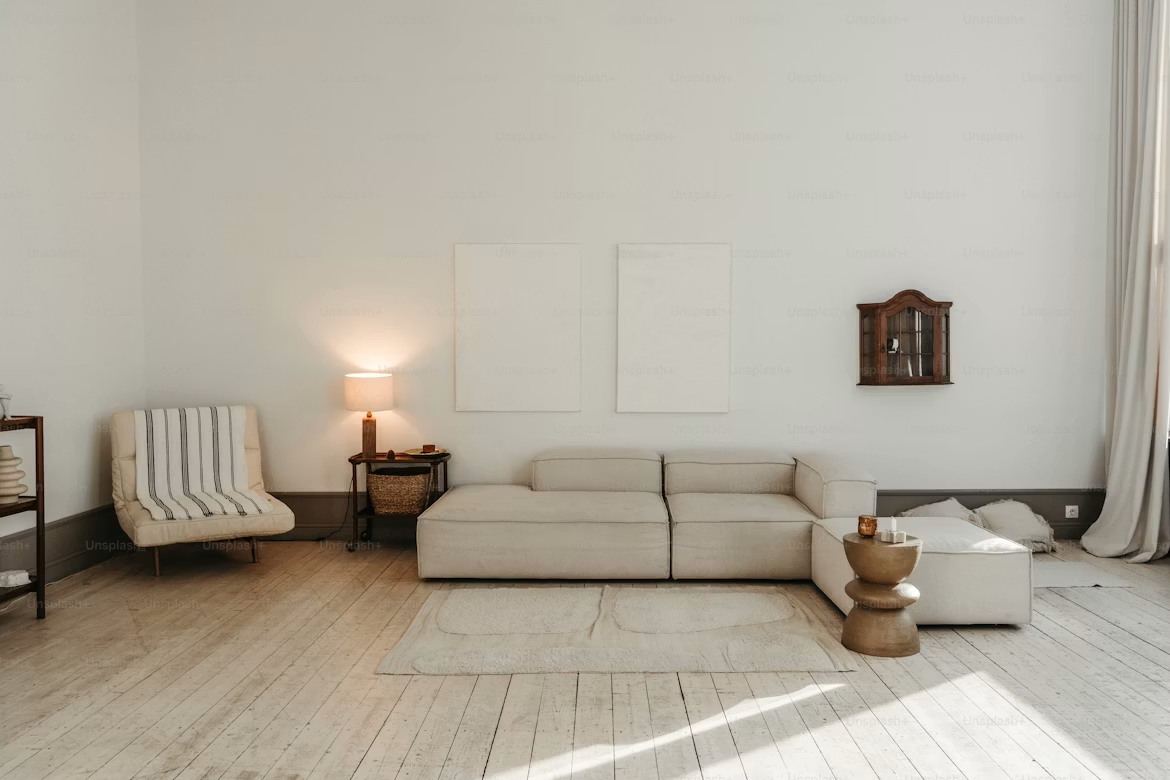
The failure mode, though, is different from Japandi’s. Without structural discipline somewhere in the equation, warm minimalism drifts. People add comfortable additions over a few months, a throw here, a new shelf, a plant in every corner, until the minimalism is completely gone. The warm is still there. The minimal is not. And you are back to a crowded studio that just happens to be brown.
For studios specifically, warm minimalism is much friendlier to accent moments. If you have been thinking about an accent wall that won’t shrink the room, this is the design language where that decision works without fighting the rest of the space. Japandi tends to resist strong accent gestures, and it’s harder to pull back from once you’ve introduced one.
3. How Each Style Actually Performs Inside a Studio
A studio is not just a small apartment. It’s a single room that has to function simultaneously as a bedroom, sitting area, kitchen, dining space, and sometimes a home office, all visible from the same vantage point. The design language you choose has to hold across all of those zones at once. Neither of these styles does that without trade-offs.
Here’s a direct comparison across the factors that matter most in a compact space:
| Factor | Japandi | Warm Minimalism |
|---|---|---|
| Clutter tolerance | Very low. Every item is visible at all times. | Moderate. Texture and layering absorb visual noise. |
| Light dependency | High. Needs natural light to feel warm. Turns cold under artificial light alone. | Lower. Warm tones and amber lighting can carry the room. |
| Color flexibility | Narrow. Muted, mostly neutral-to-dark palette. | Broad. Earthy tones, warm greens, blush, terracotta all work. |
| Budget flexibility | Lower. Requires specific, often investment-level pieces to read correctly. | Higher. Affordable pieces mix in without breaking the concept. |
| Zone definition | Excellent. Visual discipline helps define areas without walls. | Good, but requires more deliberate choices to keep zones distinct. |
| Personality expression | Subtle. Personality comes through material quality, not decor objects. | More visible. Objects, art, and color carry personal stories. |
| Risk if poorly executed | Feels cold, empty, like nobody lives there. | Feels chaotic, unstyled, like a clearance showroom. |
Japandi is unforgiving in ways that matter at this scale. One wrong piece, a rug with the wrong pile, a lamp shade in a synthetic material, and the whole room loses its coherence. When it lands, it is exceptional. The intentionality reads from the doorway. A small space feels like a considered place to live rather than a box that contains furniture. But it demands consistency that most people underestimate when they start.
The light question matters especially in studio contexts. A lot of studios do not get great natural light. Ground-floor units, north-facing windows, buildings where another structure blocks the sun by noon. Japandi in those conditions turns cold fast, and no amount of oak shelving compensates for flat overhead lighting. It needs real daylight to stay warm.
Warm minimalism is far more adaptive. The palette and material choices are engineered to produce warmth even in artificial light conditions. If your studio faces north or you’re working with two honest hours of sun per day, warm minimalism is doing functional work for you, not just aesthetic work.
There is a related problem that affects studios across the board regardless of design direction. Studio Apartment Setup has a piece worth reading on why studios end up feeling like hotel rooms, and the answer traces back almost entirely to design language, specifically the absence of one. Both Japandi and warm minimalism solve this when applied with intention. Both can recreate the hotel problem when applied without it.
4. Where People Go Wrong With Both
The most common mistake with Japandi is treating it as a color palette rather than a philosophy. People paint their walls warm grey, buy a low oak platform bed, add a single dried plant in a terracotta pot, and consider the job finished. But Japandi without material discipline is just a muted room. The handmade quality of objects matters. The restraint in item count matters. The rejection of matching sets and the preference for pieces that look like they were collected at different points in different places, that matters too. You cannot buy a Japandi room in a single weekend at one retailer.
With warm minimalism, the failure is slower but equally predictable. People start with the right instinct, fewer things, warmer tones, real attention to texture. And then, over four or five months, comfortable additions accumulate. The warm stays. The minimal disappears. Same crowded studio, now just earth-toned.
Both styles also fail when zone definition gets skipped. A studio without visual separation between sleeping, sitting, and working areas doesn’t feel like a home, it just feels like a room with too much going on. Creating zones without walls is a skill that applies regardless of aesthetic, and it is often the difference between a studio that reads as designed and one that reads as a collection of furniture in a box.
One more specific to Japandi: people over-invest in the visual layer and under-invest in storage. The visual restraint of Japandi only works when the things you are not displaying have somewhere organized to go. If the room looks minimal because there is no space for anything else, that is not Japandi. That is a studio storage problem wearing Japandi’s clothes.
5. The Honest Answer on Which One to Choose
If your studio gets genuine natural light, you have patience for building the space thoughtfully over several months rather than furnishing it in a single weekend, and you want the end result to feel deeply intentional rather than just warm and livable, Japandi will reward you. It is harder to execute in a small space. It’s more impressive when it lands.
If your light situation is imperfect, your budget means mixing affordable pieces with a few investment items, or you want to express your own personality through color and collected objects, warm minimalism is the smarter practical choice. Not because it’s lesser, but because it is built to work in more real-world conditions.
And the most livable studios I have seen, in my own practice and through the resources at Studio Apartment Setup, have been some version of the two working together. The structural discipline of Japandi as the foundation, the warmth and palette flexibility of warm minimalism filling the gaps. Purist approaches to either one are intellectually satisfying and occasionally beautiful, but they can also be brittle. A little cross-pollination makes for rooms that hold up across time and across days when everything is messy and your studio just needs to function.
Pick the one that matches your actual conditions, not just your mood board.
FAQs
Can you mix Japandi and warm minimalism in the same studio? Yes, and in practice this tends to work better than committing fully to one. The key is deciding which style leads. If Japandi is the base, warm minimalism contributes texture and a wider color range without adding visual clutter. If warm minimalism leads, Japandi’s editing discipline stops the space from accumulating too much over time. The two philosophies are compatible at their core, both value restraint, material quality, and living with less.
Does Japandi work in a studio with little or no natural light? With difficulty. Japandi in a north-facing or low-light studio requires more deliberate material choices to avoid reading as cold. Raw linen, aged wood, woven textures, and warmer-tinted LED lighting around 2700K or lower can compensate somewhat. But it’s a harder version of the style to sustain without daylight doing part of the work. If your studio’s light situation is genuinely poor, warm minimalism is the more forgiving choice from the start.
Is warm minimalism just a trend name for beige interiors? No, though it can absolutely end up there if there’s no real discipline behind the choices. Warm minimalism has structural principles: a limited palette applied with intentional variation, a controlled object count, and a consistent material language across the room. Beige by default is a shopping pattern. Warm minimalism as a design direction is a decision made deliberately at every step of the process.
Which style suits renting better when you can’t paint the walls? Warm minimalism by a clear margin. It depends far more on furnishings, textiles, and lighting than it does on wall color. A blank white-walled rental can read as warm minimalism purely through what you bring in. Japandi against stark white walls is a harder visual argument to make and requires more precise piece selection to hold together.
Why does my studio still feel like a hotel room even after I’ve decorated it? Almost always because everything in the space was purchased at once from the same source, and none of it carries any personal history or specificity. Hotels feel like hotels because nothing belongs to anyone. Both Japandi and warm minimalism can fall into exactly that trap when every piece came from the same fast furniture retailer on the same Saturday. Introduce one or two things with a real story: a piece of art you chose deliberately, a ceramic from an actual maker, books you have genuinely read. The room shifts immediately. That specificity is what separates a designed space from a furnished one.