
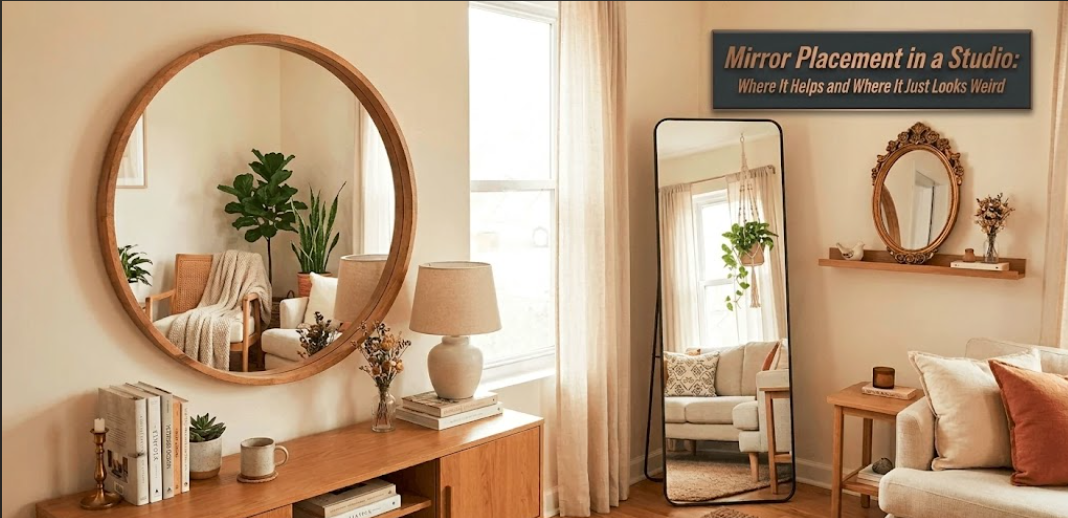
Every client who moves into a studio gets the same advice from someone. Declutter. Hang curtains from floor to ceiling. And add mirrors, because mirrors make small spaces feel bigger.
Two of those are usually right. The third is only partly true, and when it’s wrong, it’s wrong in a visible, slightly embarrassing way.
The mirror advice has a real foundation. Reflective surfaces bounce light and create the illusion of depth. That design principle is solid. But it only holds up when the mirror is reflecting something worth seeing. When it isn’t, you end up with a studio that feels busier, more disjointed, or in certain cases genuinely unsettling to be in without quite understanding why.
I’ve spent years working with small spaces in Toronto, studios included, and mirrors come up in almost every project. Some placements have transformed a room. Others I’ve quietly suggested we move. This is the more honest version of that conversation.
1. What the “More Mirror, More Space” Belief Actually Gets Wrong
The assumption that mirrors automatically expand a space skips over the part that determines whether any of it works: what the mirror is looking at.
A mirror doesn’t just double light. It doubles whatever is directly in front of it. In a studio, that could be a beautifully lit corner and a clean stretch of painted wall. Or it could be the back of your sofa, your unmade bed, the kitchen counter with two days of dishes on it, and three boxes you haven’t dealt with since moving day. Reflecting those things doesn’t make the space feel larger. It makes everything feel present twice.
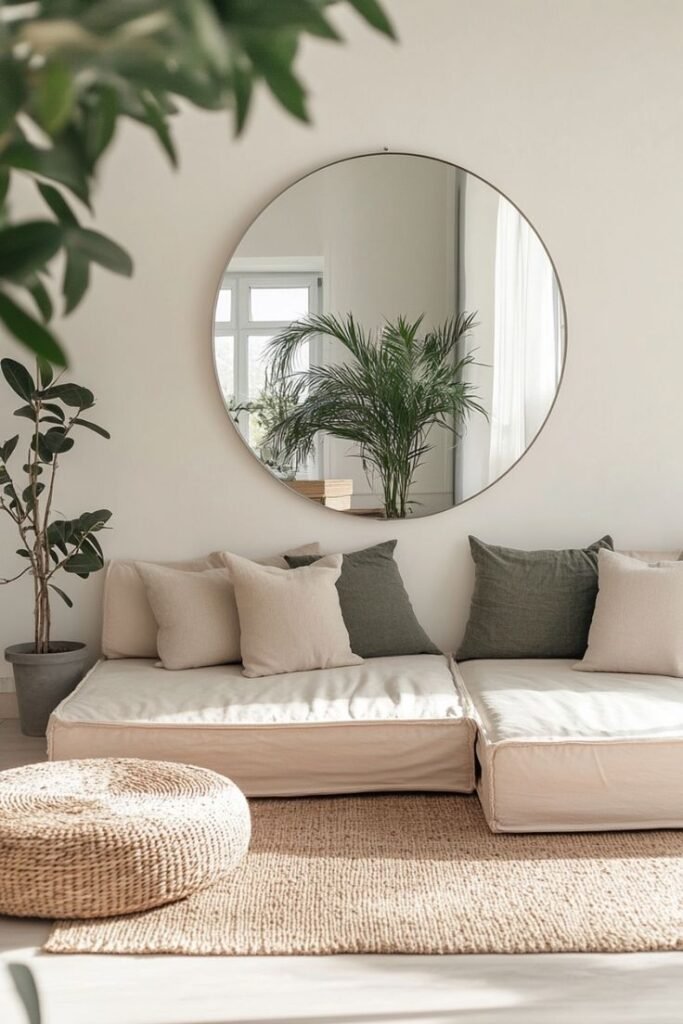
The studios I’ve worked on where mirrors genuinely changed the feel of the room all had one thing in common: the reflection was considered before the placement was decided. Nobody was looking for an available wall. The question being asked was, what’s worth doubling in here?
Before committing to any position, go stand in the spot you’re considering and take a photo behind you on your phone. That’s your reflection. If the answer is an area you haven’t thought much about, the placement probably isn’t ready yet.
2. Why the Bed-Facing Position Has Real Problems (Not Just Feng Shui Ones)
I know the eye rolls that come with mentioning mirrors and beds in the same sentence. Fair enough. But the practical case against placing a large mirror directly opposite the sleeping area has nothing to do with energy flow. It has to do with morning light and what the room communicates visually.
A mirror facing the bed does two things with some consistency. First, if there’s a window anywhere near that wall, it will catch and amplify morning light in a way that pushes wake-up earlier than intended. Second, people startle themselves on 2am bathroom trips. This sounds trivial. It happens more often than you’d expect, and it’s oddly jarring every single time.
The deeper issue is visual. A large mirror reflecting the sleeping zone doubles the visual weight of the bed. In a studio where you’re working to create at least a psychological distance between where you sleep and where you live, seeing the bed reflected on a second surface anchors the entire space to that zone. The room starts to read like a hotel room rather than a home, that oddly transient feeling that the piece on the real reason your studio feels like a hotel room addresses directly. It’s worth reading if the space feels temporary even after you’ve settled in.
There are exceptions. Small decorative mirrors hung high and angled can work near a sleeping area as art rather than functional reflection. But a large statement mirror directly opposite the bed? That placement works against you more often than not.
3. Where Mirrors Genuinely Do Their Best Work
The placements I’ve seen perform consistently well share two qualities. The mirror is adjacent to a light source rather than opposite it. And it’s reflecting a zone that looks like a deliberate design choice, not just what happened to be there.
On the wall perpendicular to the main window is the most reliable position for most studios. Light from the window hits the mirror at an angle and spreads sideways into the room, distributing brightness rather than bouncing it straight back at the glass. This is the placement that makes a room feel genuinely more open. And it solves the glare problem that comes from mounting a mirror to face a window directly.
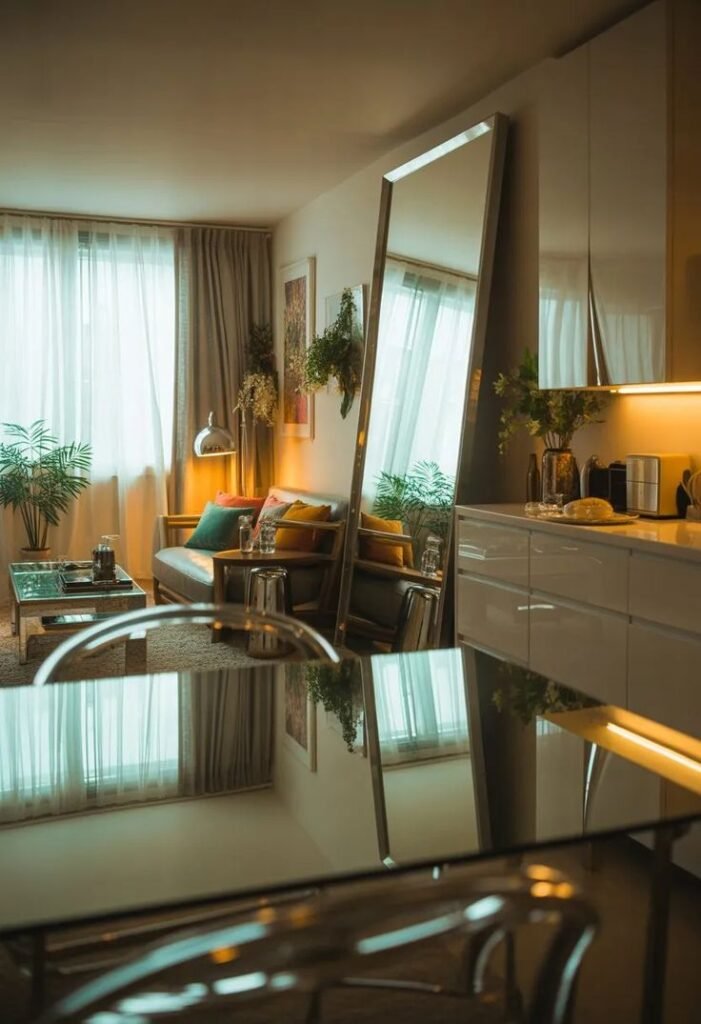
Behind or beside a lamp on a side wall is another one that works better than most people realize. The mirror amplifies the warmth of the nearby light source, creating depth and layering instead of just repetition. Studio Apartment Setup’s approach to visual arrangement in small spaces keeps returning to this combination, because it’s one of those simple pairings that reads as intentional design rather than furniture placement by default.
A mirror near the entry on a short side wall is worth serious consideration in narrower studios. Practical for a last look before leaving, but beyond that, it bounces light toward the back of the space in a way that works against the tunnel effect common in long layouts. And it reflects nothing from the living or sleeping zones, which avoids the doubling problem entirely.
4. Size Is Not What Most People Think It Is
Here’s where the small-space logic that gets passed around actually works against people. Bigger mirror, more expanded space. It sounds right. It’s wrong often enough that I’d treat it as a rule worth questioning rather than following.
An oversized mirror reflecting the wrong thing is worse than a smaller mirror in the right position. Every time. I’ve seen seven-foot leaning mirrors in 380-square-foot studios that made the space feel like a department store fitting room. Not larger. Just formally commercial and a bit strange, the same visual chaos that the piece on why your studio feels chaotic and the one fix that changes it traces back to a specific failure in spatial logic.
Scale matters against the wall the mirror occupies. A mirror that fits its context reads as considered. One that simply fills available wall space announces itself for all the wrong reasons.
Here’s a placement comparison worth referencing:
| Mirror Position | What It Reflects | Works? | Notes |
|---|---|---|---|
| Side wall, perpendicular to window | Light spread sideways | Yes | Most reliable general placement |
| Directly opposite window | Window itself, possible glare | Situational | Only if window view is clean |
| Directly facing the bed | Sleeping zone doubled | No | Avoid in most studio setups |
| Near entry on a short side wall | Open entry space | Yes | Practical and visually opens the room |
| Facing kitchen counter | Cooking clutter | No | Doubles visual activity |
| Behind or beside a warm lamp | Amplified warm light | Yes | Creates depth and warmth |
| High on wall behind sofa | Living zone from above | Situational | Works if sofa line is clean |
That table has prevented more than a few installations I would have had to tactfully undo later.
5. The One Question That Clarifies Everything
Before mounting anything, ask specifically: what is this mirror actually for?
Not “will this make the space feel bigger,” because that framing is too vague to guide a real decision. But specifically: is it here to reflect light, to add depth to a short wall, for a functional check near the door, or to give visual weight to a surface that needs it?
Different purposes lead to different placements and different sizes. A mirror meant to distribute light needs to sit near the window. A mirror meant to visually lengthen a short wall should reflect the longest stretch of open floor it can see. A functional near-entry mirror can be modest, framed simply, and hung at face height without any design ambition beyond being useful.
The studios that feel considered, the ones with visual logic that holds up when you walk in, tend to have mirrors that are doing something specific. The ones that feel off usually have mirrors that were placed where the wall had room for them. That’s the whole distinction.
For the broader question of how visual structure works in a compact space, the piece on studio apartment accent walls that don’t shrink the room covers wall treatment from a related angle. And if you want the philosophical underpinning of why intentional small-space design produces such different results from reactive decoration, how Japan built an entire culture around living well in tiny spaces is the most useful long read I can point to on the subject.
Mirror placement is one piece of that larger picture. It works best when the rest of the room’s logic is already in place.
FAQs
Can a mirror help separate zones in a studio? It can reinforce zone separation, but it won’t create zones that don’t already exist through furniture and lighting. A mirror placed at the visual boundary of the living area, reflecting that zone back on itself, can make the area feel more enclosed and complete. But if the zones aren’t established first, a mirror placed in an undefined space will just reflect an undefined space back at you.
Is there a standard height for hanging a mirror? For a decorative or light-reflecting wall mirror, centering it at eye level, roughly 57 to 60 inches from the floor to the center of the glass, is a reasonable starting point. For a full-length functional mirror, position the bottom edge about 12 inches from the floor so you can see your full reflection. Those rules are less important than what the mirror is reflecting, though. Placement relative to light and content beats height rules.
My studio has almost no natural light. Will a large mirror fix it? Only if there’s a light source worth amplifying. A large mirror in a genuinely dim room without good light reflects the dim room back at you, and you end up with more of the problem rather than less of it. In low-natural-light studios, pair the mirror with a warm lamp placed nearby so the mirror is amplifying something useful. That combination does far more for the feel of the space than mirror size or position alone.
There’s glare from my existing mirror in the evenings. What can I do before relocating it? Try adjusting the angle first. Even a few degrees of tilt, leaning a freestanding mirror slightly forward, or using a tilt bracket behind a wall-mounted one, is often enough to redirect glare up toward the ceiling rather than back at eye level. If the glare persists after that, the perpendicular-to-window position is almost certainly the better home for it, and most people find they prefer the result anyway.
Does the frame style matter in a small space, or is that just preference? Frame style affects how a mirror reads in context more than people usually expect. A heavy ornate frame in a compact studio can make even a well-placed mirror feel disproportionate to the room, even when the glass size is right. Thinner metal frames, frameless options, or simple wood frames tend to disappear more naturally into a studio wall, letting the mirror function without becoming the loudest thing in the room. Studio Apartment Setup has touched on frame and finish considerations across several visual setup topics, and the consistent thread is that quieter choices give mirrors room to do their actual job.
The advice to use mirrors in small spaces is not wrong. It just omits the part that decides whether the mirror works or makes things worse. Start with what the mirror is going to reflect, and the placement question largely answers itself.