
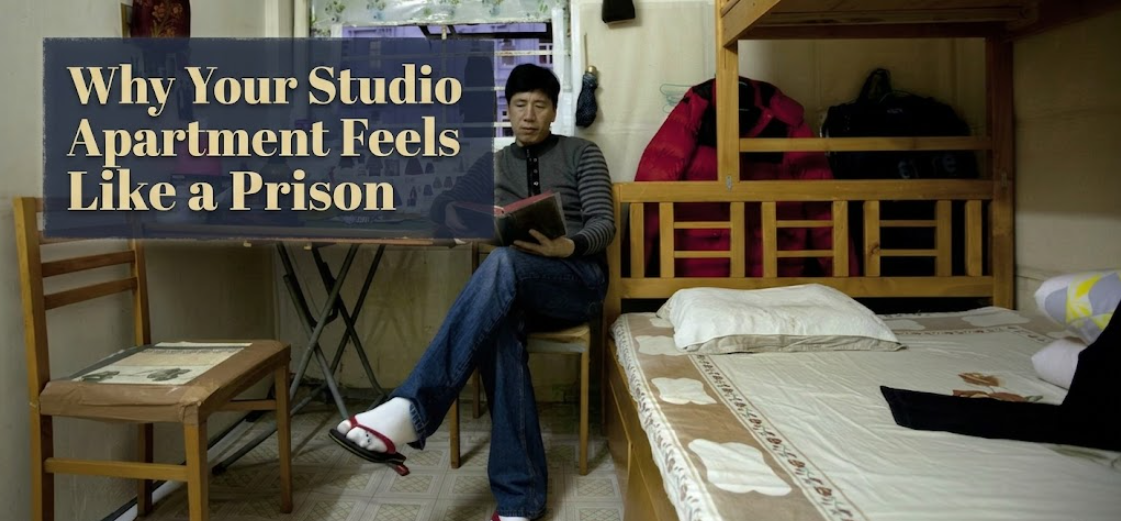
The square footage is not the problem.
I know that’s a hard sentence to accept when you’re standing in a studio apartment that’s making you feel trapped, but I’ve been designing small spaces long enough to be reasonably confident about this. The feeling of confinement in a studio almost never comes from how many square feet you have. It comes from a handful of specific, identifiable design decisions that most people never question, because the decisions seem obvious or neutral.
They aren’t.
The word “prison” comes up often when people describe small apartments that have gone wrong. It comes up more often than “cramped” or “cluttered,” both of which are practical problems with practical fixes. Prison is different. It’s psychological. And the psychological causes of that feeling are worth being specific about, because every single one of them is fixable.
1. The Myth That More Space Would Solve It
Almost everyone who feels this way about their studio has, at some point, started researching larger apartments. An extra room. A proper bedroom wall. And yes, more space generally gives you more options. But the studios that feel like prisons aren’t suffering from a square footage deficiency as much as they’re suffering from a layout and proportion problem, and those two things are entirely different.
I’ve walked through 700-square-foot apartments in Liberty Village that felt impossible, and smaller studios in Yorkville that felt workable, calm, even generous. The difference was almost never the size. It was whether the space was organized in a way that allowed actual movement, actual visual breathing room, actual zone logic.
When none of those things exist in a studio, even a generous one, the space will feel like a cell. Because that’s what it’s functioning like.
The mistake is diagnosing a design problem as a size problem. Once you make that misdiagnosis, you spend energy trying to move to a larger place or minimize your belongings to create more floor space, neither of which addresses what’s actually creating the feeling. You’d be solving for the symptom while the real cause sits untouched.
2. What Your Sightlines Are Actually Doing to You
Stand at the entry of your studio and look straight ahead.
Where does your eye land?
If it lands on the side of a bed frame, the back of a sofa, or a wall that’s six feet away, you have a sightline problem. And sightline problems are one of the primary causes of the prison feeling in small spaces.
Here’s what’s happening: the brain uses visual depth as one of its main tools for assessing how much space it has. When there’s a clear sightline, when your eye can travel across a room without obstruction, the brain registers space. When sightlines terminate immediately, when everything around you resolves at close range, the brain registers confinement. It doesn’t matter that the room might be 450 square feet. What matters is what the eye encounters when it tries to move through the space.
The common furniture mistake that kills sightlines is pushing everything against the walls. People do this because they want to preserve the center of the room, but what they actually create is a box: you’re standing in the middle staring at the perimeter from short range. Pull the main seating piece even eight inches away from the wall and a sightline opens along one side. The room reads differently. The room reads larger.
Mirrors, when placed correctly, extend visual depth rather than simply bouncing light around. A mirror on a perpendicular wall, not directly facing a window but adjacent to one, sends the eye down a visual corridor that doesn’t technically exist. Where you place a mirror in a studio matters considerably, and the wrong placement can make the problem worse, not better.
3. The Lighting Setup That Creates an Institutional Effect
A single overhead bulb on a switched fixture. That’s the lighting signature of most studio apartments, and it’s also the lighting signature of institutional spaces, not because of the light itself but because of what a single, ceiling-mounted, unmediated source does to the geometry of a room.
It eliminates shadow.
And shadow, counterintuitively, is what makes a room feel like it has dimension. When everything in a studio is lit from the same source at the same angle, every surface flattens to the same visual value. The ceiling feels as close as the walls. The depth disappears. What’s left is a kind of visual sameness, that institutional quality, that the mind reads as enclosure.
This is completely fixable without renovation. A floor lamp in the far corner. A desk or task lamp near wherever you read or work. Something warm and low near the bed. Those three sources working together in the evening transform the same studio that felt clinical at noon into something that feels contained in the good sense, warm and specific rather than flat and institutional. The overhead light, when those three things are working, shouldn’t be on at all.
The problem with relying on one overhead light in a studio is something Studio Apartment Setup covers in detail, including specific lamp placements for different studio configurations. But the principle is simple: the overhead is a default habit, not a design decision, and it’s one of the most direct contributors to the cell-like quality people struggle to name.
4. Open Plan Is Working Against You
This is the one people don’t want to hear.
Open plan is supposed to mean freedom. No walls, no division, everything accessible and visible. It sounds like the opposite of confinement. But in a studio apartment, a fully undivided open plan often produces a specific kind of claustrophobia: the claustrophobia of being everywhere at once.
When you can’t leave your bedroom to go to the living room, when there’s no visual or physical distinction between where you sleep and where you sit and where you eat, you’re not living in multiple spaces. You’re living in one space expected to serve every function. That’s not spaciousness. That’s inescapability. Every hour of every day, you’re in the same spot, facing the same walls, with no sense that you’ve moved anywhere, because you haven’t.
Creating zones in a studio doesn’t require walls. A rug under the seating area anchors a living zone. A different light source marks a work area. The orientation of furniture, a sofa with its back defining the edge of a sleeping zone, creates enough distinction for the brain to register that it has moved somewhere, even when the movement is fourteen feet.
The options for creating separate spaces in a studio without walls are more varied than most people expect. And the difference those zones make to how a studio feels over the course of a full day of living in it is significant. The square footage doesn’t change. But the psychology of it does.
5. The Threshold Problem Nobody Builds For

Well-designed homes have a moment of arrival. Some threshold, even symbolic, that marks the transition between outside and inside. A short corridor. A defined foyer. A bench and coat hooks that signal: this is where the outside world stops and your home begins.
Studios almost never have this.
You step through the front door and your entire apartment is already there, visible and present. The bed is right in front of you. The kitchen is four feet to the left. You’re already everywhere before you’ve had a chance to arrive anywhere. There’s no arrival. There’s no threshold. You step from the hallway directly into the full reality of your domestic life without pause, and the space never quite separates from wherever you’ve just been.
This matters because the threshold ritual, that brief moment of entry, is one of the ways a home signals itself as a refuge. When it’s absent, the apartment never fully feels like one. You walk in and you’re already inside your whole life. That sense of inescapability is, genuinely, what a cell is.
Creating a threshold in a studio means designating something at the entry as a boundary marker. A tall console table. A coat rack mounted at height to create a visual break. A bookcase positioned just inside the door so the rest of the apartment isn’t immediately visible when you enter. You’re not building a wall. You’re creating enough of a pause that your brain can register it as an entry rather than a continuation. And that pause changes how the whole apartment feels to come home to.
At a Glance: What Creates the Prison Feeling and What Resolves It
| Prison-Feeling Trigger | What to Do Instead |
|---|---|
| All furniture pushed flush against walls | Pull main pieces 6–12 inches into the room |
| Sightline from entry blocked immediately | Clear a visual path to a window or focal point |
| Single overhead light source only | Layer: floor lamp, task lamp, and warm accent near bed |
| No entry threshold or visual boundary | Add a console or tall piece just inside the door |
| Fully open plan with no zone distinction | Anchor zones with rugs, lighting changes, and furniture orientation |
| Curtains hung at window-frame height | Hang curtains near the ceiling to draw the eye upward |
| Mirrors placed directly across from windows | Place on perpendicular walls to create visual depth |
That last curtain row is one people underuse. Curtains hung at the window frame make the window read as a small opening in a large wall. Curtains hung from ceiling height, even if the window is mid-wall, make the ceiling read as taller and the wall as more intentional. It costs nothing extra. It’s just where you put the curtain rod.
Studio Apartment Setup’s room divider guidance is also worth working through if you want to add zone definition without blocking the light you do have. Room dividers that don’t compromise natural light are the specific category to focus on: open shelving, curtain panels on a ceiling track, low partitions. The goal is zone signal, not blockade.
The prison feeling in a studio responds quickly when you address the right category. You don’t need to renovate and you don’t need to move. One sightline cleared, one lighting layer added, one threshold created at the entry: these can shift how a studio registers in about an afternoon. The square footage stays the same. But how it feels to live in it doesn’t have to.
FAQs
My studio only has one window. Is there anything I can do about the enclosed feeling? More than you’d think, but it requires intention. Keep the window completely clear, no furniture in front of it, curtains hung high and pulled wide during the day. Place a mirror on the perpendicular wall (not directly facing the window) to bounce daylight sideways into the room rather than straight back. For evenings, warm lamp sources at floor and mid-height prevent the one-window situation from defining how the space feels after dark. You’re working with constraints, but you’re working them deliberately.
Would painting the walls a lighter color fix the prison feeling? Light paint helps, but the relationship between color and confinement is more nuanced than pale equals open. What creates the prison effect is visual flatness, so the paint decision matters most in terms of how it interacts with light and shadow. A warm mid-tone can feel more open than a cold off-white because it reads differently under lamplight in the evenings. That said, painting the ceiling the same color as the walls will make the ceiling read as lower. Keep the ceiling lighter than the walls as a baseline, regardless of what color you choose for the walls themselves.
Can room dividers help with the prison feeling or will they make it worse? Done correctly, they help considerably. A partition or bookcase that breaks the open plan creates zone distinction, and zone distinction makes the space feel like it contains multiple places rather than one uniform room. Done poorly, specifically if dividers block the only clear sightline or cut off natural light, they can intensify the enclosed feeling. Aim for open shelving, ceiling-track curtains, and low partitions before you consider anything solid and opaque.
I’ve rearranged the furniture several times and it still feels oppressive. What’s missing? If furniture arrangement alone isn’t solving it, the problem is most likely lighting and sightlines rather than placement. Arrangement can only do so much if every direction you look terminates at close range and every evening is lit by one ceiling fixture. Try spending a full week using only floor lamps and table lamps in the evenings, no overhead at all, before touching the furniture again. If the space starts feeling different at night, you’ve found your primary culprit, and furniture arrangement comes after that, not before.
My front door opens directly into the main room with no space for an entry zone. Is there a workaround? There’s almost always something. A console table just inside the door, even at an angle, creates a visual break between the entry and the main space. A tall plant in the corner nearest the door does something similar. Even a pendant or wall sconce above the entry area, a different fixture from whatever lights the rest of the room, gives the brain a cue that it’s crossed into a defined zone. These don’t require square footage so much as a deliberate visual signal, and studios can almost always accommodate that much.