

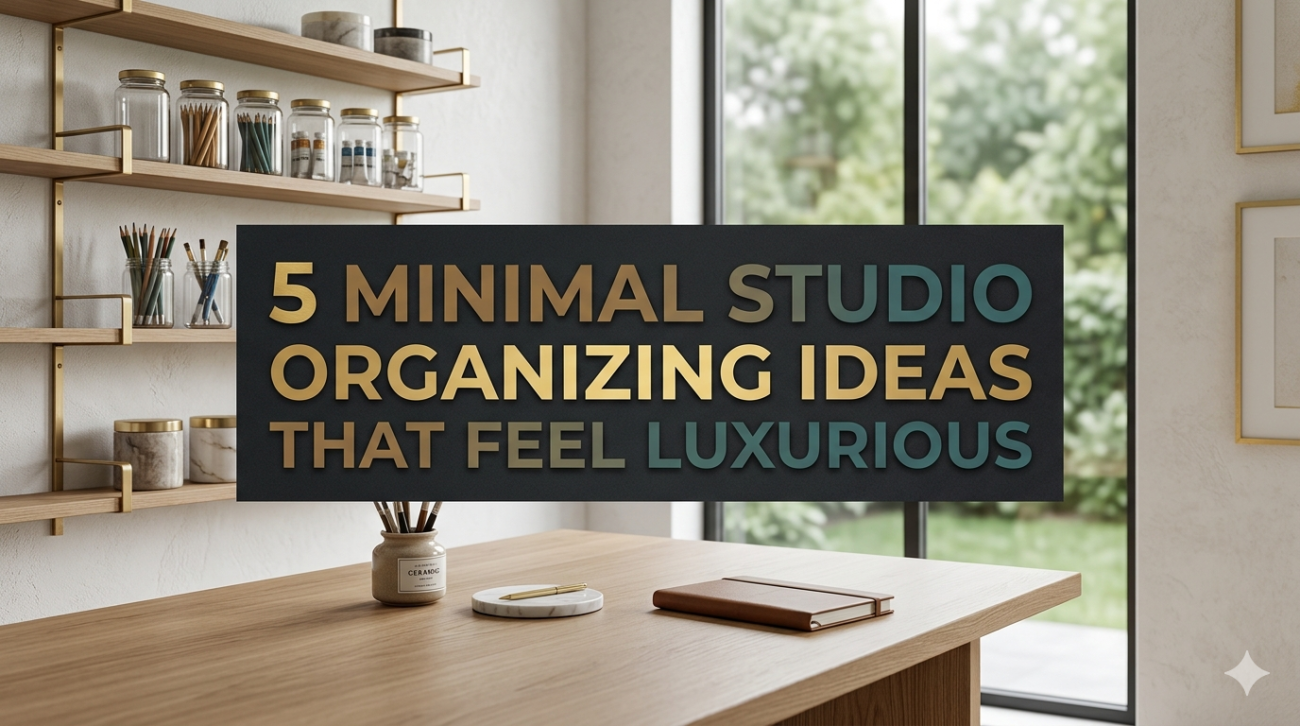
Minimalism in a studio apartment often gets misunderstood as “empty” or “bare.” In reality, the most refined minimalist spaces feel intentional, calm, and surprisingly luxurious. The difference is not how much you own, but how thoughtfully everything is arranged, hidden, and accessed.
A well-organized studio can feel like a boutique hotel suite—clean surfaces, hidden storage, soft visual flow, and zero friction in daily routines. Luxury in small spaces is not about size; it is about clarity.
Below are five minimal studio organizing ideas that don’t just reduce clutter—they elevate the entire living experience.
Idea 1: “Invisible Storage Zones” That Disappear Into the Room
One of the most powerful principles of luxury minimalism is visual disappearance. Storage should exist without being seen. The goal is not to display organization—it is to erase its visual presence entirely.
Instead of open bins and visible stacks, everything gets assigned to “invisible zones”:
- Under-bed drawers that match flooring tones
- Wall cabinets with push-to-open systems
- Furniture that doubles as hidden storage
- Neutral-toned containers that blend into walls
Key principle:
If the eye notices it, it is not minimal enough.
Invisible Storage System Breakdown
| Area | Storage Solution | Visibility Level | Luxury Effect |
|---|---|---|---|
| Bedroom | Under-bed drawers | Hidden | High |
| Living area | Storage ottoman | Semi-hidden | High |
| Kitchen | Handleless cabinets | Invisible front | Very High |
| Entryway | Built-in wall hooks behind panel | Fully hidden | Premium |
| Desk area | Drawer organizers inside closed desk | Hidden | Clean + calm |
Why this feels luxurious
Luxury spaces remove decision fatigue. When storage is invisible, your brain doesn’t register “mess potential.” The environment feels controlled, even if life is busy.
A studio using invisible zones feels automatically cleaner because there is nothing visually demanding attention.
Idea 2: “One Surface Rule” for Visual Calm
Luxury minimalism is deeply tied to surface discipline. In a studio apartment, every visible surface becomes a psychological signal. Too many objects = mental noise.
The “One Surface Rule” means:
Each surface has only ONE intentional function or grouping.
Examples:
- Nightstand: lamp only
- Coffee table: one tray with two items max
- Desk: laptop + one organizer
- Kitchen counter: daily-use items only
Surface Control Chart
| Surface | Allowed Items | Max Item Count | Effect |
|---|---|---|---|
| Coffee table | Tray + décor object | 2 | Hotel-like calm |
| Desk | Tech + organizer | 2–3 | Focused productivity |
| Kitchen counter | Daily tools only | 3–4 | Clean chef-style layout |
| Bathroom sink | Soap + one item | 2 | Spa feeling |
| Bedside table | Light + book | 2 | Restful simplicity |
Why this feels luxurious
Luxury hotels never overload surfaces. Instead, they curate them. The mind interprets empty space as richness, not lack.
Negative space becomes part of the design—not a leftover area.
Idea 3: Hidden Vertical Systems That Expand Space Without Clutter
In studio apartments, floor space is limited—but vertical space is often wasted. Minimal luxury organizing relies heavily on “vertical intelligence.”
This means using walls not for decoration, but for structured storage that feels architectural rather than functional clutter.
Examples:
- Floor-to-ceiling shelving with closed lower sections
- Floating cabinets aligned with wall color
- Hanging rail systems hidden behind furniture
- Magnetic wall strips inside cabinets
Vertical Efficiency Chart
| Vertical Zone | Use Case | Storage Type | Visual Impact |
|---|---|---|---|
| Floor to 3 ft | Hidden storage | Closed cabinets | Invisible base |
| 3–6 ft level | Daily access items | Open + semi-open shelves | Balanced |
| Eye level | Minimal display | Decorative restraint | Controlled focus |
| Above 6 ft | Seasonal storage | Closed boxes | Out of sight |
Luxury insight
The most elegant interiors guide the eye upward without visual noise. Instead of clutter spreading horizontally, it is stacked and concealed vertically.
This creates an illusion of higher ceilings and a larger room.
Idea 4: “Curated Ownership” Instead of Excess Storage
Minimal luxury is not just organizing what you own—it is reducing what you allow to exist in your space in the first place.
This idea focuses on curating possessions so that storage never becomes overloaded.
The rule:
Every item must justify its space by either function or emotional value.
Ownership Filtering System
| Category | Keep Criteria | Remove Criteria | Result |
|---|---|---|---|
| Clothing | Worn in last 3 months | Never used items | Capsule wardrobe |
| Kitchen tools | Weekly use | Duplicate gadgets | Efficient cooking |
| Decor | Emotionally meaningful | Random fillers | Intentional style |
| Electronics | Daily use | Old/unused devices | Clean tech space |
| Paper items | Necessary documents | Old paperwork | Clarity |
The luxury effect
Luxury interiors feel expensive because they are selective. Nothing competes for attention. Every object feels “chosen,” not “accumulated.”
This creates emotional clarity and physical ease.
Idea 5: Soft-Zone Layouts Instead of Rigid Room Division
Studio apartments don’t have walls to define spaces, so many people try to force structure with furniture. Minimal luxury design does the opposite—it uses soft zoning.
Instead of dividing space physically, it defines purpose visually.
Examples:
- Rug defines living area
- Lighting defines reading corner
- Furniture orientation defines flow
- Color tone separates zones subtly
Soft Zoning Map
| Zone | Definition Method | Key Element | Effect |
|---|---|---|---|
| Sleeping area | Rug + soft lighting | Bed + warm lamp | Rest separation |
| Living area | Sofa orientation | Central seating | Social focus |
| Work area | Task lighting | Desk setup | Mental productivity |
| Dining area | Small table zone | Compact table | Meal intention |
| Entry zone | Narrow rug or mat | Hooks or bench | Transition clarity |
Why it feels luxurious
Luxury spaces feel structured without feeling boxed in. Soft zoning allows movement while still giving the brain a sense of order and separation.
This prevents the “everything happens everywhere” feeling common in studios.
Summary: The Luxury Minimal Studio System
These five ideas work best when combined into a single system rather than used separately.
Here is how they interact:
| Principle | Role in System | Psychological Effect |
|---|---|---|
| Invisible storage | Removes visual clutter | Calm baseline |
| One surface rule | Controls attention | Mental clarity |
| Vertical systems | Expands usable space | Spacious perception |
| Curated ownership | Reduces overload | Emotional lightness |
| Soft zoning | Defines living flow | Structured freedom |
Together, they transform a small studio into something that feels intentional, quiet, and high-end.
Bonus Insight: Why Minimal Luxury Feels Expensive
Luxury is not about abundance—it is about control and intention. When a studio feels organized at this level, it creates three subconscious impressions:
- Everything has a place
- Nothing is accidental
- Space is respected
This is why even a small apartment can feel like a high-end suite when organized correctly.
FAQs
1. Can a small studio really feel luxurious with minimal organization?
Yes. Luxury is not size-based—it is clarity-based. Even 20–30 square meters can feel premium when clutter is removed and storage is hidden.
2. What is the fastest way to start organizing a studio minimally?
Start with surfaces. Apply the One Surface Rule first. It gives immediate visual improvement before deeper storage changes.
3. Do I need expensive furniture for a luxury minimal look?
No. The effect comes from arrangement, not price. Even basic furniture can look premium if surfaces are clear and storage is hidden.
4. How do I avoid my studio becoming cluttered again?
Use the “curated ownership” rule. If new items enter, old ones must leave. This keeps volume stable over time.
5. What colors work best for minimal luxury studios?
Neutral palettes work best: warm white, beige, soft gray, muted earth tones. They enhance visual calm and make spaces feel larger.
6. Is open shelving a bad idea for minimal studios?
Not always. Open shelving works if it is curated and limited. Overloading open shelves breaks the luxury feel quickly, so restraint is essential.