

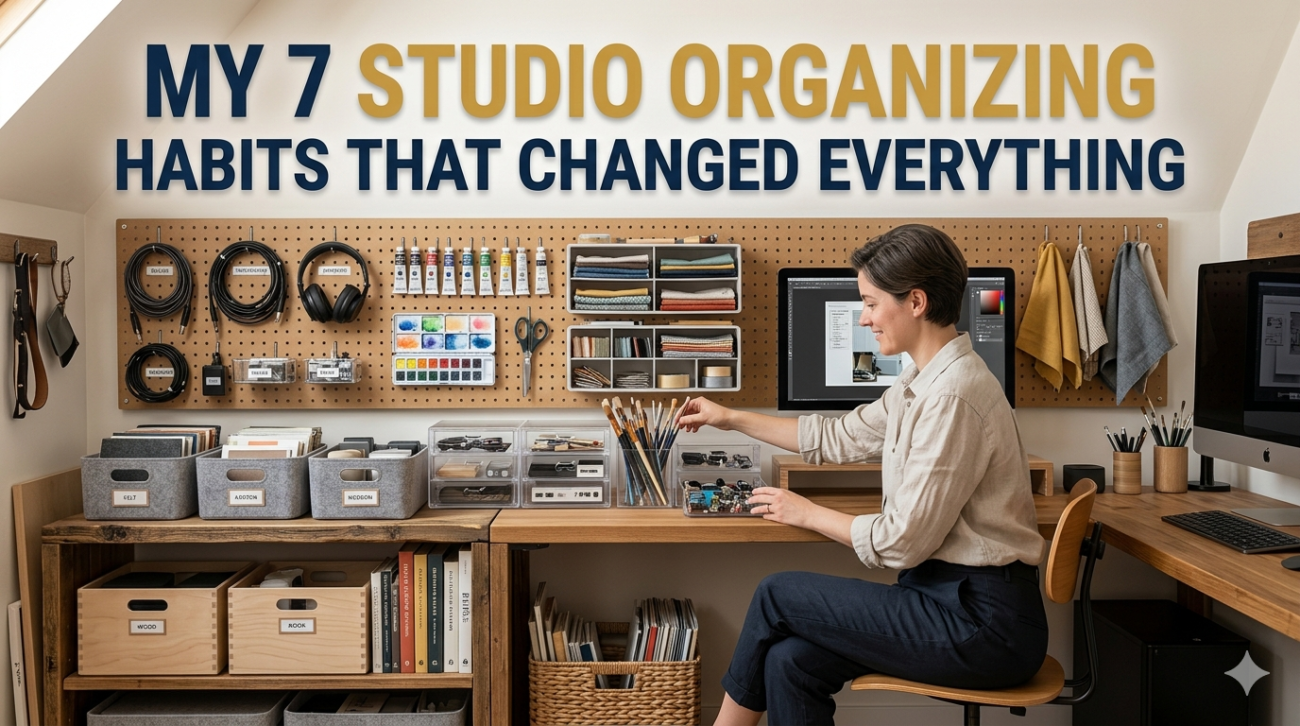
A cluttered studio doesn’t just take up space—it quietly drains focus, creativity, and energy. Over time, I realized that organizing wasn’t about perfection or aesthetic minimalism. It was about building repeatable habits that keep chaos from ever taking over in the first place.
These are the 7 organizing habits that completely transformed how my studio functions. Not overnight hacks, but sustainable systems that made everything easier, faster, and calmer.
Habit 1: The “Reset Before Exit” Rule
One of the biggest changes I made was simple: never leave the studio in chaos.
Before walking out, I spend 10–15 minutes resetting everything back to baseline. Not deep cleaning—just resetting.
What this includes:
- Returning items to designated zones
- Clearing the main work surface
- Folding or stacking used materials
- Throwing away trash immediately
- Resetting lighting/tools for next use
Why it works
Instead of waking up or entering a messy space, I always return to a neutral environment. That small habit prevents clutter accumulation entirely.
Before vs After Habit Comparison
| Situation | Before Habit | After Habit |
|---|---|---|
| Starting work | 20 min cleanup | 0–2 min setup |
| Mental clarity | Scattered | Focused |
| Productivity speed | Slow start | Immediate flow |
| Stress level | High | Low |
This habit alone removed most of my “studio anxiety.”
Habit 2: Zones Instead of Random Storage
I stopped organizing by “type of item” alone and started organizing by function zones.
Instead of:
- All notebooks together
- All pens together
- All gadgets together
I created zones like:
- Work zone
- Creative zone
- Storage zone
- Quick-access zone
Example Studio Layout System
| Zone | Purpose | Items Stored |
|---|---|---|
| Work Zone | Daily tasks | Laptop, notebook, lamp |
| Creative Zone | Art/design | Sketchbooks, markers |
| Storage Zone | Backup items | Files, supplies |
| Quick Zone | Frequently used | Charger, pens, sticky notes |
Why this changed everything
I stopped “searching for items” and started “entering zones.” That reduced friction dramatically and made the space feel more intuitive.
Habit 3: The 2-Minute Rule for Clutter Control
If something takes less than 2 minutes to fix, I do it immediately.
Examples:
- Putting clothes in laundry basket
- Returning scissors to drawer
- Deleting unnecessary desktop files
- Wiping a small spill
- Sorting mail immediately
Clutter Accumulation Chart
| Behavior | Result Over Time |
|---|---|
| Delay small tasks | Rapid clutter buildup |
| Handle immediately | Stable clean environment |
| Occasional cleanup | Weekend overwhelm |
| Daily micro-actions | Zero backlog |
This habit stopped clutter from “snowballing” into overwhelming messes.
Habit 4: Vertical Thinking for Small Spaces
In a studio, floor space is limited—but walls are underused real estate.
I shifted my mindset from horizontal storage to vertical storage.
What I added:
- Wall-mounted shelves
- Hanging organizers
- Pegboards
- Vertical file racks
- Stackable storage bins
Space Optimization Comparison
| Storage Style | Space Efficiency | Accessibility |
|---|---|---|
| Floor-only storage | Low | Medium |
| Drawer-based storage | Medium | High |
| Vertical + wall systems | High | Very High |
Key insight
The more I lifted storage off surfaces, the more “breathing room” my studio gained.
Habit 5: One-In, One-Out Rule
This habit is simple but extremely powerful.
Whenever I bring something new into the studio, something old must leave.
Examples:
- New notebook → finish or donate an old one
- New tool → remove unused duplicate
- New decor → remove something visually distracting
Impact Over Time
| Time Period | Without Rule | With Rule |
|---|---|---|
| 1 month | Slight clutter increase | Stable inventory |
| 3 months | Noticeable overload | Balanced space |
| 6 months | Overcrowded studio | Minimal, controlled setup |
This habit prevents silent accumulation, which is the biggest cause of long-term clutter.
Habit 6: Weekly 30-Minute “Studio Audit”
Once a week, I step back and evaluate the studio like a system, not just a space.
Audit checklist:
- What is not being used?
- What feels visually noisy?
- What needs relocation?
- What is running low?
- What keeps getting misplaced?
Weekly Audit Table
| Category | Question | Action Outcome |
|---|---|---|
| Tools | Used this week? | Keep or store |
| Surfaces | Visually clean? | Rearrange |
| Storage | Overflowing? | Declutter |
| Workflow | Smooth or blocked? | Adjust layout |
Why this matters
Instead of waiting for chaos, I proactively maintain order in small, manageable sessions.
Habit 7: “Invisible Storage” Mindset
This habit changed how I think about space entirely.
Not everything needs to be visible. Not everything needs to be accessible all the time.
I started separating items into:
- Daily use
- Weekly use
- Rare use
Storage Visibility System
| Category | Storage Type | Example |
|---|---|---|
| Daily use | Open access | Pens, laptop |
| Weekly use | Drawer storage | Sketchpads |
| Rare use | Hidden bins | Seasonal items |
Result
My studio stopped feeling visually overwhelming because only “active tools” stayed visible.
Combined Impact of All 7 Habits
When these habits work together, they create a self-maintaining system rather than a constantly messy room.
System Flow Chart (Simplified)
Clutter appears → 2-minute rule activates → items go into zones → weekly audit refines placement → one-in-one-out controls volume → reset habit restores baseline → vertical/invisible storage optimizes space
Overall Transformation Summary
| Area | Before Habits | After Habits |
|---|---|---|
| Organization | Reactive | Preventive |
| Cleanliness | Inconsistent | Stable |
| Productivity | Interrupted | Continuous |
| Mental load | High | Low |
| Space usage | Inefficient | Optimized |
Key Lessons Learned
- Organization is not a one-time project—it’s a loop
- Small habits outperform big cleaning sessions
- Systems beat motivation every time
- Space feels larger when clutter is controlled, not removed all at once
- Visual simplicity improves mental clarity
FAQs
1. How long does it take to build these habits?
Most of these habits become automatic within 2–4 weeks if practiced consistently. The “reset before exit” habit usually forms the fastest.
2. What if I don’t have much space in my studio?
These habits are especially effective in small spaces. The vertical storage and zoning systems are designed specifically for limited areas.
3. Do I need to follow all 7 habits at once?
No. Start with 2–3 habits first (reset rule, 2-minute rule, and zoning work best together), then gradually add the rest.
4. What’s the most impactful habit from the list?
The “Reset Before Exit” habit has the fastest visible impact because it prevents mess from compounding overnight.
5. How do I avoid falling back into old habits?
Weekly audits are key. They act like a reset checkpoint that keeps everything aligned before things spiral.
6. Can these habits work for shared studios or offices?
Yes. In shared spaces, zoning and invisible storage become even more important because they reduce confusion and overlap between users.