

Every few months, a couple lands in my consultation chair with the same exhausted look. They’ve either just moved into a studio together or they’re about to, and someone in their life has already told them it’s a terrible idea. The phrase I hear most often is, “But a studio is really just a one-person apartment, isn’t it?”
No. That belief is the source of more bad decisions than almost anything else in small-space living.
I’ve worked with couples in downtown Toronto studios barely over 400 square feet, and some of those spaces turned out genuinely beautiful. Not just functional, not just survivable, but warm and considered and real. The truth about sharing a studio isn’t a simple yes or no. It’s conditional. It depends on what you’re willing to design around, what you’re not, and whether you approach the space as a problem to endure or a project to build together.
1. The Myth That a Studio Is a Solo Space
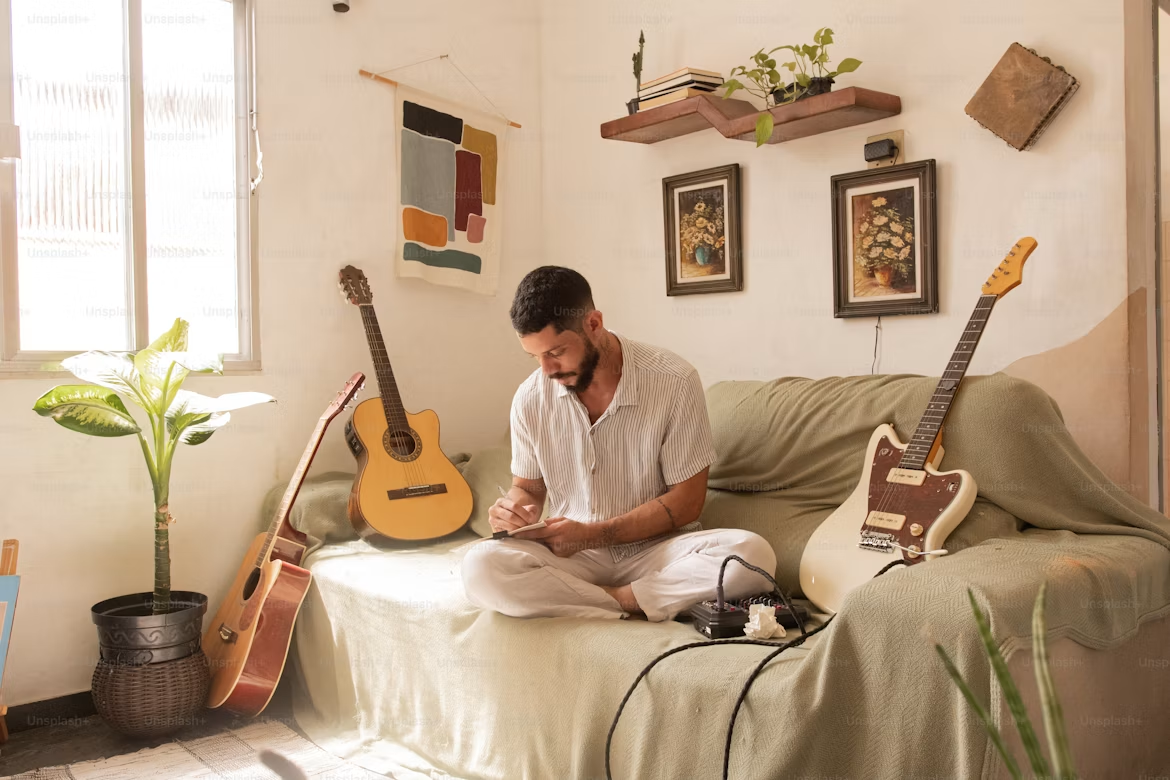
This belief has real roots. Studios became associated with single young renters, first apartments, people who haven’t quite “made it” yet. That framing stuck around, and it’s been limiting people’s thinking ever since.
But consider cities like Tokyo and Hong Kong, where couples routinely share spaces smaller than most North American studios, and not out of desperation. Out of a deeply ingrained design culture that treats compact living as a skill worth developing. Studio Apartment Setup wrote a fascinating piece on how Japan built an entire culture around living well in tiny spaces, and the philosophy there is completely different from how we tend to approach it here. Reading it genuinely changed how I advise clients.
The myth isn’t that studios are small. They are small. The myth is that small automatically means unsuitable for two people. That part simply isn’t true.
What makes a studio work for two people isn’t the square footage alone, it’s the presence of a design logic that accounts for two lives happening in one room.
2. What Two People Actually Need From the Same Room

When I walk into a studio where two people will live, I’m thinking about three things almost immediately: storage volume, visual separation, and personal anchors.
Storage volume is the obvious one. Two wardrobes, two sets of shoes, two people’s books and kitchen habits and that one thing somebody brought from their old place that doesn’t quite fit anywhere. The moment storage falls short, the space stops feeling like home. What works perfectly for one person often collapses under two. Under-bed storage becomes non-negotiable. Vertical thinking becomes essential. Shelving that goes to the ceiling, not to the midpoint of the wall.
Visual separation is subtler but equally important. Two people sharing a single open room need some version of zones: areas that visually and mentally signal where sleeping ends and living begins, where work happens, where meals belong. This doesn’t require walls. It requires intention. Studio Apartment Setup has one of the better practical guides I’ve seen on how to create separate spaces without walls, and it’s worth reading before moving a single piece of furniture.
Personal anchors are the element almost everyone skips, and they create the most friction when they’re missing. Each person needs at least one spot in the space that is theirs. A reading chair. Their side of the desk. A corner with their specific things. When every inch of a shared studio is communally owned, people start feeling like guests in their own home. And that feeling builds faster than most couples expect.
3. Where Couples Go Wrong, and It Is Not What You Think
The most common mistake I see has nothing to do with the size of the space. It happens in the first two weeks.
Couples move into a studio and try to arrange it like a one-bedroom apartment. They push the bed against the wall to “free up space,” drop a sofa in the center of the room, and end up with a layout that serves neither function well. The sofa faces the wrong direction. The bed is visible from the kitchen. There’s no clear flow between zones, and the whole space starts feeling like a negotiated draw, where both people gave something up.
The problem is they’re applying one-bedroom logic to a studio, and these spaces need their own design language entirely.
The bed is not something to hide. In a well-designed studio, the sleeping area has an identity, it belongs. Maybe it’s gently separated by a low bookshelf, or a room divider that adds definition without eating natural light. There are genuinely smart ways to approach this. Room divider ideas for studios that don’t block natural light, that resource is one I consistently recommend to clients who are just starting to think through their zoning.
The second big mistake: the wrong sleeping solution. Two people in a studio means the bed or sofa bed has to work hard, every single day. A pull-out that requires twenty minutes of wrestling to open will cause real arguments by month two. A murphy bed, when it’s properly specified and installed, can return the entire floor during daylight hours. But not every murphy bed earns the investment. There is an honest take on whether a murphy bed is actually worth it in a studio that I’d encourage anyone to read before committing.
4. The Honest Case for Sharing, and Where It Falls Apart
I want to give you a real picture here. Not the optimistic version, not the discouraging one. Just what I’ve actually seen.
Sharing a Studio: A Realistic Look
| Factor | What Works | What Doesn’t |
|---|---|---|
| Cost | Split rent is meaningful savings in most cities | One person’s clutter fills the whole space fast |
| Closeness | Forces intentional time together | No separation when one person needs space |
| Sleep schedules | Workable with the right bed setup | Different schedules in one room is genuinely hard |
| Working from home | One WFH person is very manageable | Both WFH simultaneously is a real test |
| Storage | Smart planning handles two people well | Overcrowding happens quickly without a system |
| Natural light | One well-lit space benefits everyone | Too much furniture can block windows completely |
The sleep schedule row is the one I want to flag specifically. If one person works nights and the other is up at six in the morning, a studio will strain the relationship in ways that a one-bedroom simply wouldn’t. That’s not a design problem. That’s a compatibility question, and it needs to be answered before signing a lease, not after.
For everything else on that list, the challenges are solvable. They require honest conversations and early planning, but they’re solvable. I’ve seen it done well, repeatedly.
5. The Real Order of Decisions
When a couple asks me how to make a shared studio genuinely feel like home for two people, I take them through a specific sequence. This part matters, because most people get the order backwards.
Start with the sleeping setup. Everything else flows from this decision. Whether you go with a murphy bed, a quality sofa bed, or a proper queen frame, that choice determines the floor plan. It determines the zone logic. Don’t treat it as a secondary consideration you’ll sort out later. It’s the first decision.
From there, define your zones out loud before touching the furniture. Say to each other, “this corner is for work, this area is where we eat, this wall belongs to the bedroom zone.” Agreeing on zones verbally before moving anything prevents the majority of the spatial frustrations I’ve watched couples go through. Studio Apartment Setup put together a solid framework for first-time setups at their guide to starting a studio when you have nothing, and it translates just as well when two people are building from scratch together.
Then, only then, do you source furniture. Pieces that work twice as hard as they look. Storage ottomans, extendable dining tables, a bedside table that moonlights as a desk. In a shared studio, every piece has to earn its square footage. If it’s purely decorative and takes up floor space, it’s competing with your quality of life.
One thing I always tell clients: there’s a difference between a space that looks like a compromise and one that looks like a collaboration. A compromise is where both people gave something up. A collaboration is where both people put something in, and what came out is better than either would have created alone.
That’s what a well-designed shared studio actually looks like.
FAQs
What is the minimum studio size that works for two people?
Most designers would put 450 square feet as a comfortable floor for two people with smart planning in place. That said, I’ve seen 380-square-foot spaces work beautifully when the couple was genuinely deliberate about layout and storage. Square footage matters less than you’d expect once the design logic is right.
Do you need separate wardrobes in a shared studio?
Not necessarily separate pieces of furniture, but yes, each person needs their own clearly defined clothing zone. A shared closet works fine if it’s organized from day one with boundaries. The moment it becomes one shared pile, it becomes a daily source of low-grade tension.
What if one of us works from home full time?
One WFH person in a studio is very manageable with a dedicated desk zone. Two WFH people simultaneously is harder, and it’s worth thinking through honestly. A bookshelf behind the work chair, or even a modest acoustic panel, makes a difference. Some couples rotate library or coffee shop time for focused deep work, which is a practical workaround more people should consider.
Can a shared studio feel genuinely romantic, not just efficient?
Absolutely, and this is one of my favourite things to design around. A studio that’s been intentionally lit, layered with texture, and styled with care can feel genuinely intimate. The right lighting alone changes the entire mood of a small space. Don’t let the practicality conversation push out the beautiful parts. Those matter more than people give them credit for.
Should the bed be the main visual focus or should it be tucked away?
In most studios I’d say: own the sleeping area rather than disguise it. Trying to hide a bed in a compact space often makes everything feel more awkward, not less. Style it well, anchor it with a rug and a pendant or sconce, and use soft zoning to give it definition. A confident sleeping area reads as intentional design. A hidden one usually just reads as a space that’s trying too hard.
Sharing a studio is one of those things that depends far more on who you are than on the square footage available. The couples I’ve seen genuinely thrive in small shared spaces are the ones who approached it as a design project together, made clear decisions early on, and stopped expecting the space to behave like something it isn’t.