
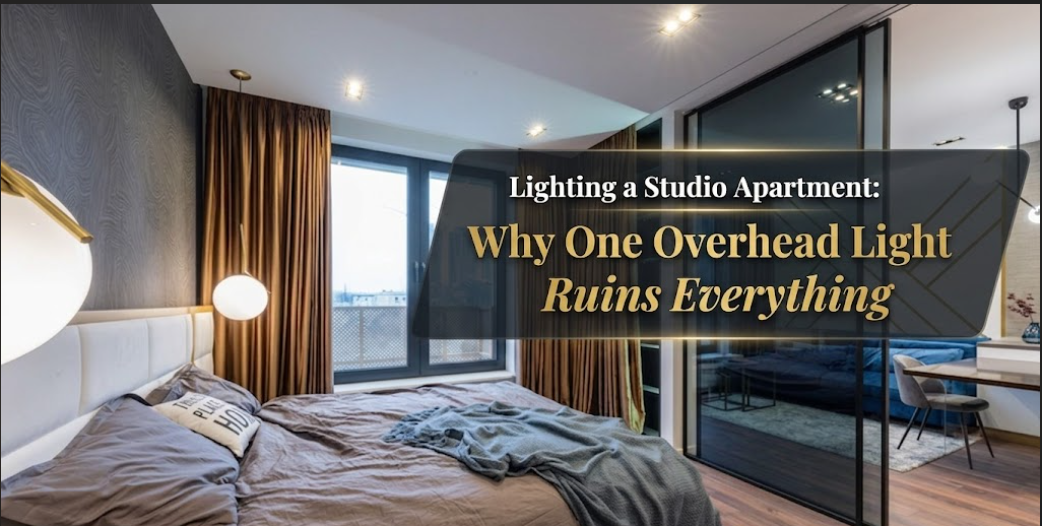
A few years back I walked into a client’s studio apartment and genuinely thought something was wrong with the building. The whole place felt institutional, flat, like a break room someone had tried to decorate. She’d done everything else right. Good rug, proportionate furniture, a nice linen sofa in a warm ivory. The space should have felt polished. Instead it felt exhausted.
I looked up. One ceiling fixture, dead center, casting that even, directionless glow that leaves no shadow and no depth anywhere in the room. Everything lit at the exact same intensity. The bed zone, the living area, the kitchen counter, all reading as the same space because they were all receiving the same flat wash of light from above.
We fixed it in one afternoon. No new furniture, no paint, no renovation. Just light placement. And the apartment became a completely different place.
I’ve thought about that visit often over the years, because it clarified something I’d known technically but hadn’t articulated clearly: in a small space, light isn’t just functional. It’s the primary structural tool. More than furniture arrangement. More than colour. The way you layer light in a studio is what determines whether it feels like a home or a waiting area.
1. The Myth That One Good Fixture Is Enough

The idea most people carry into a new studio apartment is that brighter equals better. Get a strong enough ceiling light and the whole room is handled. Maybe swap it for something more attractive, a flush mount with a nice shade instead of the builder’s bare bulb, and you’re done.
This logic makes sense on paper. Light is light, and more of it is usually an improvement over less. The problem is that overhead light, especially centred overhead light, creates a specific quality of illumination that works against small spaces. It casts shadows downward, which flattens surfaces. It eliminates the contrast between zones, so the room reads as a single undifferentiated space. And because it hits every corner at roughly the same intensity, the eye has nowhere to rest and nowhere to travel. The room feels smaller, not larger.
Natural light doesn’t behave this way. Sunlight enters from the side, from a specific angle, and changes throughout the day. It creates gradients, warm pockets, shadows that shift. This is why a studio with good windows feels completely different from one with none, even if both are lit to the same lux level. The direction and quality of light are doing psychological work that raw brightness cannot replicate.
Layered artificial lighting mimics this. A floor lamp in the corner of a living zone, a table lamp on the nightstand, under-cabinet lighting in the kitchen, a small pendant or sconce near the dining table. Each light source covers a zone, defines it, and together they create the variation that makes a room feel dimensional rather than flat.
2. What Flat Lighting Actually Does to a Studio
I want to be specific here because “bad lighting” sounds vague, and the consequences aren’t just aesthetic. They’re practical and psychological.
When a studio has only overhead lighting, every surface reflects light at the same intensity. Your eye moves around the room and finds no hierarchy, no visual rest point, nothing to settle on. This is fatiguing in a way that’s hard to name but easy to feel after an hour in the space. It’s one of the reasons some studios feel draining to spend time in even when they’re tidy and reasonably furnished. The lighting is doing the wrong kind of work.
It also collapses zones. One of the core challenges in a studio is creating a sense of separation between how you sleep, how you work, and how you relax, all within the same open room. Good lighting is one of the most effective ways to achieve this without any physical division. When you dim the floor lamp in the living area and turn on just the bedside lamp, your body understands that it’s transitioning to rest mode. That’s not a soft truth about ambience. That’s your nervous system responding to spatial cues. The overhead light, because it covers everything equally, prevents any of this from happening.
And then there’s the hotel room problem. Single overhead lighting, combined with neutral walls and inoffensive furniture, is the precise formula that makes a studio feel temporary and impersonal, like somewhere you’re staying rather than somewhere you live. I wrote about this for Studio Apartment Setup readers in a piece on why studios end up feeling like hotel rooms, and lighting was at the root of almost every example.
3. The Layering System That Actually Works
Layered lighting in a studio follows a straightforward three-layer logic that professional designers use in every residential project regardless of size: ambient, task, and accent.
Ambient is your general illumination, the background light level that allows you to move safely around the room. In most studios, the overhead fixture handles this. The mistake is treating ambient light as the only layer. It’s the foundation, not the finished room.
Task lighting is specific and directed. A desk lamp for working. Under-cabinet strips in the kitchen. A reading lamp positioned at shoulder height beside wherever you sit. Task light exists for functional reasons, but it also does zone-defining work because each light source marks a specific activity. When the desk lamp is on and the rest of the room is dim, the work zone activates. When it’s off, it recedes.
Accent lighting is what most studio residents skip entirely, and it’s the layer that does the most for mood. A small uplighter behind a plant. LED strip lighting behind a bookcase. A table lamp with a warm amber bulb on a sideboard. Accent lighting has no functional purpose at all, and that’s precisely what makes it so effective. It creates warmth and intimacy in corners that would otherwise feel unused. It adds the depth that flat overhead lighting strips away.
For anyone starting fresh with a studio and trying to sequence what to prioritize, the guide at Studio Apartment Setup on where to start when you have nothing is useful context, lighting fits into the layering approach there too.
4. Colour Temperature: The Detail Most People Miss
Even when someone commits to layered lighting, there’s one variable that quietly undoes the whole effort: mismatched colour temperatures.
Colour temperature is measured in Kelvins. The lower the number, the warmer and more amber the light. The higher the number, the cooler and bluer it becomes. Mixing a 2700K bulb in your floor lamp with a 5000K bulb in your desk lamp and a 3500K bulb overhead means the room has three different white values competing with each other, and the result looks cheap and unresolved even when the fixtures themselves are beautiful.
For a studio apartment, the rule I follow with clients is simple: keep everything between 2700K and 3000K throughout the living and sleeping areas. That’s the warm, incandescent-adjacent range that reads as residential and comfortable. The kitchen can go slightly cooler, 3000K to 3500K, because task accuracy matters when you’re cooking. But the moment you introduce a daylight-range bulb (4000K and above) in a living area, the warmth you’ve built with the other layers collapses.
Here’s a quick reference for how to think about temperature across zones in a typical studio:
| Zone | Recommended Colour Temp | Notes |
|---|---|---|
| Sleeping area (bedside lamps) | 2700K | Warm, low stimulation, supports wind-down |
| Living/lounge zone (floor lamp, table lamp) | 2700K–3000K | Residential feel, flattering on skin tones |
| Work zone (desk lamp) | 3000K–3500K | Slightly cooler for focus, but not harsh |
| Kitchen (under-cabinet, overhead) | 3000K–3500K | Balanced between function and warmth |
| Accent/decorative (bookcase, plant uplighters) | 2200K–2700K | The warmest range, purely for atmosphere |
Getting this consistent is a small thing that has an outsized effect on whether a layered lighting setup feels intentional or accidental. And it costs nothing extra, it’s just a matter of reading the packaging before you buy.
5. The Rental Problem, and What You Can Actually Do

A significant portion of people living in studios are renters, which means they can’t install new fixtures, run new wiring, or replace the overhead light the landlord chose. This is a real constraint and it’s worth addressing directly rather than pretending everyone has the option to renovate.
The good news is that the most impactful layers of a lighting plan don’t require any permanent installation at all. Floor lamps, table lamps, clip-on task lights, LED strip lighting with adhesive backing, battery-operated puck lights inside cabinets. These cover ambient fill, task work, and accent all without touching the ceiling or the walls.
The overhead light can usually be managed with a dimmer plug, a simple adaptor that sits between the fixture’s plug and the wall outlet and allows you to control intensity without any wiring work. Worth checking if this is permitted under your lease before buying one, but most landlords have no objection to it since it’s fully reversible.
The one thing renters often miss is using lamps to actively compete with the overhead light rather than supplementing it. If your ceiling fixture is on and your floor lamp is also on but at low intensity, the overhead still dominates and flattens the room. The fix is to make your layered lights strong enough to carry the room on their own in the evening, so you can turn off the overhead entirely after dark and let the lower-placed sources do the work. That shift alone, from ceiling-dominant to lamp-dominant light, changes the feeling of the space more than almost any other single adjustment.
For studios where the layout itself needs rethinking alongside the lighting, the room divider guide at Studio Apartment Setup is worth reading in parallel, especially the sections on how dividers interact with natural and artificial light sources.
Frequently Asked Questions
My studio only has one plug-in ceiling light and I can’t add fixtures. What’s the fastest fix? Buy one good floor lamp and position it in the corner of your main living zone. That single addition, especially if the bulb is warm (2700K) and the lamp stands around 150–160 cm tall, will transform the room in the evening more than any other change. Add a table lamp to the bedside area second. Two lamps from a thrift store will outperform a single expensive overhead fixture every time.
What wattage should I be using in a studio apartment? For lamp bulbs, 40 to 60 watt equivalents in LED are enough for most residential lamps. The old-wattage thinking doesn’t quite translate to LED, so focus on lumens instead: a bedside lamp needs around 400–600 lumens, a floor lamp covering a living zone should be 700–1000 lumens. More than that in a studio and you risk washing out the warmth you’ve been building with the other layers.
Is warm white always the right choice? My studio gets very little natural light. Counterintuitively, yes. A cooler bulb in a dark room doesn’t make it feel brighter, it makes it feel clinical. Warm light is more forgiving in a space that lacks daylight because it creates the sense of a lit interior rather than an overcast one. If you want to increase the perceived brightness of a low-light studio, the better approach is more light sources at warm temperatures rather than fewer sources at cool temperatures.
I tried a floor lamp and it still doesn’t feel like it’s doing much. What’s going wrong? Usually one of two things. Either the bulb is too cool (check that it’s 2700K, not 4000K, they can look similar in the packaging), or the lamp is positioned against a wall that’s too far from where you sit, so the light doesn’t actually reach your zone. A floor lamp works best placed within 60 to 90 cm of the seating area, angled slightly toward the wall or ceiling to create a wash rather than a direct downward spotlight.
Does lighting really affect how big a studio feels? Directly, yes. Low-placed light sources with warm colour temperatures make a ceiling feel higher by drawing the eye to the walls and mid-height surfaces rather than the ceiling itself. Overhead light does the opposite: it draws attention upward and makes the floor plan feel constrained. Accent lighting in corners visually expands the room by reaching areas that would otherwise drop into shadow and read as void space.

3 thoughts on “Lighting a Studio Apartment: Why One Overhead Light Ruins Everything”