
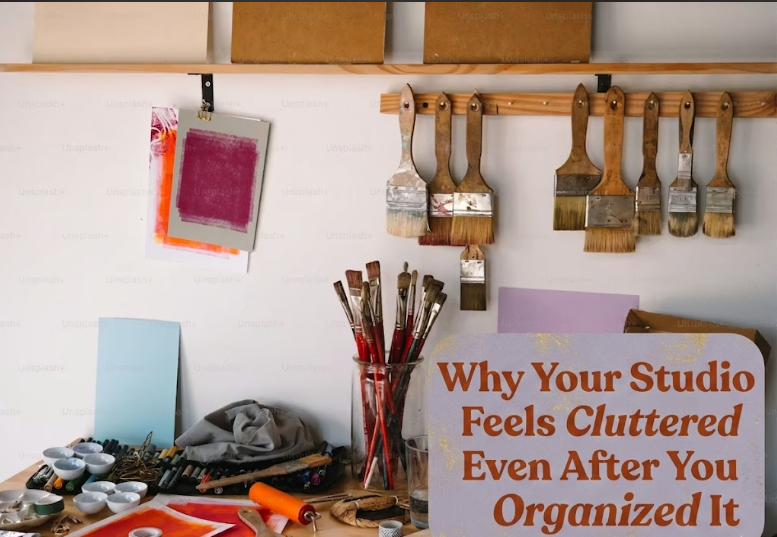
The most common thing I hear from people who’ve just spent a full weekend sorting, folding, and reorganizing their studio is some version of this: “I did everything. I bought the bins. I labeled them. I cleared the floor. And it still feels like a mess.”
I’ve heard it from clients in Toronto. I’ve heard it from people who email me after watching a segment. And I hear it constantly through the community at Studio Apartment Setup, where the question comes up in every possible variation: why does this space still feel chaotic when everything technically has a home?
The short answer is that organizing and visual calm are not the same thing. They never were. Confusing the two is genuinely the most expensive mistake you can make in a small space, not because you’ll waste money, though you might, but because you’ll waste time solving the wrong problem.
1. What “Visual Clutter” Actually Means (and Why Organized Stuff Still Counts)
Physical clutter is easy to identify. It’s the jacket that never makes it to the hook, the mail pile that’s been threatening to avalanche for three weeks, the gym bag that lives between the couch and the wall. You can point to it. You can move it.
Visual clutter is different. It’s the total number of distinct objects your eye has to process when it scans the room. And organized items absolutely still count.
A row of eight matching storage baskets is eight things. A color-coded bookshelf is dozens of objects competing for attention, each one individually legible to the eye. A pegboard with 20 kitchen tools hanging in perfect order is neater than a drawer full of the same tools, but it is not calmer. The eye still registers every single one.
This matters more in a studio than anywhere else because there’s no physical distance between you and everything you own. In a larger apartment, a cluttered corner shelf in the entryway barely registers from the living room couch. In a studio, every surface is in your direct sightline. All the time. That’s not a flaw in the apartment, it’s just geometry.
The reason your studio still feels chaotic after a big organizing session is almost always this: you managed the physical problem while leaving the visual one entirely intact.
And the visual one is harder to see because it doesn’t look like mess. It looks like organization.
2. The Furniture Scale Issue Nobody Is Talking About
The second reason a studio stays feeling cluttered after organizing has nothing to do with how things are stored. It’s the furniture itself.
Wrong-scale furniture is one of the most consistent issues I see in small space consultations. And here’s the thing: when I say wrong scale, I’m almost always talking about pieces that are too large, not too small. People assume a big, generous sofa fills a studio and makes it feel complete. What it actually does is eliminate the breathing room that makes a small space feel livable at all.
When a sofa is too deep, it pushes toward the center of the room and creates a visual dam. When a dining table is wider than the space can absorb, it blocks the natural sightlines through the apartment. A bed frame with a tall headboard can create what feels like a physical wall, chopping the room into sections that read as cramped even when everything is spotless.
The principle I come back to consistently: at least 30% of your floor should be visibly open when you stand at the entrance to the room. If you see mostly furniture rather than floor, no amount of organization will change how the space feels. The layout principles that interior designers apply first start here, at scale and sightlines, before anything else.
This is where the frustration usually runs deepest. You’ve done all this work, bought all these systems, and the space still feels tight. But reorganizing your belongings doesn’t fix a furniture scale problem. It never will.
3. Where People Go Wrong with Storage Solutions
Storage solutions are the drug of studio apartment living. I say that as someone who recommends them regularly. The problem isn’t the solutions. It’s the accumulation.
Here’s the pattern I see constantly. Someone moves in, buys a few bins, feels better. More stuff accumulates, more bins follow. Then comes the urge to unify the look, so matching lids appear, labels emerge, a whole system develops. At a certain point, the storage solutions have become the décor. The room is no longer an apartment; it’s a display of systems.
And every single container, however coordinated and tidy, is still something the eye has to register.
| “Looks Organized” | “Feels Visually Calm” |
|---|---|
| Full open shelves, color-sorted | Partially filled shelves with clear gaps |
| Matching bins along every wall | One or two closed storage pieces, rest is empty |
| Pegboard with full tool display | Pegboard with only the three daily-use items |
| Labeled containers for every sub-category | Fewer categories, fewer containers overall |
| Open storage filled to capacity | Closed-front storage or highly curated open units |
The place where people go wrong most reliably is open shelving. It sounds ideal. You can see everything, you never lose anything, it feels intentional. The catch is that everything is always visible. The eye never gets to rest. Even beautifully styled open shelves add cognitive load when you’re in the same room for 16 hours a day.
Closed-door storage, even inexpensive closed storage, is generally more effective for visual calm than expensive, beautifully organized open storage. This is a consistent finding across the guides on vertical space use in studio apartments and it holds in practice too. The eye doesn’t process closed surfaces as clutter. It processes them as walls.
One more thing: surface clutter is its own separate problem. Even a room with immaculate storage will feel overwhelming if the counters, side tables, and desk are perpetually occupied. Leave some surfaces empty, deliberately, not because it looks minimalist but because those empty patches are where the eye finally gets to exhale.
4. Zone Confusion, and Why It Reads as Chaos
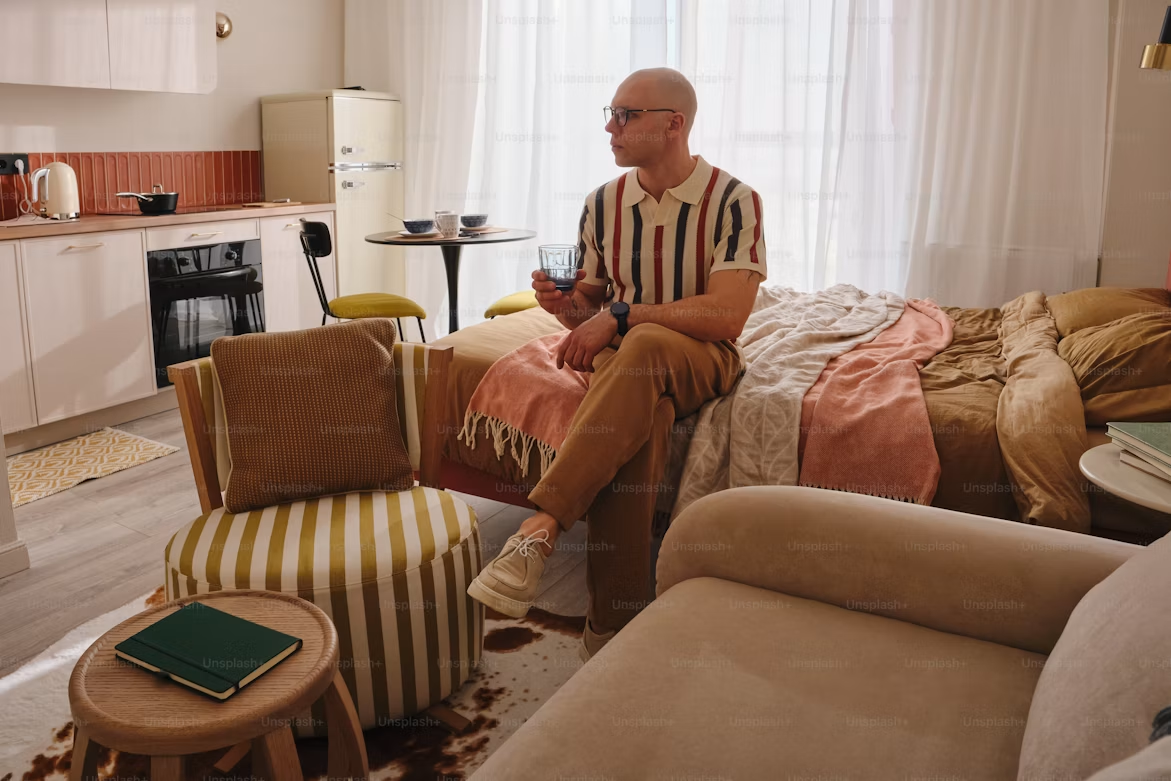
Studios require you to sleep, eat, work, and relax in the same footprint. That’s a lot to ask of any space. And when those zones aren’t clearly defined, the brain doesn’t know how to process what it’s looking at. It reads everything simultaneously, all the time, and that is quietly exhausting.
This is entirely separate from organization. You can have a perfectly arranged work desk and a perfectly made bed, and if they bleed into each other without any visual separation, the whole room registers as one undifferentiated zone of activity. The brain can’t locate itself. It experiences the entire apartment as busy.
Defining zones doesn’t require walls or room dividers, though those are options. A rug under the seating area signals that zone has a boundary. A dedicated light source over the desk creates distinction without a partition. The direction furniture faces can establish separation that feels deliberate. Creating separate spaces without walls is something designers have been doing in small footprints for decades, and the tools for it are simpler than most people assume.
The feeling of clutter, very often, is not about the objects in a space at all. It’s about cognitive confusion. And you cannot organize your way out of cognitive confusion. That’s a design problem.
Before You Buy Another Storage Bin: A Quick Reference
Run through this honestly:
□  Can you see 30%+ of bare floor from the entrance?
□  Does your largest furniture piece leave clear sightlines through the room?
□  Is there at least one surface that stays intentionally empty?
□  Do most of your storage solutions use closed fronts rather than open faces?
□  Are your zones defined by at least two different cues (rug + light, angle + texture)?
□  Does the room use a maximum of three dominant colors across walls, furniture, and textiles?
If you’re saying no to most of these, the cluttered feeling you’re living with is a design problem. Not an organization problem. The right lighting setup alone can shift how defined and calm a studio feels, and it’s one of the most underestimated parts of the whole conversation.
Organization is a maintenance system. A good one keeps things from falling apart. But it doesn’t create the feeling of space, or calm, or room to breathe. Those come from decisions that happen before you ever pull out a storage bin: furniture at the right scale, zones that the eye can locate and separate, surfaces with actual empty space on them, and a clear understanding of the difference between things being stored and things being visible.
The studios that feel genuinely calm tend to have less stuff visible at any one moment. Not necessarily less stuff overall, but less competing for attention simultaneously. That’s not achieved through better bins or a better label maker. It’s achieved by being honest about what actually needs to stay visible and what should disappear behind a door.
Studio Apartment Setup is built around exactly this kind of honest accounting. The organization piece matters. But it’s about the fourth thing on the list, not the first.
Frequently Asked Questions
If I’ve organized everything, why does my studio still feel small and tight?
Organization and visual spaciousness are different problems with different solutions. A well-organized studio can still feel cramped if the furniture is the wrong scale for the square footage, if your activity zones bleed into each other without definition, or if too many items remain visually exposed. The fix is almost always a design adjustment, not another round of sorting.
How do I know if I have too many storage containers for my studio?
A practical test: if your storage containers are filling more than two full walls or covering more than half your total shelf space, you’ve likely crossed the line where the storage itself is adding to the visual noise. Consolidate categories, reduce the container count, and move toward closed-front storage where you can. Every container you remove from visible space is one fewer thing the eye has to process.
Is open shelving always a bad idea in a studio?
Not always, but it demands discipline that most people underestimate. Open shelving works when it’s deliberately curated, meaning genuinely few items displayed with visible breathing room between groupings. Fully-loaded open shelves in a small space read as clutter regardless of how neatly they’re arranged. If you love open shelving, use one unit, keep it intentionally sparse, and close off the rest.
My studio feels busy even though I own very little. What’s going on?
Usually it comes down to scale and color distribution. A few oversized furniture pieces, or a collection of items with high visual contrast, competing patterns, or mismatched textures, will make the eye work just as hard as a room full of things. Assess your furniture size relative to the room dimensions, and look at whether your textiles, storage containers, and surfaces share a coherent palette.
Should I get rid of all visible storage?
No. One or two well-chosen storage pieces that also function as furniture, a storage ottoman, a low sideboard with drawers, work well and solve real problems. The issue isn’t visible storage in principle. It’s when storage solutions multiply until the storage becomes the defining feature of the room. The goal is a living space with some organized storage in it, not a storage facility you happen to sleep in.