
Most studio storage problems aren’t storage problems. They’re purchasing decisions made three weeks before move-in, executed against a floor plan that looked nothing like what the actual space turned out to be.
I’ve been designing compact spaces for most of my career, and certain mistakes show up so reliably I could identify them before walking through the door. The storage crisis in most studios follows a pattern. And the pattern starts not with a lack of hooks or shelves, but with four specific decisions that compound against each other until the space feels genuinely unworkable.
These are the four that waste the most real estate.
1. Furniture That Takes More Than It Gives Back
The scale problem is the one that hurts first and most. People choose furniture based on how it photographs, or how it reads on a showroom floor surrounded by two thousand square feet of context. In a studio, scale runs a completely different set of calculations.
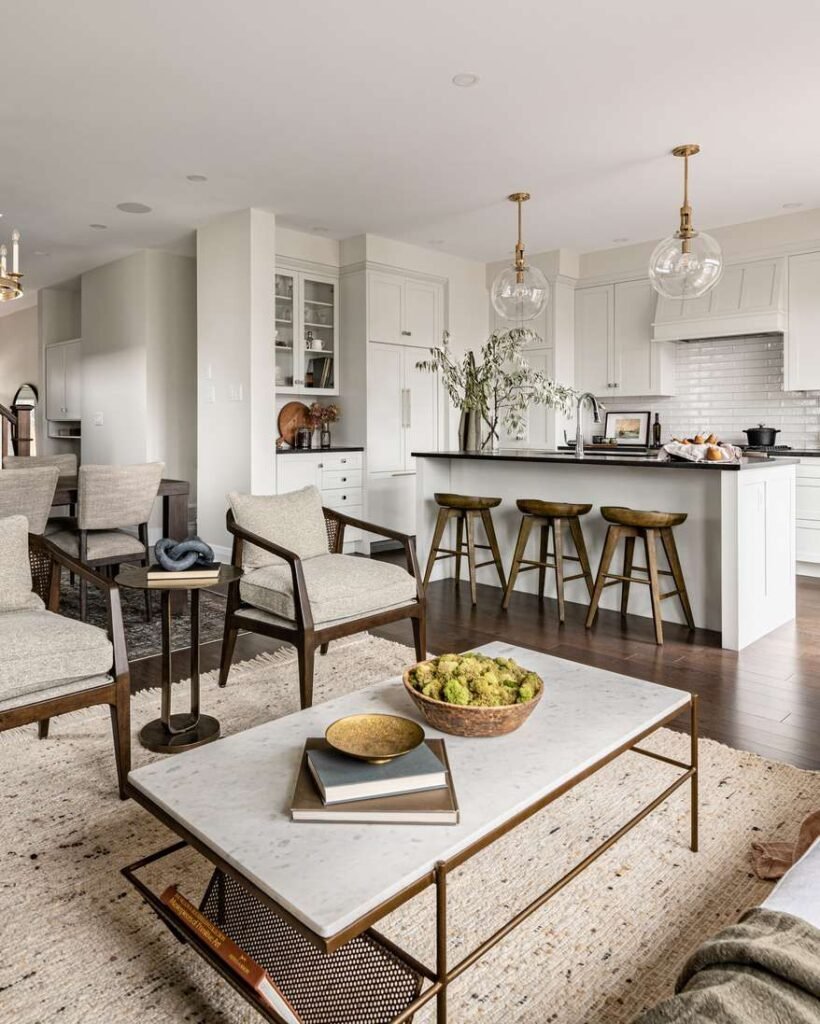
The specific culprit I see most is depth. Not width. Not height. Depth.
A sofa that sits ninety centimetres deep takes a measurably different toll on a studio floor plan than one that sits seventy-five. A bookcase that’s forty centimetres deep is almost never forty centimetres of genuinely useful storage in a residential setting, because most books are twenty to twenty-five centimetres deep and the remaining space becomes a shelf for things with nowhere else to go. A platform bed sitting fifteen centimetres off the floor eliminates under-bed storage completely. These aren’t minor inconveniences. Each one is a permanent subtraction from the storage equation.
Storage furniture falls hardest into this trap. A large cube storage unit looks like a smart organiser in a wide entrance hall. In a studio, it becomes a room divider that blocks natural circulation and creates a dead zone behind it that’s now inaccessible. Large ottomans with lift-top storage are popular because they photograph well and feel clever, but a sixty-by-sixty centimetre ottoman takes up roughly the same footprint as a small armchair and provides maybe twenty-five to thirty litres of accessible storage. An armchair with a narrow side table achieves the same seating function at a fraction of the floor commitment.
The rule I apply in client projects is proportionality. Every piece of furniture should earn its footprint in storage, function, or visual purpose. If it’s doing none of the three at meaningful scale, it’s costing more space than it returns.
2. Under-Bed Storage Loaded in Reverse
Under-bed storage is one of the most valuable zones in a studio. It’s also one of the most consistently misused.
The mistake is rotation, specifically using under-bed space for high-rotation items. Spare blankets, gym bags, the shoes you wear most days, extra towels. All of it goes under the bed because there’s room under the bed and there’s nowhere else obvious to put it. Then every time any of it is needed, someone is on hands and knees pulling out containers, moving things to reach what’s at the back, and putting everything else back in.
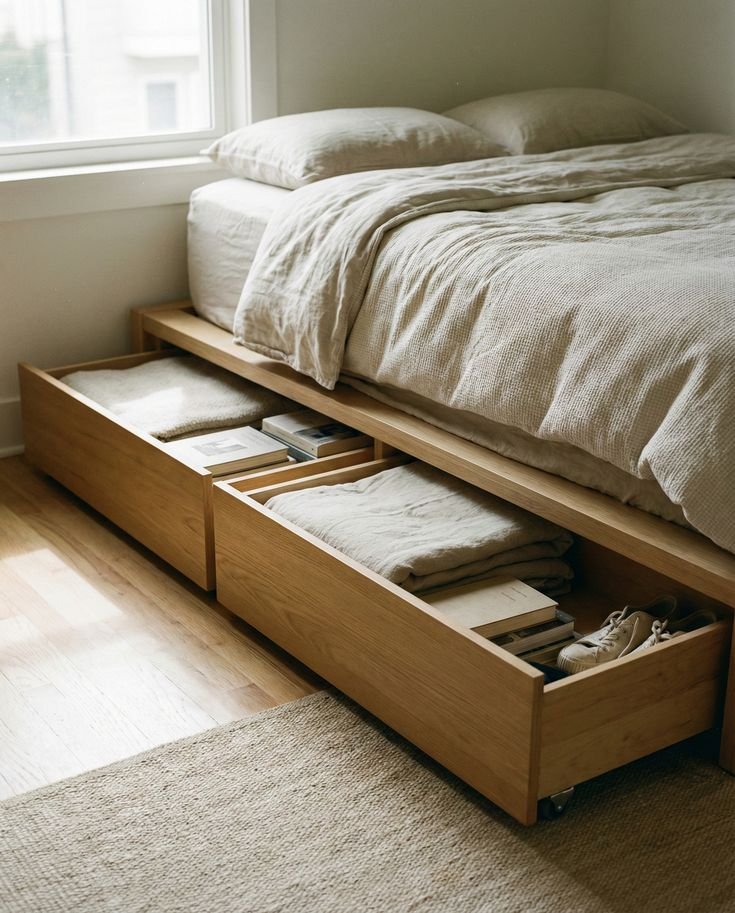
Under-bed storage should be reserved for low-rotation items. The second duvet. The luggage. Off-season clothing. Things accessed once a month at most. The logic is simple: under-bed access costs physical effort that above-floor access doesn’t. Reserving it for rarely-needed items means paying that cost infrequently. Using it for weekly items means paying constantly, and the predictable outcome is that people stop accessing it properly and it becomes a zone where things go to disappear.
The Studio Apartment Setup guide on under-bed storage in a studio covers which container types work at different bed heights and what actually fits under standard bed frames. Worth reading before buying any containers.
The companion error is buying flat bins that span the full width of the bed’s underside. These look tidy. They’re also nearly impossible to access because pulling out the entire container is required to reach anything inside it. Smaller containers organised in a row, each holding one category of item, perform better because only the relevant container comes out rather than the entire inventory.
3. Buying Containers Before Editing
I’ve started mentioning this proactively in every studio consult, because without flagging it, people make the same mistake reliably. They decide to get organised. They go buy a set of matching storage boxes, bins, and baskets. They come home and try to fit their existing belongings into the new containers. The containers never quite work. Some items don’t belong to any clear category. Half the bins end up holding random assortments of things that needed somewhere to go. The edit happens in reverse, things get put somewhere rather than somewhere right.
Containers purchased before editing are built for a version of your belongings that no longer reflects reality.
| Sequence | What You End Up With |
|---|---|
| Buy containers first, then try to organise into them | Wrong sizes, mismatched categories, leftover items, bins abandoned within weeks |
| Edit belongings first, then buy containers | Containers sized to actual inventory, clear categories, nothing left without a home |
| Edit, then measure existing storage spaces, then buy | Containers that fit the space, the belongings, and the access patterns without guessing |
The correct sequence is edit first, measure second, buy third. Decide what’s staying in the apartment before buying anything. The edit doesn’t need to be extreme, it just needs to happen before the shopping. Once you know exactly what you have and how much of it there is, the container decisions become obvious rather than speculative.
The number of containers also matters. A studio with twelve different storage bins in the closet is not more organised than one with five. It’s less organised, because more containers means more cognitive load to maintain the system. Every container is a commitment to knowing what’s in it and keeping it correctly stocked. Systems with fewer, larger, clearly-labelled containers hold up in daily life. Systems with many small ones don’t.
If the idea of buying less before getting organised is one you want to think through further, the piece at Studio Apartment Setup on what happens when you stop buying for thirty days is a useful frame for it.
4. Treating Vertical Space as Decoration
I want to be specific about what ignoring vertical space actually costs, not in vague terms but in real numbers.
A wall two and a half metres tall with roughly two metres of usable vertical space above counter height represents, across three walls of that height in a standard studio, approximately six square metres of potential storage surface. Most studio residents never touch any of it.
Six square metres is the floor area of a large bathroom. It’s not a trivial amount of space. And the reason it goes unused is almost never that it’s inaccessible, it’s that people default to storing things at waist height and below because that’s where access feels immediate. The upper portions of walls register as display space or empty space, not storage space.
What this costs is compression. Every item that could live at height instead lives on a horizontal surface, competing with everything else for the same zone. Counter clutter, overcrowded shelves, storage furniture pushed past its intended capacity, all of it traces back to the same failure to use the vertical dimension properly.
Floating shelves installed seventy to ninety centimetres above counters. A second closet rod mounted at high position for out-of-season garments. Wall-mounted storage above the desk. A floor-to-ceiling bookcase rather than one that stops at eye level. None of these require structural work. They require a decision to use the space that’s already there.
The practical caveat: don’t store anything above shoulder height that you need to access daily. High vertical space is for low-rotation items, reference books, backstock supplies, seasonal decor. Daily items below that line, everything else above it.
5. An Inventory the Space Was Never Built For
This is the most personal one. It took me longer than I’d like to admit to start saying it plainly in client conversations.
The storage problem in a studio is sometimes a genuine space problem. But it’s at least as often an inventory problem. People own more than the apartment was designed to hold, and they’ve organised that excess very carefully into every available corner rather than questioning whether they still need it.
A studio apartment holds a specific amount of stuff. When the inventory exceeds that capacity, no system fully compensates. You can optimise, use smarter containers, claim vertical space, squeeze another twenty or twenty-five percent of capacity out of the apartment. But there’s a ceiling. And past that ceiling, clever organisation is just rearranging the same overload.
The question worth asking, particularly if you’ve tried multiple approaches and the space still feels impossible, is not “where does this go?” but “should this still be here?” The winter coat that doesn’t fit the closet but might come back into rotation someday. The kitchen appliances used twice in four years. The book collection that belongs to a period of life that ended some time ago.
Editing is a design decision as much as a storage decision. A studio that holds fewer things well is more livable than one that holds many things poorly. I’ve never walked out of a well-edited small space thinking it looked sparse. I have walked out of dozens of overstuffed ones thinking they’d be transformed by a single serious edit.
The zone structure of the apartment affects how all of this plays out, too. A studio without clear functional zones ends up with items from every area of life scattered across every surface because there’s no spatial logic to contain the drift. Creating separate spaces in a studio without walls at Studio Apartment Setup deals with the zoning question directly, and once zones are established, the storage decisions inside each one become considerably simpler.
The mistakes above compound each other when they land in the same space, which they usually do. Oversized furniture reduces the number of storage configurations possible. Under-bed storage used in rotation means daily effort for daily items. Containers bought before editing never quite fit. Vertical space ignored crowds everything onto horizontal surfaces. And an unedited inventory fills all of it, regardless of the system applied.
Fix one of them and something improves. Fix all five and the apartment is a different place to live.
FAQs
I keep reorganising and the studio still feels full. At what point is more reorganising not the answer?
When you’ve reorganised three times and the result is the same, the inventory is the problem, not the organisation. More bins and a better system won’t change what the space holds. A direct edit of belongings, starting with the category that takes up the most physical space, produces faster results than another round of reorganisation.
Is it true that matching furniture sets make a studio feel smaller, not bigger?
Consistently true. Matching sets read as a single large visual block rather than individual pieces with breathing space between them. Mixing furniture at different scales and with slightly different finishes creates more visual rhythm and makes the room feel less compressed. Why matching furniture sets make a studio look smaller goes into the specifics of why this happens visually.
How do I know if I actually have too many storage containers?
If you can’t name the contents of a container without opening it, you have too many. A functional system is one where every container holds a single clear category and you know at a glance which container is which. Opening two or three containers to find something is a sign the system has either too many categories or no consistent logic behind the categories it has.
What’s the one piece of furniture that wastes the most floor space in a studio?
Oversized sectional sofas, almost always. A sectional bought for a living room works beautifully in a living room. In a studio, the L-shape occupies a corner that would otherwise allow flexible storage placement or circulation, and the depth of most sectionals extends far into usable floor area. A well-chosen two-seat sofa takes a fraction of that footprint and leaves considerably more flexibility around it.
Should I get a murphy bed or a sofa bed if I want to reclaim daytime floor space?
They solve different problems at different price points. A murphy bed reclaims the most floor space during the day but costs more and requires wall mounting. A sofa bed costs less and needs no installation, but converts less completely, the sleep surface is typically worse, and the conversion takes more time. Neither is universally better. The murphy bed versus sofa bed breakdown at Studio Apartment Setup gives an honest assessment of both before committing either direction.