
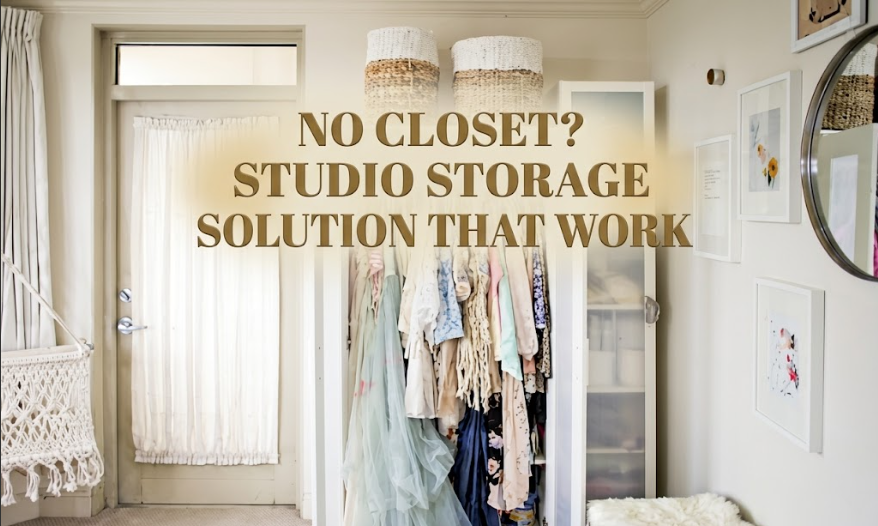
A few years back I got a call from a woman who had just signed a lease on a studio in a century-old building in the Annex neighbourhood in Toronto. She was thrilled. Original hardwood floors, high ceilings, enormous windows. Then she mentioned almost as an aside: “Oh, and there’s no closet.”
Not a small closet. Not a hall closet that’s essentially a bathroom cabinet with a rod in it. No closet at all. A bent curtain rod screwed into the corner with a bedsheet panel in front of it, and that was the landlord’s version of “closet included.”
She wasn’t unique. Old buildings, converted lofts, basement studios renovated before code required it, apartments in cities where rental inventory is so tight that landlords know you’ll take what you can get. These spaces skip the closet entirely. And nearly all storage advice assumes you have one as a starting point.
The good news is that this is fixable. Not perfectly, not without choosing what matters to you, but fixable in ways that don’t make your apartment look like a storage unit that someone accidentally furnished.
1. Before You Buy Anything, Look at What the Room Actually Has
Every time I walk into a no-closet apartment, I ask the person to stand still in the middle of the room for a few minutes and resist the urge to immediately start measuring things. Just look. What’s there. Not what’s missing.
Because every room has something. Usually it has more than the person living there has noticed.
In almost every studio I’ve worked in, there’s vertical wall space that goes completely unused. There’s clearance under the bed or sofa that no one’s accounted for. There’s the back of the entry door, the back of the bathroom door, one dead corner that’s not doing anything. Those aren’t glamorous solutions but they’re real ones, and they’re already there before you spend a dollar.
The woman I mentioned above, her apartment had a full eight-foot wall beside the entry with nothing on it. No windows, no outlets, no interruptions. Sixty percent of her storage problem was already solved the moment I looked at that wall and she stopped seeing it as empty space.
When you’re starting fresh with no closet, I’d suggest reading through where to start when you have nothing because it reframes the way you assess a room before making purchases, and that framing matters.
2. The Wardrobe Decision Is More Specific Than People Realize

The first product category everyone reaches for in a no-closet apartment is a wardrobe or armoire. This is the right instinct. The execution is usually where things go sideways.
Here is the most common version of what happens. Someone buys a wardrobe that looks good in the listing photo, it’s 72 inches tall, 36 inches wide, 24 inches deep. They bring it home and it takes over the room. The 24-inch depth means it protrudes two full feet from the wall, which in a 12-foot-wide studio is not a neutral presence. It becomes the room.
Shallow wardrobes exist. Wardrobes at 18 inches deep handle hanging clothes without any problem, most dress shirts, jackets, and structured trousers hang fine at that depth. They’re genuinely harder to find in retail and they cost more, but they are the correct product for a small space. The IKEA PAX system in its shallowest configuration runs at 14 inches deep, which is a significant difference in a compact room.
The second mistake is buying something that stops at six and a half feet when the ceiling is eight. That eighteen inches above the wardrobe becomes a no man’s land, collecting dust, looking awkward. Either find a taller unit or mount open shelving directly above and use that run of wall all the way to the ceiling. Storage you don’t see is still storage.
Wardrobe vs. Open Clothing Rail: An Honest Breakdown
| Wardrobe or Armoire | Open Clothing Rail | |
|---|---|---|
| Keeps clothing out of view | Yes | No |
| Ceiling-height flexibility | Limited to product height | Fully adjustable |
| Visual weight in the room | Significant | Light |
| Works for renters (no drilling) | Yes, freestanding | Yes, freestanding rail systems exist |
| Approximate cost | $200 to $800 | $40 to $200 |
| Requires editing your wardrobe | Low | High |
| Handles folded items well | Yes | Needs additional shelving |
The open clothing rail has become more accepted in interior design, partly because the Japandi and warm minimalist aesthetics have normalized visible clothing as a design feature rather than a practical compromise. But I’ll be direct: this only works if the clothing on it looks curated. Fifteen or twenty pieces, organized by color and type, reads well. Forty pieces crammed onto a single rail reads like a closet with the door ripped off.
If you’re not someone who regularly edits what’s in your wardrobe, and most people aren’t, the armoire with actual doors is the better choice for how you actually live.
3. Floor Space Is Not the Right Measure

This one I see constantly, clients evaluating every storage option almost entirely by how much floor space it takes up. And I understand why, floor space in a studio feels precious. But it’s the wrong metric.
The more useful measures are wall run and height. How much continuous wall does this piece occupy? How high does it go? A wardrobe that runs 60 inches wide and reaches the ceiling is almost always better than one with the same footprint that stops at six feet, because you’ve doubled the useful storage without spending an extra inch of floor.
That top section of a tall wardrobe is where seasonal items, luggage you use three times a year, extra bedding, and things you genuinely don’t need to access weekly can live without affecting your daily routine. Dead vertical space is just unused volume. Fill it.
The guide on how to use vertical space the right way gets into the mechanics of this in a way that transfers directly from closet planning to wardrobe and open-shelf planning. Worth reading before you configure anything.
4. Under the Bed Is a Serious Option, Not a Last Resort
Under-bed storage gets treated as a slightly embarrassing plan B. The option you choose when you’ve exhausted the real ideas.
It isn’t. In a no-closet apartment, the space under a standard queen bed is about 28 square feet of floor area that no one sees. At 12 to 13 inches of clearance with a standard flat under-bed box at 6 inches of height, you have room for shoes, folded sweaters, off-season items, bags you don’t reach for weekly.
The part most people don’t check before buying: the center support legs on many bed frames. A lot of standard bed frames have one or two center legs positioned in ways that block access to a portion of the under-bed space. Before buying a set of under-bed boxes, actually get down and look. Some platform frames have zero clearance. Some have solid platforms. Some have legs positioned at the exact wrong spots.
The detailed breakdown on under-bed storage in a studio, what fits and what doesn’t covers the specific dimensions and frame types that actually work in real apartments, not just in product photos. It’s a better use of twenty minutes than buying something and discovering it doesn’t fit your situation.
5. Making It Look Like You Chose It
Here’s the thing nobody talks about enough in no-closet apartments. The practical problem gets solved faster than the visual one.
You can piece together enough storage to function in a few hours: a wardrobe, a shelf above it, a few under-bed boxes, hooks near the door. Total storage might be significant. But if all of it reads as mismatched, improvised, accumulated over time without a plan, the room feels like a placeholder. Not charming temporary. Uncomfortable temporary. The kind of space you don’t want to invite people into.
The fix isn’t expensive. It’s just a decision made once and followed. Pick one finish and repeat it across the storage pieces you choose. If the wardrobe is natural oak, the open shelving brackets above should match or at minimum complement. If the clothing rail is black powder coat, the hooks at the entry and the shelf brackets elsewhere go black too. You’re building a visual language for the room and storage is part of it.
I had a client once, completely unrelated to the Toronto apartment, a freelance architect working from his Kensington Market studio, who had done everything right functionally. Good wardrobe, under-bed storage, hooks in the right places. The room still looked chaotic because the wardrobe was walnut, the shelves were white IKEA, the rail was chrome, and the hooks were brushed nickel. Every piece was reasonable on its own. Together they said nothing coherent.
He spent a weekend repainting the shelf brackets, swapping the chrome rail for a black one, and adding black hardware to the hooks. Same storage, same volume, different room.
Studio Apartment Setup addresses this from the zoning angle, which is a related idea, and there’s a piece specifically on why your studio feels chaotic and the one fix that changes it that approaches the same principle from a different angle. The core point is the same: coherent is more important than clever.
FAQs
I’m renting and can’t drill into walls. Can I still create a real storage system?
Yes. Freestanding wardrobes, open clothing rails with weighted bases, modular shelving systems that lean against the wall, all of these work without anchoring. The trade-off is that freestanding systems have more visual weight than wall-mounted ones and are somewhat less stable. For a no-drill setup that looks considered, a freestanding shallow wardrobe with a leaning ladder shelf alongside it covers most of your storage categories without touching a single wall.
My studio has truly zero closet space and the wardrobe options I’m finding are all too wide. Any alternatives?
Two narrow wardrobes side by side often work better than one wide unit. Two wardrobes at 24 inches each give you 48 inches of combined hanging space, which is comparable to a standard small closet. Position them together on one wall, align the hardware and finish so they read as a single system, and add open shelving above. The visual result is a storage wall rather than two separate pieces of furniture. It also gives you a small gap between units if the door swing is tight.
How do I deal with shoes when there’s no entryway and no dedicated storage?
Shoes need a fixed zone near the entry. Not because neatness is virtuous but because shoes placed anywhere else will migrate and create the low-level disorder that makes the whole room feel off. A two or three-tier shoe rack takes up about 18 inches of floor space near the door and handles daily footwear cleanly. Boots and seasonal shoes go into under-bed storage or into vacuum bags in the wardrobe.
I’ve seen open clothing rails everywhere online. Are they practical in a real studio, not just in styled photos?
Practical, yes, with conditions. They require you to keep the clothing on the rail edited, around 15 to 20 items maximum looks intentional, 35 items looks like overflow. They also require some investment in matching hangers, which sounds minor but actually matters visually. If those two things are in place, an open rail works. If you tend to accumulate more than you purge, the enclosed wardrobe is a better fit for how you actually live.
Does the color of a wardrobe affect how small the room feels?
The depth of the wardrobe affects the room more than the color does. A white wardrobe that’s 24 inches deep reads as larger and more intrusive than a dark walnut wardrobe at 18 inches deep, despite what conventional wisdom about light colors might suggest. The same principle applies to any storage piece in a small space: proportions and footprint matter more than finish color.