
I walked into a four-hundred-square-foot studio in Toronto’s Annex neighbourhood a few years ago and had to stop myself from letting out an audible sigh. The tenant had genuinely tried. There was a bookshelf along one wall, a coat rack squeezed near the door, and a little rolling cart next to the kitchen counter that had become a graveyard for things without a home. She was standing in the middle of it all with her hands on her hips.
“I’ve literally run out of room,” she told me.
She hadn’t run out of room. She’d run out of wall strategy.
That apartment had three full walls of vertical space that were doing absolutely nothing except holding paint. That’s the thing about studios, the walls aren’t decoration. They’re storage waiting to happen. And pegboard, when it’s used thoughtfully, is one of the most flexible, low-cost, high-impact systems you can install on them.
But here’s where most people go wrong: they treat pegboard like a shortcut rather than a system. They buy the board, stick in some hooks, hang things wherever they fit, and then wonder why it looks chaotic two weeks later.
These three tricks are what separate a pegboard wall that actually functions from one that becomes a glorified junk heap at eye level.
1. Zone the Board Before You Buy a Single Hook
This is the step that basically every tutorial skips right over. And it’s the most important one.
Most people install the board first, then go to the hardware store and buy a generic variety pack of hooks, bins, and shelves, then start placing things based on what seems to fit. The result is a board that looks like it was organised during an earthquake. No logic, no visual grouping, just things hanging wherever there was space.
Zone it first. On paper, before you own a hook.
Draw the board roughly to scale and decide which area handles which category of things. In a kitchen context, maybe the left third handles oils, spatulas, and cutting boards. The centre holds small canisters and dry goods. The right side is for cleaning tools or dish towels. In a studio living and work area, you might zone it into a charging station, a stationery section, and a daily-carry accessories area.
Each zone should have a rough boundary you don’t cross. You’re essentially creating invisible dividers within the board so it never becomes one undifferentiated surface of hanging objects.
This also tells you exactly what to buy. When you know a zone is holding three bottles, a set of measuring spoons, and two jars, you can choose precisely the right cup holders and hooks for that zone. No guessing, no impulse buying a twenty-piece pegboard kit that’s ninety percent things you’ll never use.
I had a client in a west-end studio with a pegboard above her desk that was completely off the rails, hooks falling out constantly, things piling up with no sense of order. Once we sat down and zoned it properly (stationery pocket on the left, cord management row through the middle, a small shelf for her planner on the right) it became the most functional corner of her whole apartment. Same board. Same wall. Just a plan behind it this time.
If you’re new to thinking about how your studio’s space is organised, the guide at Studio Apartment Setup on starting from zero is worth spending twenty minutes with before you start any storage project. Getting the thinking in order first changes every decision that comes after.
2. Use Depth Variation to Create Real Storage Range
Here is the thing most guides don’t tell you about pegboard accessories: they don’t all project the same distance from the board, and that difference is actually your biggest design advantage.
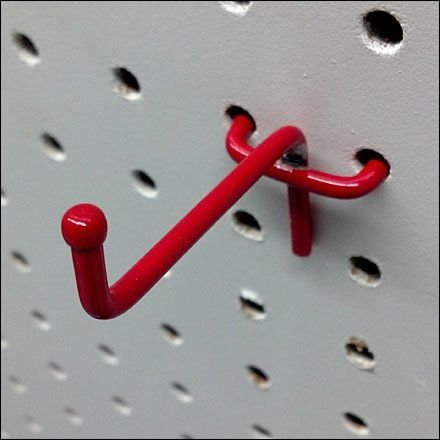
Standard single hooks sit roughly an inch and a half from the board surface. Small shelf brackets bring items out about three to four inches. Deeper baskets and bins project five to six inches. Wooden dowel shelves can support items eight to ten inches deep depending on the build. And clip-on pot racks and larger organiser baskets can project even further.
If every accessory you install projects the same distance, the board reads flat. Visually flat and functionally limited. But when you deliberately layer different depths across zones, things stored close to the board (keys on a hook, a small mirror, a calendar page clipped at the top) combine with things held further out (a fruit basket, a small plant shelf, a container of kitchen tools) to create actual range. Your eye moves through it rather than bouncing off a flat grid of identical projections.
Think about the way a well-designed boutique or gallery display works. Objects at different distances from the wall create depth and separation naturally. They also make it easier to see and access each thing without moving others out of the way.
The practical limit to keep in mind: pegboard is anchored into drywall at the end of the day, and unless you’ve hit studs with your furring strips, there’s a weight ceiling to respect. I’d be cautious about anything over about fifteen pounds on a single hook. But for the categories that most studio residents actually need to organise, kitchen tools, cables, bags, plants, stationery, craft supplies, depth variation is completely achievable within safe weight limits.
Using vertical space in a studio apartment is always about creating the most storage yield per square foot of wall. Depth layering is how pegboard delivers on that promise instead of just looking like a flat, busy surface.
3. Make It Look Like It Actually Belongs in the Room
This is the chic trick. And in a studio, it matters more than anywhere else, because your storage is always in the room. Always on display. There’s no mudroom to hide the messy shelf or a garage that nobody sees. Whatever you put on your wall, you’re living with it constantly.
Paint the board. This is the single most impactful change you can make before you hang a single thing.
A raw brown hardboard pegboard announces itself as a utility object. A painted board, especially one matched to your wall colour, reads as a deliberate design element instead. The items on it become the visual subject, not the board itself. I’ve done this in studio spaces where guests walked in and genuinely could not tell the storage system was a pegboard until they got close enough to see the hooks.
The contrast approach works too, and works beautifully when done with intention. A deep forest green or matte black pegboard in an otherwise neutral studio can read as a striking feature wall moment, especially when paired with brass or brushed gold hardware and a couple of trailing plants. I’ve designed studio setups like this and the reaction is always the same: people are surprised when I tell them it started as a fifty-dollar hardware product.
| Approach | Best For | Paint Finish to Use |
|---|---|---|
| Match the wall colour | Small studios, seamless look | Eggshell or satin |
| Soft contrast (dusty blue, sage green) | Adding warmth or colour | Satin or semi-gloss |
| Bold contrast (black, deep forest green) | Feature wall statement | Matte or chalk finish |
| Natural wood stain | Warm, organic, Japandi-leaning spaces | Penetrating oil or wax finish |
Beyond paint, think about hardware consistency. Mixing chrome hooks with brass pegs with matte black bins is the fastest way to make a board look unplanned. Choose one hardware finish and stay with it. Every accessory in that finish, and the board will read as intentional regardless of what’s hanging on it.
And leave breathing room. Not every peg needs to be filled. Deliberate empty space between zones makes the board look curated, not crammed. A small framed print hung from a hook, one trailing pothos in a little clay pot, a woven tray tucked into a corner of the board. These are the touches that push a pegboard from “wall-mounted storage solution” to “this person clearly has taste.”
The broader question of how your studio’s decor either opens the room up or closes it down is worth thinking about. This piece on decor mistakes in a first studio at Studio Apartment Setup is one of the more honest takes I’ve come across on that specific subject.
4. The Placement Mistake That Undoes Everything
Where the board goes matters more than any of the three tricks above. Because if the location is wrong, nothing else works. You won’t use a storage system that’s inconvenient to reach, no matter how beautifully it’s organised.
The most common mistake is putting a pegboard behind a door that swings open and blocks it, or in a hallway corner where you’d have to physically step around furniture to access it. The board gets ignored. Not because the system failed, but because the friction of using it is just slightly too high.
Pegboard works best at genuine eye level, in a location you pass multiple times a day. Directly above a desk. Behind a kitchen prep zone. At the entry of a studio where you naturally set things down and pick things up when you leave. Those placements get used consistently. An out-of-the-way board becomes another surface that slowly fills with things you meant to deal with later.
And once it’s up and running, don’t treat it as fixed. The whole advantage of pegboard over traditional shelving is that you can reconfigure without a drill every time your needs change. If a zone isn’t working after six weeks, move things around. Try a different accessory. The flexibility is the point, and it’s worth using it.
Why your studio feels chaotic is a question that usually has a spatial answer rather than a stuff-related one. And for most studio apartments I’ve worked in, the walls are the untapped part of that answer.
FAQs
Can I install pegboard in a rental without losing my deposit?
Technically yes, but be honest with yourself about what the install involves. The furring strips that create the necessary gap between the board and drywall do require screws into the wall, typically four to six of them for a standard four-by-four foot panel. Most landlords consider a few small holes filled with spackle before move-out to be normal wear and tear, but read your lease first. Anyone suggesting Command strips as an alternative is describing a different product entirely, those won’t support the weight of an actual pegboard system.
What size board should I start with?
A two-by-four foot panel is a reasonable starting point if you’re uncertain about commitment. It’s big enough to hold a meaningful amount of storage but small enough to test your zoning approach without covering an entire wall. Standard pegboard panels come in two-by-four, four-by-four, and four-by-eight foot sizes at most home improvement stores. For a kitchen wall, I’d recommend going to at least four-by-four.
Why do my hooks keep falling out?
Almost always one of two reasons: you didn’t leave the proper gap behind the board (which means the hooks can’t engage the back side properly), or your hooks aren’t compatible with your board’s hole spacing. North American standard pegboard uses one-inch hole spacing with quarter-inch holes. Some imported boards use a different spacing that won’t accept standard hooks. When in doubt, buy your hooks from the same supplier as your board.
How do I get rid of the workshop look?
Paint it, first and always. Then choose hooks in a single consistent finish rather than mixing hardware styles. Leave intentional empty space between zones. And add at least one non-functional element, a small framed image, a trailing plant, a decorative object, anything that signals the board was curated rather than filled. The difference between a garage workshop pegboard and a design-forward studio pegboard is almost entirely in those choices.
Is pegboard worth the effort compared to a regular wall shelf?
For a studio, yes, specifically because of the flexibility. A fixed shelf commits you to one configuration. Pegboard lets you reorganise every time your life changes, and in a single room that functions as bedroom, kitchen, office, and living room all at once, your needs will shift often. A basic four-by-four pegboard setup with a solid accessory kit runs well under ninety dollars, which puts it firmly in reach of studio storage approaches under fifty dollars in spirit, if not quite at that price point for the full install.