
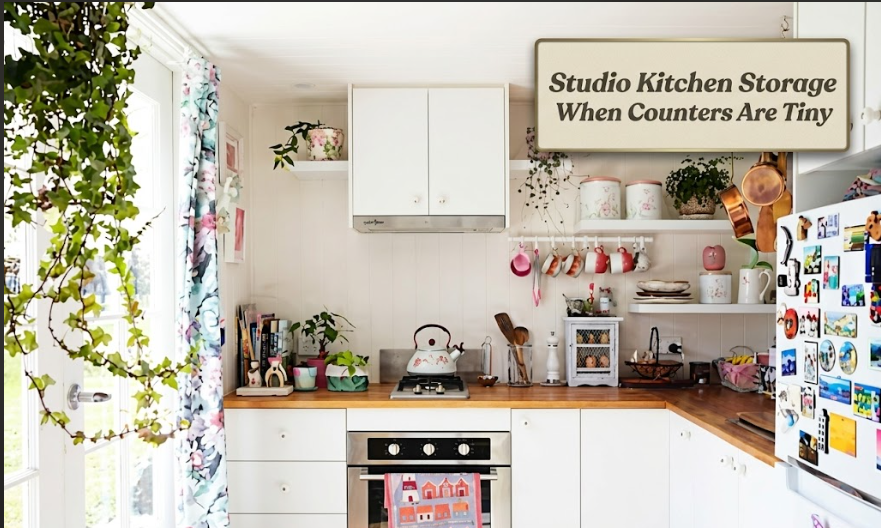
The misconception I see most consistently in small kitchens is this: the solution is better organization. More canisters. A nicer knife block. A tiered produce basket. A dish rack that drains into itself instead of onto the counter. People spend real money on organizers, arrange everything very carefully, and end up with exactly the same amount of counter space they started with, just more expensively occupied.
Counter clutter in a studio kitchen isn’t an organization problem. It’s a volume problem. And no amount of matching containers changes that.
This distinction matters because it changes how you approach the whole kitchen. The first step isn’t to buy anything. It’s to take almost everything off the counter and interrogate each item individually before letting it back on.
1. Three Myths That Make Small Kitchens Worse
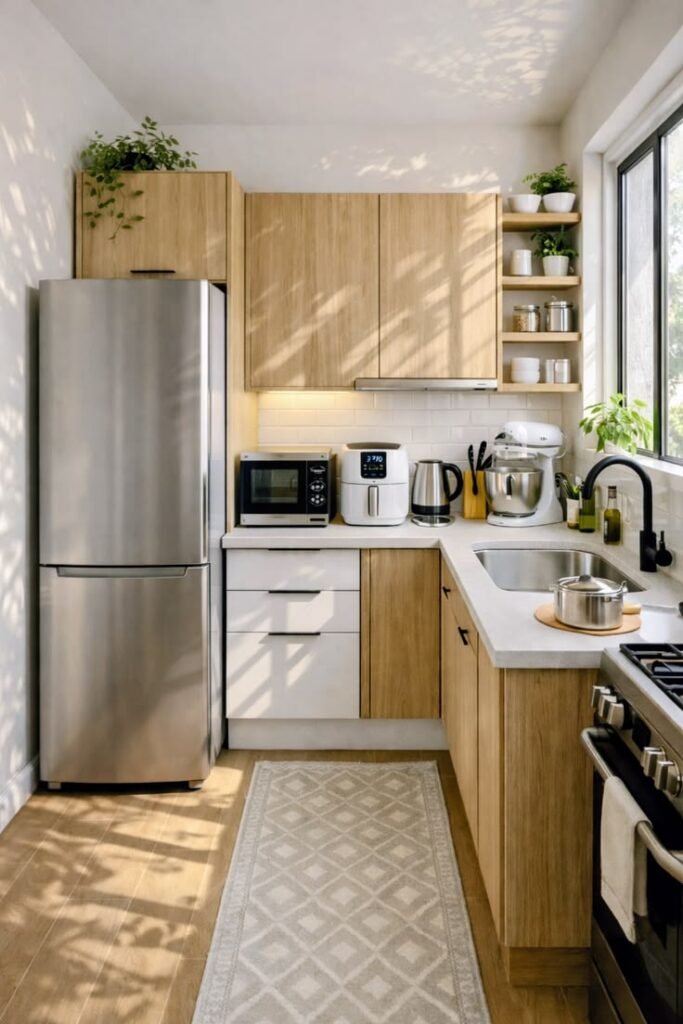
Myth: You need appliances accessible because you use them every day.
Most people own between four and seven countertop appliances. The toaster, the coffee maker, the electric kettle, the air fryer, a blender, possibly a stand mixer. Ask yourself when you last used each one and you’ll usually find the coffee maker or kettle gets used daily and the rest gets used occasionally at best. The daily items earn counter space. The rest belong in a cabinet.
The resistance to this comes from a usability argument: “If it’s in a cabinet I won’t use it.” This is frequently true, which means one of two things. Either you genuinely use the appliance so rarely that it’s acceptable in a cabinet, or the barrier of opening a cabinet door is stopping you from using something you actually value, in which case it’s a habit problem, not a storage problem.
Myth: Open shelving above the counter gives you more storage.
Open shelving gives you more visible storage. In a studio kitchen where space is genuinely tight, visible storage looks worse than no storage the moment it gets crowded. Three open shelves with mismatched spices, a half-used bag of pasta, a cutting board standing up against the wall, and a few random jars reads as chaos. The same shelves with twelve identical spice jars, two matching bowls, and nothing else reads as a design decision.
Open shelving works in small kitchens only if you’re prepared to edit what goes on it aggressively, and keep it that way.
Myth: A larger cutting board solves the counter space problem.
A large cutting board placed over the sink is a real space-creation technique in small kitchens, and one I do recommend. But it doesn’t solve storage, it just temporarily reclaims a surface. The storage problem lives in the cabinets and on the walls, not in the cutting board.
2. What Actually Belongs on a Studio Counter
The honest answer is: very little.
Every item on a kitchen counter has to pay rent in one of two ways. Either it’s used every single day without exception, or its size or fragility makes cabinet storage genuinely impractical. That’s the test.
Here’s a plain-text checklist to work through. Go through your counter items and ask where each one actually belongs.
COUNTER AUDIT: KEEP OR STORE?

Item                       | Qualifies for Counter If...
---------------------------|------------------------------------------
Coffee maker or kettle     | Used daily. Yes, keep it.
Toaster                    | Used daily? Keep. Used occasionally? Cabinet.
Air fryer                  | Takes 30% of the counter? Belongs in a cabinet.
Knife block                | Magnetic wall strip is better and frees surface.
Dish rack                  | Only if no drying space alternative exists.
Fruit bowl                 | If you actually eat the fruit. Otherwise, skip.
Paper towel holder         | Under-cabinet mount replaces it entirely.
Stand mixer                | Cabinet only, unless you bake multiple times a week.
Oil and salt               | Acceptable near the stove. Two items maximum.
Spice jars                 | Drawer, cabinet, or magnetic wall strip. Not the counter.
Cutting board              | Hung vertically or stored in a cabinet slot.
Small appliance #5, 6, 7   | Give them away.
Every item that moves off the counter does one of two things: goes into a cabinet, or goes onto the walls. That’s it. There’s no third category.
3. Going Vertical Above and Around the Counter
Studio kitchens have one chronic underused asset: the wall space above the counter that isn’t taken up by cabinets. This zone, usually 18 to 24 inches between the top of the counter and the bottom of the upper cabinets, is where most of the useful wall storage goes.
A magnetic knife strip mounted here takes knives completely off the counter and off a knife block without any footprint. A standard 16-inch strip handles five to seven knives comfortably. Mounting it at eye level rather than above the cabinets is counterintuitive to a lot of people but it’s the right call: you can see what you’re reaching for without hunting.
Under-cabinet hooks work well for mugs, measuring cups, and utensils. A strip of five or six hooks underneath one cabinet section frees up an entire drawer. The caveat is that hooks only look clean if what’s hanging on them is consistent, not a random collection of things that didn’t fit elsewhere.
Wall-mounted spice rails are a reasonable option if you’re renting and the wall surface accepts adhesive strips at the weight rating you need. Magnetic spice tins on the side of the fridge are a better option if you have limited wall surface. A full set of 12 tins occupies roughly 30 inches of fridge real estate and removes spices from counter and cabinet entirely.
The article on studio kitchen storage without a pantry gets into the cabinet and pantry side of this in more depth. Worth reading alongside this if you’re also dealing with nowhere to store dry goods.
4. Making Two Cabinets Behave Like Four
Most studio kitchens have between two and four upper cabinets and one or two lower cabinets. The standard depth is 12 inches for upper and 24 inches for lower. Standard shelf configuration inside is usually a single fixed shelf, meaning two levels per cabinet. That’s a poor use of vertical space inside the cabinet.
Adjustable shelf risers, the kind that sit inside an existing cabinet and create a third level, roughly double the usable space in an upper cabinet without any installation. They run about $10 to $20 for a pair. A single cabinet that normally holds plates and bowls in two stacks now holds three.
Nesting cookware matters more than most people account for. A 10-inch skillet, an 8-inch skillet, and a small sauce pot that all nest inside each other take up one cabinet slot. The same three pieces that don’t nest take up three. If you’re buying new cookware for a studio, nesting capacity is more important than brand.
Turntables, the lazy Susan style, inside corner cabinets and deep lower cabinets are genuinely useful for accessing things stored at the back. Without one, the back eight inches of a lower cabinet is practically unreachable and becomes dead storage.
5. The Edit That Does More Than Any Storage Product
There’s a version of this conversation that avoids the uncomfortable part, but I’m not going to do that.
The most effective kitchen storage solution in a studio apartment is owning fewer kitchen things. Fewer appliances. Fewer gadgets. Fewer specialty tools bought for one recipe and never touched again. Fewer duplicate items, because two peelers exist in a kitchen drawer and nobody knows how they got there.
Studio Apartment Setup addresses this from a different angle in the piece on what happens when you go 30 days without buying anything new, and the mindset it describes applies directly to the kitchen. The kitchen accumulates fast because it’s easy to justify each individual purchase. A spiralizer for $18 seems reasonable. But it takes up the same space as six mugs and gets used four times a year.
The question isn’t whether each item is useful in isolation. It’s whether this specific item earns its place in a kitchen with 18 inches of counter.
If you’re still figuring out what you actually need in a studio setup from scratch, the week-one essentials guide is a useful starting reference for kitchen tools specifically.
And one more note, because I see this and it drives me a little crazy: the spice collection. Most home cooks use 8 to 12 spices with regularity. If you have 30 spice jars in a studio kitchen, 18 of them are working against you. Consolidate or donate. The kitchen immediately gets better.
FAQs
My studio kitchen has no upper cabinets at all. What do I do?
A freestanding kitchen cart with shelving is the most common solution, and it works if you choose one that fits the space. Look for a cart with a butcher block or stainless top, two shelves underneath, and a footprint under 30 by 20 inches. It adds counter space and storage simultaneously. The downside is floor space, so position it against a wall and only add it if you genuinely have space to keep a walking path clear.
Is a magnetic spice rack on the fridge actually enough for real cooking?
For most people who cook four or five times a week at home, yes. A set of 20 to 24 magnetic tins covers the spices most people actually use. The practical issue is visibility. Tins on the side of the fridge aren’t visible the way a counter display is, so label the top of each lid, not just the face. You’ll see what you’re reaching for when the tin is at shoulder height.
The counter in my studio kitchen is genuinely around 12 inches deep. Is that fixable?
Counter depth is fixed. What you can do is extend the usable prep surface with an over-the-sink cutting board, which adds 6 to 10 inches of prep surface at the same height. Boards sized to fit across most standard sinks run about $25 to $45 and are one of the few products that make a genuine square-footage difference rather than just a visual one.
I rent, so I can’t install anything permanently. Which wall storage options still work?
Adhesive strips rated for heavier loads, specifically the 3M Command strips rated at 4 to 7 pounds, handle magnetic strips and small hooks on smooth painted drywall reliably. They won’t work on textured surfaces or poorly primed walls. For a heavier option like a full spice rail or small shelf, freestanding solutions that lean or sit on the counter are safer in a rental context. The over-the-door pantry organizer used inside a cabinet door is another no-drill approach worth considering.
Before signing my studio lease, is the kitchen size something I should actually evaluate?
Yes, and more specifically than most people do. The things to check before you sign a studio lease piece covers this, but for the kitchen specifically: count the linear feet of counter, count the number of cabinets, and check whether the refrigerator opens in a direction that blocks the main prep space. A studio with 6 linear feet of counter and four cabinets is workable. One with 3 feet of counter and two cabinets requires accepting real constraints on how you cook at home.