
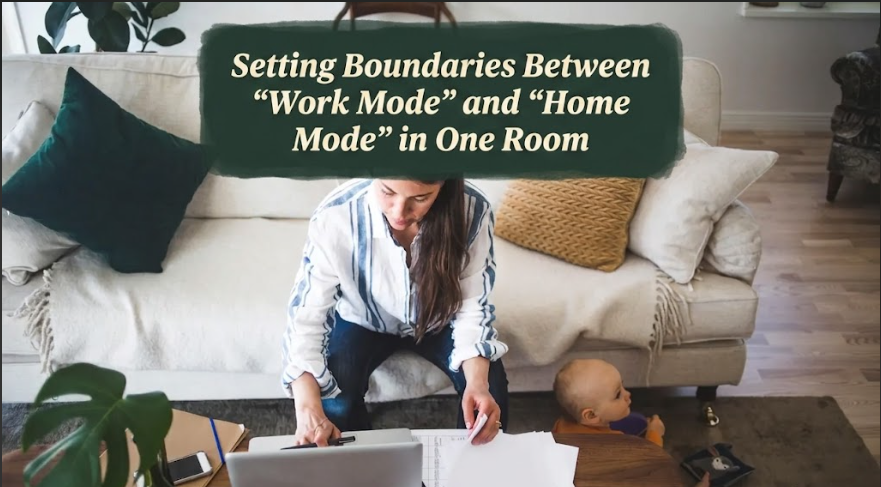
Your brain does not know the difference between your desk and your bed if they’re four feet apart and facing the same direction. That’s the whole problem, stated as plainly as I can state it. Not motivation, not discipline, not a productivity app. Proximity and sightline.
I started working from a studio myself for about eight months a few years back, between projects, and I genuinely thought my design background would save me from the usual traps. It didn’t. I set my desk up facing the window, which felt smart at the time, natural light, good energy, all of it. What I hadn’t accounted for was that my bed was directly behind my chair, in my peripheral vision every single time I turned to grab a coffee or stretch. By week three I was waking up at 2am thinking about client emails. That’s not a discipline problem. That’s a spatial one, and it’s fixable in a way that discipline usually isn’t.
1. Start With Sightlines, Not Furniture
Before you buy a single divider or rearrange anything, walk to your desk chair and sit down. Actually sit in it. Now look around, slowly, a full turn if the room allows it. Every single thing your eyes land on while sitting at that desk is something your brain associates with work, whether you intend it to or not. If your bed is in that sightline, your brain is quietly building an association between “the place I sleep” and “the place I answer emails,” and that association gets stronger every single day you sit there.
Start With Sightlines, Not Furniture
This is the step almost everyone skips, and it’s the one that actually matters most. People jump straight to buying a room divider or a folding screen, which can help, but only after you’ve solved the sightline problem at the source. A screen placed behind you doesn’t remove your bed from view if you’re facing the wrong direction to begin with.
Turn your desk so the bed is behind you, ideally against a wall you’re not facing at all during work hours. If your studio’s layout won’t allow that because of window placement or electrical outlets, and sometimes it genuinely won’t, the fallback is a visual break between the two, which is where the piece on separating your work zone from your sleep zone in a studio setup goes further than I can here.
2. Build a Two-Minute Transition Ritual
Here’s something I didn’t expect to matter as much as it did. In a house with a separate office, the walk from the office to the kitchen or living room acts as a transition. Your brain gets a few minutes of neutral space to shift gears. In a studio, that walk doesn’t exist. You go from typing an email to lying on your bed in about four seconds, and your nervous system doesn’t get the memo that work ended.
I started closing my laptop, physically standing up, and doing one small, specific, slightly ritualistic thing every day at the end of work. For me it was making tea, the same mug, the same few minutes, every single afternoon. It sounds almost silly written down. But the repetition is what does the work, not the tea itself. Your brain learns the sequence, laptop closed then tea then home mode begins, the same way it learns any other habit loop.
Pick something concrete. Not “relax for a bit,” which is too vague to actually register as a signal. Change your shirt. Move a specific object from your desk to a drawer. Light a candle you only light after work hours. The action needs to be repeatable and slightly deliberate, not something you’d do anyway during the workday.
3. Use Light Temperature as a Second Signal
This one surprises people, including some of my own clients when I bring it up. Studio Apartment Setup’s lighting layering guide covers general lighting layering elsewhere, but the boundary-specific version is simpler than a full lighting plan. Work hours, cooler white light at your desk, ideally from a task lamp rather than an overhead fixture. After hours, warmer, dimmer light, and if you can manage it, a completely different light source than the one you used for work.
Your body responds to light temperature more than most people realize, and using two visibly different light sources for the two modes gives your brain a second, non-verbal cue that something has changed, separate from whatever ritual you built in step two. I’ve had clients tell me this single change did more for their sense of “leaving work” than a divider ever did, which I’ll admit surprised me the first few times I heard it.

4. Keep a Physical Boundary, Even a Small One
You don’t need a wall. You don’t even need a full room divider, though the ones I’ve tested and recommend do help in the right layout. What you need is one object between your work zone and everything else that has to be physically moved, opened, or crossed to switch modes. A folded screen you push closed. A curtain you pull across. Even a laptop stand you physically pack away each evening, so the desk itself disappears from view rather than sitting there half asleep, half awake, all evening.
I’ll be honest, the curtain option is the one I recommend most often now, mostly because it’s cheap and it works without eating floor space the way a divider does. The three curtain divider ideas piece goes through the specific hardware and hanging heights that make this actually functional rather than flimsy.
Here’s a quick-reference version of the whole approach:
- Face your desk away from your bed, full stop, before doing anything else
- Build one small, repeatable transition ritual you do every single day at the same point
- Use two visibly different light sources for work hours versus evening
- Keep one physical object, however small, that has to be moved to end the work day
- Avoid working from your bed or sofa entirely, even occasionally, since it collapses the boundary you’re trying to build
Where People Usually Undo All of This
The most common mistake, and I see it constantly, is doing all four of these things and then answering one work email from bed on a Sunday because it felt faster than getting up. That single exception resets the association your brain just spent weeks building. I’m not saying you’ll never do it. I’ve done it myself, more than once, and each time I noticed the boundary got a little blurrier for a few days afterward. But the fewer exceptions you make, the faster the whole system holds without effort.
And if video calls are part of your work setup, the framing and background people notice on camera adds a whole separate layer to this, one I’d genuinely recommend reading, in the video calls in a studio piece, before your next call if you haven’t already sorted out what’s visible behind you.
One Honest Note Before You Try This
None of this works instantly. Give it two full weeks before deciding whether it’s working, because the first several days will feel like nothing has changed and that’s normal.
FAQs
What if my studio is too small to face my desk away from my bed? Use a tall object, a bookshelf, a folding screen, even a tall plant, as a partial visual block rather than relying on furniture orientation alone. It won’t be perfect, but it reduces the sightline enough to matter.
Does this actually work if I live alone and there’s no one to “catch” me working late? Yes, arguably it matters more, since there’s no external cue like a coworker leaving the office to signal the day is over. The ritual has to do that job on its own.
How long before this stops feeling forced? Most people I’ve worked with notice it start to feel automatic somewhere around the two to three week mark, assuming the ritual stays consistent and specific rather than vague. It’s one of the most common follow-up questions Studio Apartment Setup readers send me after trying this.
Is it worth buying a proper room divider or is a curtain enough? A curtain is enough for the visual and psychological boundary. A solid divider adds a small amount of sound dampening too, which matters more if you’re on calls frequently.
Can lighting alone fix this without the other steps? No, lighting is a strong secondary cue but not a substitute for sightline and ritual. Layered together, all three do more than any one alone.
If your studio’s whole layout still feels like it’s fighting you rather than working with you, the piece on why your studio feels chaotic and the one fix that changes it is a good next read.