

A client of mine asked me something last spring that I still think about: “If I can’t afford a room divider or built-in shelving, can a rug actually do that job on its own?” She had a single open rectangle of a studio, a queen bed on one side, a small sofa on the other, and nothing separating them but air. My answer surprised her a little. Yes, a rug can do a version of that job. Not the whole job. But more of it than most people expect.
Here’s the misconception I run into constantly. People assume one large rug under everything creates a cohesive, “put together” look. It’s the opposite, in most studios. One giant rug spanning the whole floor tends to flatten the room into a single zone, which is exactly the problem you’re trying to solve. The room already feels like one zone. Adding one rug that touches every piece of furniture just confirms that feeling instead of breaking it.
1. The Belief: Bigger Rug Equals Bigger, More Unified Room
This is the advice you’ll see everywhere, and it’s not entirely wrong for a real living room with defined walls. In that context, sizing up does create cohesion. But a studio doesn’t have the walls doing the zoning work for you. The rug is one of the few tools you actually have left, and if you use it the way you’d use it in a three bedroom house, you waste its one real advantage.
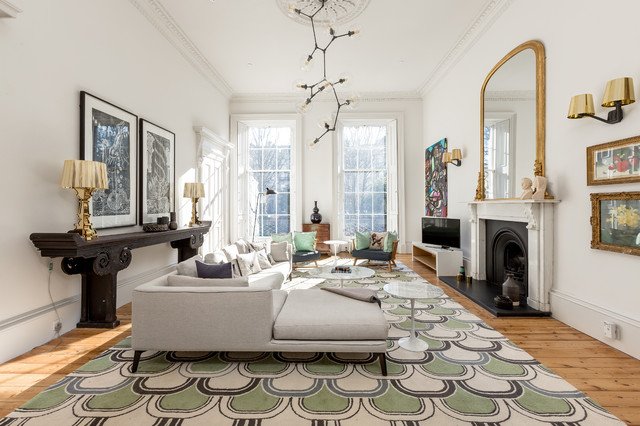
I made this exact recommendation to a client early on, before I fully understood studios as their own category rather than a smaller version of a regular apartment. We rugged the whole floor in one continuous piece. The room looked nice in photos. In person, walking into it, there was no sense of arriving anywhere. No transition. Just one flat plane from door to window.
2. Why It’s Wrong: A Single Rug Removes the Cues Your Eye Needs
Your eye reads floor changes as room changes. That’s true whether the “room” is defined by walls or not. Studio Apartment Setup gets this question in different forms constantly, and the answer always comes back to the same mechanism: a floor transition, even a subtle one, tells your brain “you have left one area and entered another,” the same way stepping from tile onto carpet in a normal home signals kitchen to living room.
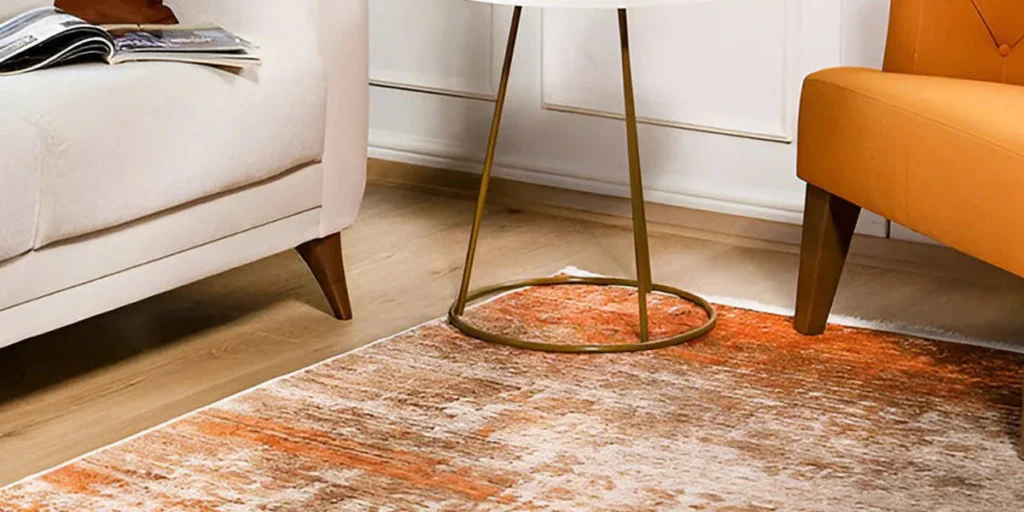
One continuous rug removes that cue entirely. And here’s where people usually go wrong twice over, not once. First mistake is the single giant rug. Second mistake, when people do catch on and try to fix it, is buying two rugs that are nearly identical in color and pattern. That still reads as one zone, your brain just sees a seam in it rather than two distinct spaces.
If you’re working with a layout where zones matter and walls aren’t an option, the piece on studio apartment zones and how to create separate spaces without walls covers the layout side of this in more depth than I can here, but the rug principle is the fastest single change most people can make this weekend.
3. What Actually Works: Two Distinct Rugs, Deliberately Different
The fix is two smaller rugs, chosen to read as clearly separate from across the room, not matching, not coordinating in an obvious “these go together” way. Different texture, different tone, sometimes different shape entirely. A rectangular rug under the sleep zone, a round or square one under the seating zone. The contrast is doing the work your walls would otherwise be doing.
Sizing matters more than most people think, and this is where the general “buy the biggest rug you can afford” advice actively works against you in a studio. The rug sizing guide and the rule most people break goes into the exact proportions, but the short version is that each rug needs to extend far enough under its furniture group to read as a defined footprint, without extending so far that it starts creeping toward the other rug and closing the gap between zones.
That gap matters. Leave visible flooring between the two rugs, even eighteen inches to two feet if the room allows it. That strip of bare floor is doing more zoning work than either rug alone.
| Zone | Rug Shape | Rug Tone Relative to Other Zone | Approx. Distance From Other Rug |
|---|---|---|---|
| Sleep zone | Rectangular, under bed and nightstands | Warmer or darker | 18-24 inches minimum |
| Seating zone | Round or square, under sofa/chairs | Cooler or lighter | 18-24 inches minimum |
| Entry/transition | No rug, or a narrow runner | Neutral, distinct from both | N/A |
I’ll admit this table oversimplifies it a little. Every room’s proportions are different and I’ve broken these exact ratios plenty of times when a client’s furniture demanded it. But it’s the right starting point before you go shopping.
4. Where People Still Get Stuck Even After Buying Two Rugs
The most common failure point, once someone has actually bought two separate rugs, is furniture placement that ignores them. If your sofa’s front legs are on the rug and the back legs are floating off the edge onto bare floor, the rug looks like an accident rather than a decision. All four legs on, or all four legs off with just the front legs anchoring the rug’s front edge under a coffee table, both read as intentional. Two legs on and two off does not.
This is a mistake I made in my own first studio, actually, and I didn’t catch it for months. My sofa sat half on, half off a rug I’d chosen carefully, and I couldn’t figure out why the whole seating area still felt unresolved even though I’d done the “right” thing by using a separate zone rug. Once I pulled the sofa fully onto the rug, the zone read correctly for the first time.
If your studio’s biggest issue isn’t the rug at all but general chaos in how the space reads room to room, the piece on why your studio feels chaotic and the one fix that changes it is worth pairing with this, since rugs are only one piece of the zoning puzzle.
One Last Practical Note
Don’t buy both rugs on the same day from the same collection. It’s tempting because it’s convenient, and it almost always results in two rugs that are secretly coordinated enough to blur back into one zone. Buy them a week apart if you have to, from different sources, and hold them up against each other before committing. This is the kind of small, unglamorous fix I keep coming back to whenever Studio Apartment Setup readers send me photos of a space that “should” work but doesn’t quite.
FAQs
Can I use one large rug if my studio is unusually big? In a genuinely large studio, over 500 square feet, a single large rug under just the seating area can work, paired with a second smaller rug or none at all under the bed. Under 400 square feet, two distinct rugs almost always outperforms one.
What if I can only afford one rug right now? One rug under the seating area, paired with a completely bare floor under the bed, still creates more zoning than one rug spanning both. Bare floor next to a rug reads as a boundary on its own.
Do the two rugs need to be the same quality or price point? No. I’ve had clients pair a nicer wool rug in the seating zone with a budget flatweave under the bed, and it worked fine because the tones and shapes were deliberately different, not because the materials matched.
How do I know if my two rugs are too similar? Stand at your front door and look at the floor from across the room. If you can’t immediately tell where one rug ends and the other begins without walking over, they’re too similar.
Should the rugs match my curtains or bedding? Loosely coordinate, don’t match exactly. A rug that matches your bedding perfectly tends to visually merge with it, which undoes some of the zoning contrast you’re trying to create.
For anyone rethinking their whole layout rather than just the floor, the guide on the four studio apartment layout principles every interior designer uses first is a good next stop.