
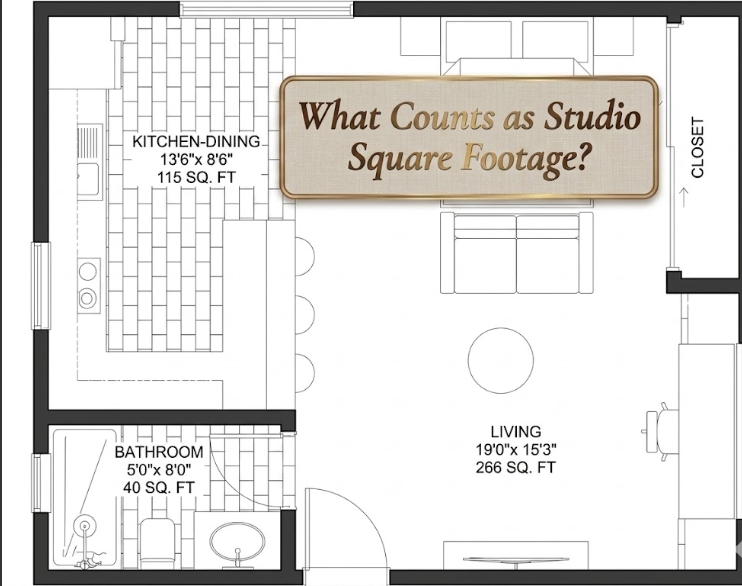
Two studios in the same building can both be listed at 410 square feet and feel like they belong to different buildings entirely. One has an open footprint you can actually furnish. The other loses half its number to a deep entry hall, a boxed-in mechanical unit, and a kitchen nook that barely qualifies as a kitchen. The number on the listing rarely tells you which one you’re getting, and almost nobody asks how that number was calculated until after they’ve already signed.
1. “Square Footage” Isn’t One Number, It’s Several
There’s no single agreed-upon way to measure an apartment. For single-family homes and many condos, appraisers follow ANSI Z765-2021, which sets specific rules: measurements are taken to the exterior walls, ceilings need to be at least 7 feet over more than half the room, and anything below grade gets reported separately rather than folded into the total. For multi-unit rental buildings, the relevant standard is ANSI/BOMA Z65.4, which actually offers two different methods. The Gross Method measures to the outside of the exterior walls, wall thickness and all. The Net Method measures only to the inside finished surface. Same apartment, two legitimate numbers, and a noticeable gap between them.
Here’s the part most renters never find out: most rental listings don’t use either standard. The number often comes straight from decades-old architectural drawings that nobody has re-measured since the building was converted, renovated, or split into smaller units. A landlord isn’t lying when the number is off. They’re usually just repeating what’s already on file.

2. What Usually Makes the Cut
Some things are counted almost every time, regardless of which method a building happens to use. In-unit closets count, even the shallow ones that hold one row of hangers and nothing else. The bathroom counts, walls and all. A galley kitchen or kitchenette counts, even when it’s really just a counter and two appliances against one wall. In an alcove studio, the sleeping nook counts too, since it’s enclosed living space within the same four exterior walls as the rest of the unit.
This is also where loft-style studios get interesting. If the loft has a real floor you can stand on, it typically gets added to the total. If it’s more of a platform with a ceiling too low to stand under, the rules get murkier fast, and this is exactly the kind of detail that varies building to building.
3. What Quietly Eats Into Your Real Floor Space
This is the gap that catches people off guard. A number can be technically accurate and still mislead you about how much usable room you’ll actually have.

Mechanical or HVAC closets are a common culprit, especially in older buildings or anywhere with packaged through-wall units. They sit inside the footprint, so they get counted, but you can’t put a dresser where the unit lives. Structural columns do the same thing in converted industrial buildings: counted on paper, unusable in practice, and often positioned exactly where you’d want to put a bed. Sloped ceilings under a loft or alcove are sometimes included in the gross number even for the section where you can’t stand upright, which is technically allowed under most standards as long as part of the room clears the minimum height.
Balconies and patios behave differently than people expect. They’re frequently left out of the unit’s listed square footage altogether, or reported as a separate line item, which is one reason a unit “with a balcony” doesn’t always feel bigger than one without.
If you’re trying to figure out how much vertical storage you’ll need to make up for whatever floor space disappears, studio apartment storage and how to use vertical space the right way is worth reading before you start buying shelving.
4. The Mistake Almost Everyone Makes With This Number
People treat listed square footage as a stand-in for “how much furniture will fit,” and that’s where things go wrong. Two studios at an identical 400 square feet can have completely different open floor plans depending on where the windows sit, where the columns land, and how deep the closets cut into the room.
We see this constantly on Studio Apartment Setup: someone buys a sofa or bed frame sized for “a 400 square foot apartment” without ever measuring their actual open floor, and the piece either doesn’t fit through the door or eats the one clear wall they had. The listed number is a starting point for comparing units. It is not a substitute for measuring your own walls before you buy anything. This matters even more for furniture that needs clearance on multiple sides, like under-bed storage in a studio, where a few inches of difference decides what actually slides under.
5. Getting the Real Number Before You Sign
None of this means the listed square footage is useless. It just means it’s a starting figure, not a guarantee.
A quick reference for what to expect:
| Feature | Usually counted in listed sqft? | Usable as open floor space? |
|---|---|---|
| In-unit closets | Yes | No, storage only |
| Bathroom | Yes | No, separate room |
| Kitchenette/galley kitchen | Yes | Partial |
| Sleeping alcove or loft (standing height) | Yes | Yes |
| Sloped ceiling under 5 ft | Sometimes | No |
| HVAC or mechanical closet | Often | No |
| Structural column or beam | Yes | No |
| Balcony or patio | Rarely, often separate | No, separate from interior |
Before you sign anything, ask the leasing office directly which method was used to measure the unit, and ask if they have a floor plan with actual dimensions rather than just a single total. Bring your own tape measure to the walkthrough, even if it feels like overkill standing in someone’s leasing office. Measure the open floor between the windows and the door, not just the perimeter of the room. If you’re already deep in the process, what to ask your landlord before moving into a studio and the five things to check before you sign a studio lease cover a few other questions worth asking in the same conversation.
A tape measure costs less than a wasted trip to return a couch that doesn’t fit. That’s really the whole argument for doing this before move-in day instead of after.
Frequently Asked Questions
Does a sleeping loft or alcove count toward square footage? Usually, yes, as long as it has standing height and is enclosed within the unit’s exterior walls. Lofts with low ceilings or platform-style construction are measured more inconsistently, so it’s worth asking specifically rather than assuming.
Why do two studios with the same listed square footage feel so different in person? The total doesn’t describe layout. Window placement, closet depth, and structural columns can all eat into usable space differently even when the overall number on paper is identical.
Is the bathroom included in the total square footage number? Yes, almost always. The bathroom is enclosed living space within the unit, so it counts toward the total even though you obviously can’t use it as open floor space for furniture.
Do balconies or patios add to a studio’s square footage? Often not, or only as a separate reported figure rather than part of the main total. Don’t assume a unit with outdoor space is automatically larger inside than one without it.
How can I find the real usable floor space before signing a lease? Ask for a dimensioned floor plan instead of just a total number, and measure the open floor yourself during the walkthrough. The listed square footage tells you how the unit compares to others on paper. Your tape measure tells you what will actually fit.