
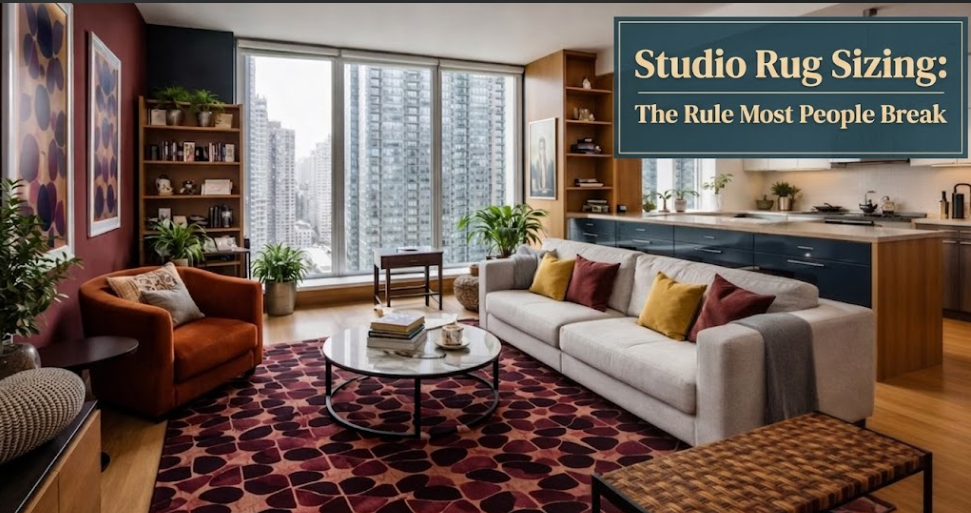
Every week, without fail, at least one or two clients send me photos of a studio apartment that isn’t coming together the way they hoped. Good furniture, thoughtful colour choices, decent layout. And then there’s the rug: a modest little 5×7 sitting in the middle of the room like it got dropped there accidentally and nobody moved it yet.
I’ve been designing spaces for over two decades, and rug sizing is the single most consistent mistake I see in small spaces. Not paint colour, not furniture scale, not lighting. The rug. Or more precisely, the belief that going smaller is the safer, smarter choice when you don’t have much floor space to work with.
It isn’t. And in a studio, where one rug may have to do the work of three separate rooms, getting this wrong affects everything else around it.
1. The Myth That’s Shrinking Your Studio
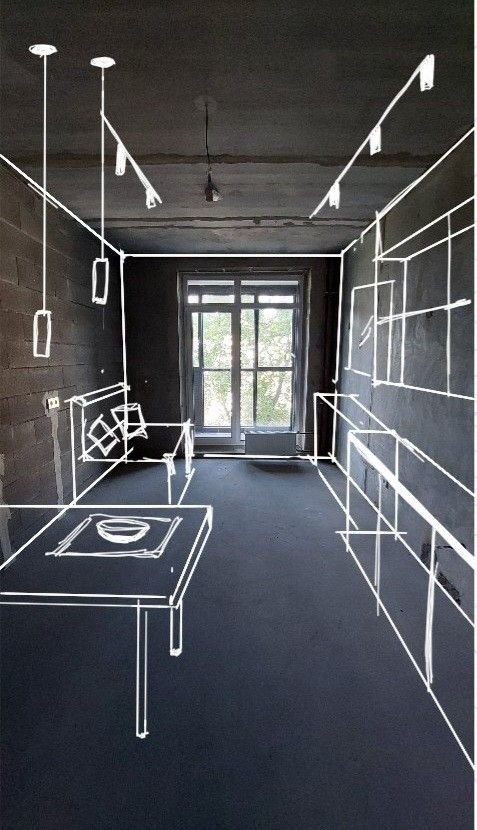
The logic seems reasonable enough. You’ve got 480 square feet, maybe 550 on a generous day. The last thing you want is a rug eating up the floor, so you go conservative, a 5×8 or a 5×7, tuck it under the coffee table, and wonder later why the room feels restless and slightly off.
What’s actually happening is straightforward. A rug that’s too small for the furniture arrangement it’s meant to anchor makes the furniture look like it doesn’t belong together. The sofa sits behind the rug rather than on it. The chairs hover at the edges. Everything floats with nothing connecting the pieces, and the eye reads this as disorder even if you can’t immediately name why.
But here’s what nobody says clearly enough: a small rug in a small room doesn’t make the room look bigger. It makes it look smaller. Because instead of one continuous visual plane, you’ve got a patch of rug surrounded by floor, surrounded by furniture with no clear relationship to any of it. The eye breaks it into fragments, and fragments read as crowded.
I’ve seen beautifully furnished studios with genuinely good taste throughout, and the whole room feeling anxious and unsettled, all because of one rug that was six inches too narrow on each side.
Go large. It takes confidence the first time. But it’s right.
2. What a Properly Sized Rug Actually Does
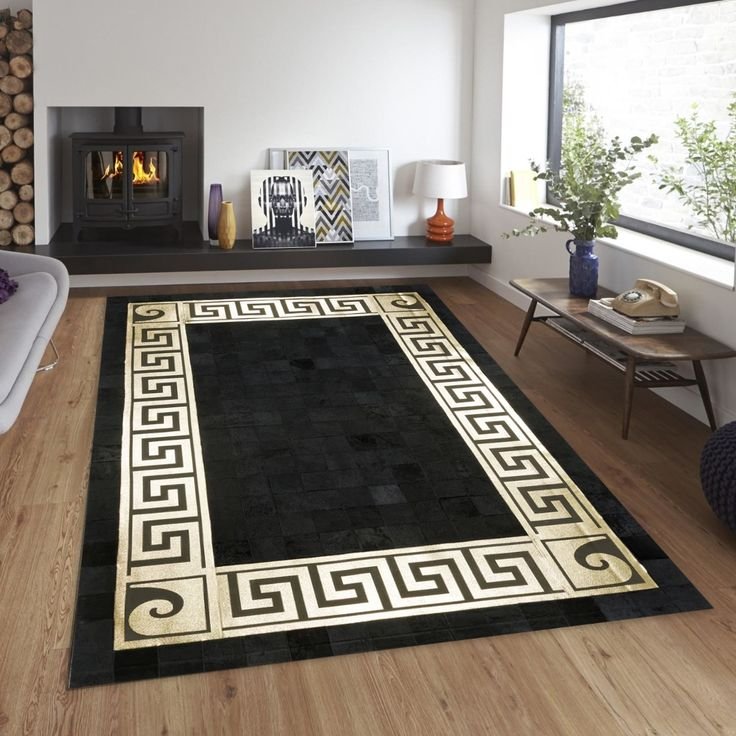
A rug in a studio apartment isn’t decoration. It’s architecture.
When you’re working with an open floor plan, the rug is often the primary tool available to tell the eye where one zone ends and another begins. It replaces walls. It says: this is the living area, this is where the dining happens, this over here is the bedroom. Without that signal, a studio reads as a single crowded room with too much furniture pushed into it.
The team at Studio Apartment Setup puts it well: creating zones in an open plan isn’t about physical dividers. It’s about visual ones. A well-sized rug anchors a furniture grouping so convincingly that you don’t need walls to separate the living zone from the sleeping zone. Their breakdown of how to create separate spaces without walls is worth reading before you buy anything, because it shows how the rug fits into a larger zoning strategy rather than being a standalone decision.
A properly sized rug also handles the visual weight of the room better than most people expect. It creates continuity. The eye travels across it and reads the arrangement as intentional, considered, finished. Same reason a well-chosen paint colour transforms a room more than any individual piece of furniture can. It’s a field. It sets the stage for everything sitting on top of it.
If you’ve ever wondered why a room in a design magazine looks so settled even with modest furniture, a lot of that is the rug. Correct size, correct placement. That combination does more heavy lifting than almost any other single decision in the space.
3. The Numbers You Actually Need
Enough philosophy. Here’s what matters when you’re standing in a rug shop or scrolling online at midnight.
For a living seating area, the goal is to have at least the front two legs of every piece of seating sitting on the rug. All four legs is ideal, but front legs on is the functional minimum that will read as intentional. A rug where only the coffee table sits on it, while all the sofa legs are on bare floor, is always going to look disconnected, it won’t matter how nice the sofa is.
For most studio apartment living arrangements, the sizing works out like this:
A 5×8 handles a single armchair with a side table. That’s it, it won’t carry a full sofa arrangement. An 8×10 is the starting point for a compact sofa setup. Still conservative, but functional. A 9×12 sounds enormous and looks exactly right once it’s on the floor.
For dining zones, the clearance needed is 24 inches of rug extending past each edge of the table, so that chairs remain on the rug when someone pulls them out to sit. This is the measurement almost nobody follows, and it’s why so many studio dining corners look slightly awkward even when the table and chairs are perfectly good. A 36-inch round dining table needs a rug that’s at least 6 to 7 feet across. Most people are working with a 4-foot round under that same table and wondering why the chairs feel like they belong to a different arrangement entirely.
Studio Rug Sizing at a Glance
| Studio Zone | Furniture | Minimum Rug Size | Ideal Size |
|---|---|---|---|
| Living seating area | Compact sofa + 1 chair | 8 x 10 | 9 x 12 |
| Living seating area | Loveseat only | 6 x 9 | 8 x 10 |
| Dining area (36″ round table) | 2 to 4 chairs | 6′ round | 8′ round |
| Dining area (48″ x 30″ rect. table) | 4 chairs | 5 x 8 | 6 x 9 |
| Bedroom zone | Full or Queen bed | 8 x 10 | 9 x 12 |
| Reading nook or desk corner | Single chair | 4 x 6 | 5 x 8 |
These numbers aren’t arbitrary suggestions. They’re the actual clearances needed for arrangements to feel complete rather than half-assembled.
4. Where People Usually Go Wrong
Getting the size right is the primary thing. But there are a few placement mistakes that undermine even a properly sized rug, and I see them nearly as often as the size errors themselves.
The first one: pushing the rug against the wall. The instinct is to free up space in the center of the room, so the rug gets backed into a corner or pressed against a baseboard. What happens is the rug looks like it’s hiding. It loses its ability to anchor anything. The rug needs to float within the furniture arrangement, not press against the room’s perimeter like it’s apologizing for being there.
The second mistake is more subtle: centering the rug on the room rather than on the furniture grouping. The rug belongs to the arrangement, not to the geometry of the floor plan. If your seating is in the lower half of the studio, the rug goes there. Centered on the room but off-center from the furniture is almost always worse than either alternative.
Third: pattern scale that fights the space. A large-scale geometric or oversized abstract works in a studio because it reads as one intentional thing. A small, busy, all-over pattern on a large rug reads as visual noise, and noise makes a small room feel smaller. When in doubt, simple texture, neutral or warm tone, large scale if you’re going patterned at all.
A side note here: I’ve noticed that rug mistakes tend to compound when other furniture decisions aren’t working either. The rug problem gets worse because everything around it is already a bit off. If that sounds familiar, the 6 decor mistakes in a first studio piece covers how these errors stack on each other. A too-matchy furniture set makes a space feel smaller, and then a tiny rug underneath it makes it feel smaller still. Fix the rug first, then reassess everything else.
And if you’re working on making the space feel bigger overall, mirror placement interacts with rug sizing in ways that matter. A well-sized rug combined with a correctly placed mirror can genuinely double the perceived depth of a studio. The mirror placement guide is clear on when this works and when it just looks forced.
5. Before You Buy, Do This First
Tape it out on the floor.
Painter’s tape costs almost nothing and will save you a very expensive return shipment. Mark the exact dimensions of the rug you’re considering directly on the floor, then arrange your furniture in the layout you intend. Stand back. Live with it for a day. You’ll know immediately if it’s too small. A 5×8 marked out on the floor beside a full sofa looks dramatically different from a 5×8 listed in a product description, and most people are genuinely surprised by how little it covers in context.
Also: measure the furniture grouping, not the room. The room’s square footage doesn’t determine the correct rug size. The furniture arrangement does. A sofa that’s 90 inches wide with two chairs flanking it has specific clearance requirements that are what they are regardless of whether the room is 400 or 700 square feet.
Material matters in a studio more than people realize, because a studio rug gets more traffic across a smaller area than a living room rug in a larger home. Very high-pile, plush rugs are beautiful initially, but they compress fast, show traffic paths, and can visually lower ceilings because they raise the perceived floor height. Low to medium pile, flatweave, or natural fiber rugs tend to hold up better, feel more intentional, and age well. Wool and wool blends are worth the investment if the budget allows. A rug that lasts ten years costs less over time than three inexpensive ones.
Studio Apartment Setup readers often ask about layering rugs, and it can work beautifully: a natural fiber base like sisal or jute underneath a smaller, more decorative rug creates depth and visual interest. But the base rug still needs to be the right size. You can’t fix a 5×8 by laying a second rug on top of it.
And if the arrangement still doesn’t feel settled after you’ve sorted the rug, it may be the zones themselves that need work rather than any individual piece. The room divider ideas for studios piece addresses this well. A rug defines a zone from the ground up. A room divider reinforces it from another angle. The two approaches solve the same problem, and sometimes you need a bit of both.
Frequently Asked Questions
Can a 5×8 rug work in a studio apartment? It can, but only in specific spots: a compact reading nook with a single chair, a small bedroom corner with a twin bed, or a dining zone with a very small round table seating two. For any living arrangement that includes a standard sofa, a 5×8 will leave the sofa legs off the rug entirely, and the room will read as incomplete regardless of everything else you’ve done right.
How far under the bed should a rug extend in a studio? At least 18 inches on both sides and at the foot of the bed. That’s the minimum clearance for stepping onto rug rather than bare floor when you get up, which matters both for comfort and for the zone to read as intentional. For a queen bed, that typically means an 8×10 at minimum, with 9×12 being better if the space allows.
Is it okay to use two rugs in a studio instead of one large one? Yes, and in most studios it’s the better approach. One rug anchors the living zone, one anchors the sleeping zone. They don’t need to be identical, but they should feel related: similar tone palette, compatible pile height, nothing that looks like an accident when they’re both in view. Two right-sized rugs do more for the feeling of the space than one enormous rug stretched across everything.
Does rug colour actually affect how large a studio feels? More than colour, what matters is tonal contrast with the floor. A rug that’s close in tone to the floor creates visual continuity, and continuity reads as spacious. A rug that sharply contrasts with the floor visually cuts the room and can make it feel fragmented and smaller. This is why a mid-tone jute or wool rug often works better in a light-floored studio than either a very dark rug or a white one.
What’s the single biggest rug mistake in a studio? Going too small, and then pushing the already-too-small rug against a wall to try to compensate. It compounds both errors at once. The rug gets treated as an accessory when it should be doing structural work. Size up by at least one standard dimension from whatever feels safe, center it on the furniture arrangement, and let the front legs sit on it properly. The room will feel different within a day.