

Color drenching made my 380 square foot studio feel noticeably bigger after a month, and the strange part is the color itself barely mattered. What actually changed was the seams. Every spot where wall meets trim meets ceiling is normally a place your eye stops and registers “this room ends here.” Take that away and the room stops announcing its own boundaries every few feet.
1. What Color Drenching Actually Means, Beyond a Coat of Paint
Color drenching isn’t just picking a bold wall color. It means walls, trim, ceiling, and often doors all go the same color or close to it, sometimes with a slightly higher sheen on the trim so it still reads as trim up close. Furniture can join in too if you’re committed, though most people stop at the architecture.
The point is removing contrast, not adding drama, even though it looks dramatic in photos. A small room usually has white trim cutting across colored walls, which sounds tidy on paper but actually fragments the space visually. Drenching gets rid of that fragmentation. It’s a deceptively simple idea that takes more paint and more patience than it looks like it should.
2. Week One: Picking the Color and Nearly Talking Myself Out of It
I tested four swatches on the same wall over a weekend, watching how each one shifted from morning light to the kind of flat gray afternoon light my one window actually gets most days. Two looked great at 9am and dead by 3pm. One read more brown than I wanted by lamp light. I landed on a muted clay, somewhere between terracotta and a dusty rust, mostly because it held its color steady across all three lighting checks instead of swinging hard in one direction.
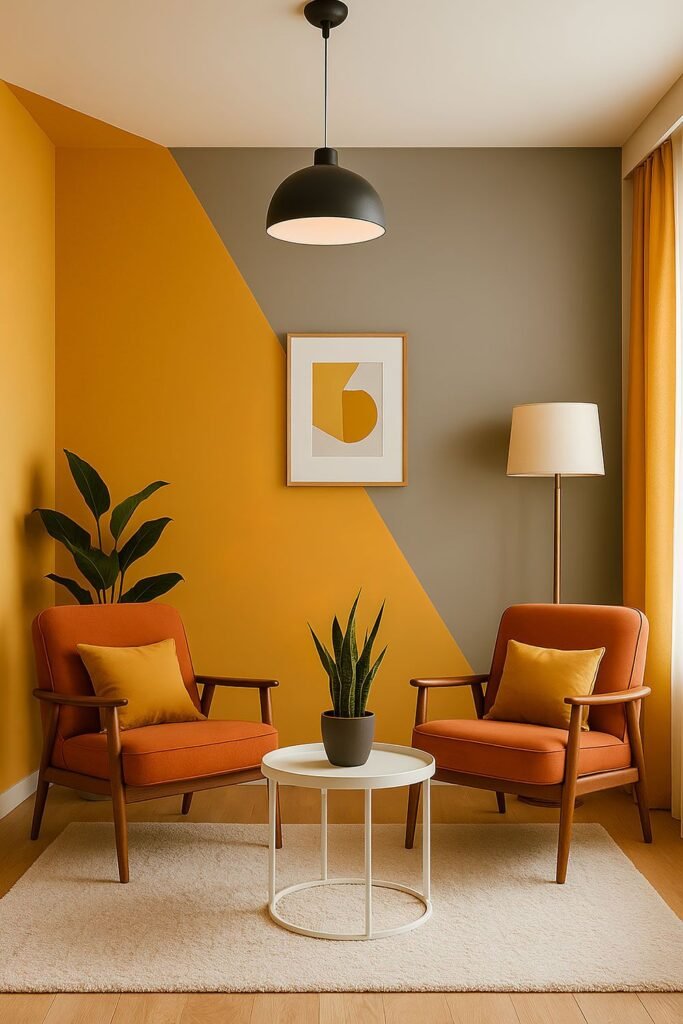
And I almost didn’t go through with it. A whole room in one mid-tone color felt risky the night before painting, even though I’d researched the trend for weeks. If you’re hunting for ideas in this same territory, Studio Apartment Setup’s accent wall guide is worth a look before you commit, since it covers a lot of the same color logic on a smaller, lower-stakes scale.
Paint alone ran close to $140 for enough gallons of wall paint plus a quart of trim paint in a matching sheen. That’s the real number, not the rounded-down one people quote when they’re trying to make a trend sound cheap.
3. Weeks Two and Three: What Actually Changed in the Room
The shift wasn’t immediate. The first few days I mostly noticed the smell of fresh paint and a faint worry that I’d made a mistake. By the second week, something clicked, the room had stopped reading as four separate planes and started reading as one continuous shape. That’s the actual mechanism behind the “bigger” feeling people report. It’s not an illusion exactly, it’s just your eye no longer doing the work of cataloging where one surface ends and another begins.
Here’s roughly how it played out:
Week 1   Paint goes up. Room feels smaller, slightly chaotic, very "in progress."
Week 2   Eye adjusts. Boundaries between wall and ceiling start to blur.
Week 3   Furniture and light start working with the color instead of against it.
Week 4   Room reads as one cohesive space. Feels larger, calmer, more finished.
A few of the decor choices I’d made in my first year in this apartment suddenly looked wrong against the new color, which forced a small secondhand reshuffle I hadn’t planned on. Some of those original mistakes are the same ones covered in Studio Apartment Setup’s rundown of early decor missteps, if you want the longer version of what tends to age badly in a studio.
4. The Mistake That Almost Wrecked the Whole Thing
Here’s where people usually go wrong with this trend, and I nearly did the same thing. I picked a color I liked in isolation without checking whether it actually matched the furniture style I already owned. Color drenching makes every inconsistency in a room more obvious, not less, because there’s no white trim left to act as a visual buffer between your paint choice and your furniture choice.
My space leans a little Japandi, low wood tones, not much ornamentation, and the clay color worked because it’s warm without being precious about it. A more saturated jewel tone would’ve fought with the furniture instead of complementing it. The line between styles that pair well with a drenched room and styles that clash with one is covered in more depth in Studio Apartment Setup’s comparison of Japandi and warm minimalism, and it’s worth reading before you buy paint, not after.
5. The Verdict After a Month
I’d do it again, and I’d pick the same color again too, which says something. The room genuinely feels different to live in, not just to look at in photos. That distinction matters more than most design content seems to think it does.

What I’d change is the timeline. I underestimated how much furniture shuffling a full color change forces on you, and I’d budget an extra weekend for that instead of treating the paint job as the finish line. Studio Apartment Setup gets a fair number of questions about whether bold paint choices actually hold up day to day in a small space, and a month in, this one has.
The room doesn’t look staged anymore. It looks like somewhere I actually decided to live.
6. Quick Answers to Common Questions
Do I have to paint the trim and ceiling too, or is the wall color enough? Walls alone will get you part of the effect, but the trim is usually what breaks the illusion. If budget or time is tight, prioritize trim over ceiling, since trim sits at eye level and does more visual work.
Will a dark color actually make my studio feel smaller instead of bigger? Not necessarily, and this is one of the more persistent myths in small-space design. A dark color drenched evenly tends to read as enveloping rather than cramped, while a dark color paired with bright white trim is what actually shrinks a room by chopping it into contrasting pieces.
What paint sheen works best for this in a small space? Matte or eggshell on walls, satin on trim, is the standard split. The slight sheen difference keeps trim readable as trim without bringing back the stark white contrast you’re trying to get rid of.
Can renters actually do this, or is it homeowner-only? Depends entirely on your lease. Some landlords are fine with bold colors as long as you repaint neutral before moving out, others aren’t. Ask before you buy paint, not after, since repainting a fully drenched room back to white takes more coats than people expect.
How much paint does a full studio drench actually take? For a studio in the 350 to 450 square foot range, plan on two to three gallons of wall paint and a quart of trim paint, plus extra for a second coat almost everywhere. Buying “just enough” rarely works out, since drenched rooms show patchy coverage more than rooms broken up by white trim.
If you’re on the fence about going this bold, Studio Apartment Setup’s piece on whether dark paint actually works in small spaces is a reasonable next read before you pick up a brush.