
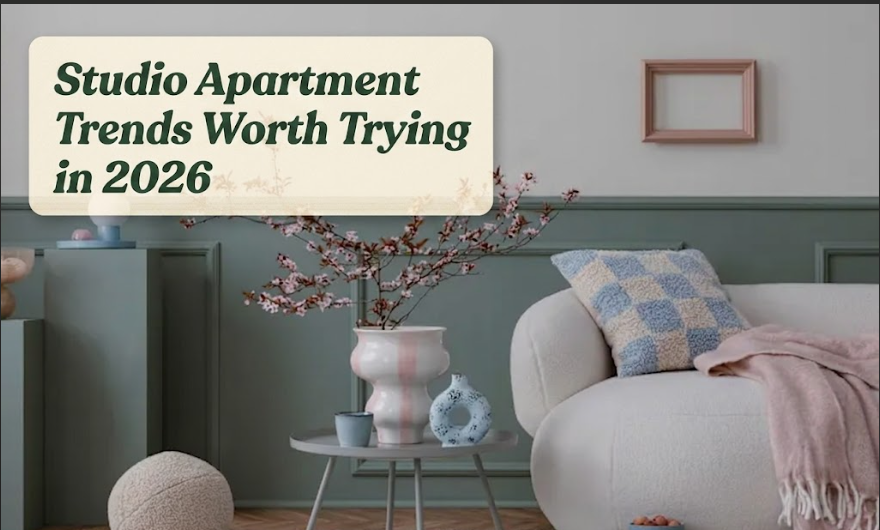
A reader asked me last week whether any of this year’s big design trends were actually worth bothering with in a space under 400 square feet, or if they’re all built for houses with rooms to spare. Fair question. Most trend roundups this year are full of statement floral sofas, daybeds replacing sofas entirely, and dedicated game parlors for weekly Mahjong nights. None of that means much when your living room, bedroom, and dining room are the same twelve feet of floor.
So I went looking at what’s actually trending in 2026 and ran it through a filter most design coverage skips. Does this scale down. Does it survive contact with a studio.
1. The Problem With Most Trend Lists This Year

Walk through any 2026 design roundup and you’ll see big, room-hungry ideas. Oversized rounded sofas and chaise lounges are everywhere. Built-in banquettes are having a moment. So are dedicated hobby spaces, card tables, little nooks carved out just for puzzles or games. All genuinely nice ideas. All assuming you have a spare wall, a spare room, or at minimum a spare twelve square feet to dedicate to something that isn’t sleeping, working, or storing your winter coat.
A studio doesn’t get to assume any of that. So the real question for 2026 isn’t “what’s trending,” it’s which of these trends still function once every surface in the room is already doing two or three jobs.
2. The Trends That Actually Scale Down
A few do, and they scale down well.
Mirrored surfaces are back in a big way this year, panelling, backsplashes, even mirrored ceiling sections in moodier rooms, and this one happens to translate almost perfectly to a studio. The trend exists in bigger homes mostly for drama. In a small space it does real work, bouncing light into corners that a single overhead fixture usually misses. If you’re rethinking your lighting setup at the same time, Studio Apartment Setup’s piece on warm versus cool bulbs pairs naturally with this one, since mirror placement and bulb temperature end up affecting each other more than people expect.
Bold, saturated color is having a real moment too, and it’s not just wall paint. Designers are leaning into terracotta, deep green, and chocolate brown in a way that pushes back hard against a decade of all-white minimalism. We tested a version of this ourselves a few months back with a full-room color treatment, and the short version is it works, especially in a single room where consistency matters more than it would across a whole house.
Thicker, vintage-style picture frames are also creeping back in, replacing the thin, float-mounted frames that have dominated for years. That one actually solves a problem rather than just looking nice. A thicker frame anchors a piece of art instead of letting it disappear into a busy wall, which matters a lot if you’re working with the kind of limited, careful wall display Studio Apartment Setup has written about before, where mixing eras on one small wall has to be done with restraint.
3. Built-In Storage, and Why It’s More Complicated Than It Looks
Seamless built-in storage and millwork is one of the most talked-about small-space trends this year, and it deserves a closer look instead of a blanket yes. It looks fantastic in every photo. It’s also the trend most likely to run into a wall, literally, if you’re renting.
| Built-In Storage Upgrade | |
|---|---|
| Pros | Disappears into the wall, no visual clutter, custom-fit to odd corners |
| Cons | Often requires landlord approval, costly to install, hard to take with you |
| Best for | Owners, long-term renters with flexible landlords |
| Skip if | You move every year or two, or your lease restricts wall modifications |
If you’re renting short-term, the trend is still useful as a direction even if the full built-in version isn’t realistic. Modular shelving that mimics the look without permanent installation gets you most of the visual payoff. Studio Apartment Setup has covered the case for skepticism here too, and it’s worth reading before you spend on built-ins specifically, since storage upgrades only help if the layout underneath them already makes sense.
4. The Trends I’d Skip in a Studio
Here’s where people usually go wrong chasing a trend list without adjusting for square footage. Oversized rounded sofas and the daybed-replacing-the-couch trend both look incredible in a living room with breathing room around them. In a studio, the same piece eats the one stretch of floor you needed for getting from the door to the kitchen. A big, deep silhouette that’s meant to be lounged in from multiple angles needs space on multiple sides, and a studio rarely has that to give.
Dedicated hobby nooks and game parlors run into the same wall. Lovely idea, genuinely. But carving out permanent square footage for something that only gets used once a week competes directly with square footage you need every single day. And the indoor hydroponic garden panels trending this year, small as they are, still need a spot near a window that isn’t already claimed by a desk or a bed frame, which in most studios it already is.
None of these are bad trends. They’re just trends designed around a different floor plan than yours.
5. What’s Actually Worth Trying
If I had to narrow this year’s options down to a short, realistic list for a studio, it’d be mirrored surfaces near your darkest corner, one bold color choice applied consistently rather than scattered across accent pieces, and thicker frames on whatever small wall display you already have. All three cost less than a single piece of statement furniture, and all three respect the fact that a studio has to work hard before it gets to look good.
That’s really the throughline across every Studio Apartment Setup piece we’ve done on trends. Whatever you try has to earn its square footage twice, once for function and once for looks, or it doesn’t belong in a room this size.
6. A Few Questions Worth Asking Before You Commit
Do I need to go all in on a trend, or can I just try part of it? Part of it, almost always. Color drenching one wall instead of the whole room, or adding mirrored panelling to a single corner, gets you most of the visual benefit without the full commitment or cost.
What’s the cheapest 2026 trend to test in a studio? Thicker picture frames, by a wide margin. Swapping frames on art you already own costs very little and changes how a wall reads almost immediately.
Is color drenching still worth it if I’m renting? Usually yes, as long as your lease allows painting and you’re prepared to repaint before moving out. Budget extra coats for the repaint, since drenched rooms tend to need more coverage going back to neutral than a single accent wall would.
Which trend is easiest to undo if it doesn’t work out? Mirrored panels and bold accent pieces are the easiest to reverse. Anything involving paint or built-ins takes more effort to walk back, so test those instincts on a smaller scale first.
Are built-in storage trends realistic for most renters? Not in their full form, no. A modular version that mimics the look without permanent installation is the more realistic route for anyone who isn’t planning to stay in the same unit for several years.
If you’re the type who likes testing new layouts every time a trend catches your eye, Studio Apartment Setup’s piece on rearranging a studio every month is a reasonable next stop, since most of these trends are easier to commit to once you already know how to move a small room around without starting from scratch each time.