
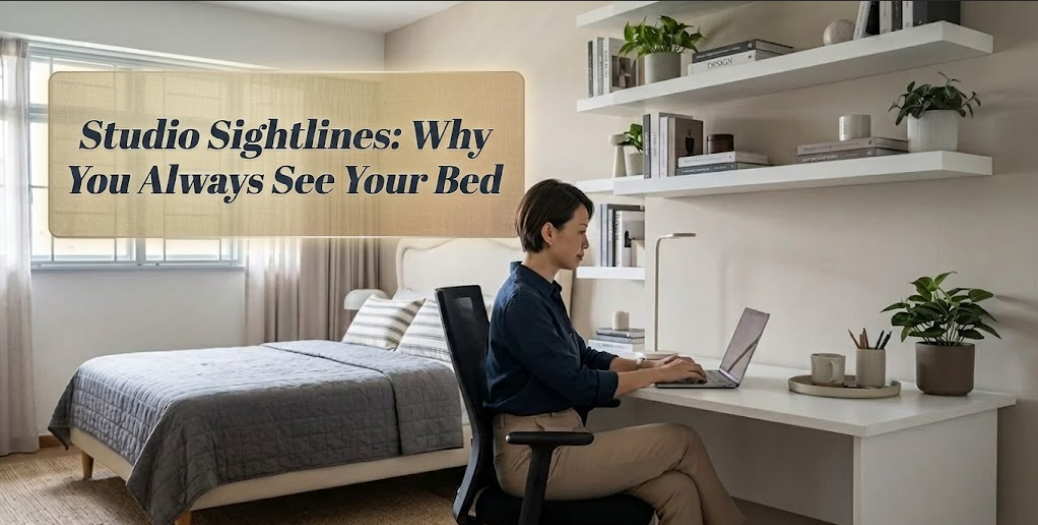
I walked into a client’s 310 square foot studio a few years back, and the first thing I saw, before the kitchen, before the one decent window, was the bed. Not because it was messy or in the way. It was made, tidy, perfectly fine on its own. It just happened to sit directly in the line of sight from the front door, which meant every single person who ever walked into that apartment saw the bed before they saw anything else about the person who lived there.
She’d never noticed it. Most people don’t, until someone points it out, and then they can’t stop seeing it.
1. Why This Happens in Almost Every Studio

It’s rarely a styling mistake. It’s geometry. Most studios only have one or two walls long enough to fit a full or queen bed without blocking a window, a closet door, or the kitchen. That usually leaves exactly one logical spot, and in a huge number of layouts, that spot happens to face the entry door head on.
So the bed goes there because there’s genuinely nowhere else for it to go, and the sightline problem comes along as a side effect nobody planned for. It’s not about being tidy or being lazy with decor. It’s that the apartment was built around a kitchen and a bathroom core, and the leftover rectangle of floor space dictates the rest.
2. The Mistake People Make Trying to Fix It
Here’s where it usually goes wrong. People notice the problem, feel a little exposed by it, and reach for the tallest, heaviest room divider they can find to block the view completely. It solves the sightline issue. It also blocks half the daylight in a room that probably didn’t have much to spare in the first place, and now the studio feels like two smaller, darker rooms instead of one open one.
The other common fix is curtains hung straight down from a low rod, which technically hides the bed but reads visually as “the apartment has a permanently drawn curtain in it,” which is its own kind of strange. If you’re shopping for divider options, Studio Apartment Setup’s roundup of dividers that don’t block natural light is worth a look before buying the first solid panel you find online.
3. What Actually Breaks the Sightline Without Closing Off the Room
The fix isn’t always a full divider. Sometimes it’s smaller than that.
Angling the bed even ten or fifteen degrees off the entry sightline does more than people expect. A bed placed dead straight in line with the door reads as “bedroom.” The same bed angled slightly, with the headboard catching the eye instead of the full length of the mattress, reads as furniture, the way a chaise or a daybed would in a living room.
A console table or low dresser at the foot of the bed works as a soft interruption too, the kind of thing your eye lands on first instead of traveling straight past it to the pillows. And a sheer or partial-height curtain, hung from the ceiling rather than a short freestanding rod, blocks the direct sightline while still letting light bounce through the fabric. Studio Apartment Setup’s piece on curtain hanging height goes into why ceiling-height mounting changes the effect so much compared to a standard rod, and it’s a small detail that makes a real difference here.
A few clients have also had good luck with privacy curtains specifically built for this kind of zoning rather than generic window curtains repurposed for the job, which Studio Apartment Setup covers in more detail in this guide, if you want options beyond the basic rod-and-panel setup.
4. The Part Nobody Thinks About: The Floor
This is the side thought that’s easy to skip, but it matters more than it sounds like it should. A rug under the bed area, sized to actually contain the bed and a nightstand or two rather than floating under just the mattress, does something a divider can’t. It tells your eye “this is a separate zone” without blocking a single sightline at all.
Most people undersize this rug by a lot, which is a sneaky reason a sleep area still feels exposed even after adding furniture to block the view. If you’re not sure what size actually works here, Studio Apartment Setup has a breakdown of the rug sizing rule most people get wrong, and it applies just as much to a bed zone as it does to a living room arrangement.
And one more thing worth saying clearly. None of this fixes a layout that was doomed from the start. If your studio’s door, window, and only usable wall are arranged in a way that makes any bed placement visible from the entry, no amount of styling closes that gap completely. Studio Apartment Setup has written about the layout signs that point to a genuinely difficult floor plan, and it’s worth ruling those out before assuming the problem is solvable with furniture alone.
5. A Quick Sightline Check Before You Rearrange Anything
Before moving furniture around, it helps to actually map what you’re working with. Here’s a simple checklist worth running through standing at your own front door:
- Stand at the entry door and note the first three things you see
- Is the bed one of them? If yes, by how much (full view, partial, headboard only)
- Is there a wall, dresser, or rug edge between the door and the bed
- Does a window sit directly behind the bed, pulling extra attention to it
- Could the bed angle change without blocking a closet or outlet
Most people skip this step entirely and go straight to buying something. Five minutes of standing at your own door tells you more than most product pages will.
She ended up angling the bed about fifteen degrees, added a low dresser at the foot, and sized a proper rug under the whole sleeping area. The bed didn’t move more than a couple feet. It just stopped being the first thing anyone noticed, which was really the only goal to begin with.
6. Common Questions About Bed Sightlines
Is it actually a problem if guests see my bed when they walk in? Not a problem exactly, but it does shape the first impression of the space, and most people would rather their kitchen or living area set that tone instead of an unmade or overly prominent bed.
Does a room divider block the bed or just block light? Both, usually, unless you choose something specifically designed with gaps or sheer panels. Solid floor-to-ceiling dividers tend to block more daylight than people expect once they’re actually installed.
What if I genuinely can’t move the bed at all? Angling it slightly, adding a console or dresser at the foot, and sizing a proper rug underneath will all help even without relocating the bed itself. Combined, those three changes do more than any single fix on its own.
Should the headboard face the door or the window? Neither is required, but a headboard that’s the first thing visible from the door tends to read as furniture, while a bed with its long side facing the door tends to read as bedroom, which is usually the distinction people are trying to avoid.
Is sizing a rug really going to change how exposed the bed area feels? Yes, more than most people expect. A correctly sized rug visually defines the sleeping area as its own zone, which reduces that exposed feeling even when the sightline itself hasn’t changed much.
If your studio’s whole layout still feels like it’s working against you after sorting out the sightline, it might be worth a broader look at what’s actually causing that, which Studio Apartment Setup digs into here.