

The storage obsession needs to stop.
I say this as someone who has walked through hundreds of small spaces, and the pattern is always the same. The client has already tried to solve the problem with containers. An ottoman that lifts open. A bed raised on risers. Floating shelves pressed onto every wall. And the studio still feels wrong. Still too tight, too chaotic, too much. So they think: more storage. A better system. Maybe a different brand of the same type of bin.
No. That is not what’s missing.
The space feels the way it does because of how it is laid out, not because of how much it can hold. Those are two completely different problems. They need two completely different solutions.
1. The Myth That More Storage Equals More Room
I’ve had clients apologize to me when I walk into their studio, like they’ve personally failed some kind of test. The bins are labeled. The closet has been reorganized twice. There’s a pegboard above the kitchen counter. And the space still feels like it’s slowly closing in on them.
Storage is a management tool. It manages what you own. It does not change how a space functions, how it flows, or how it feels when you come home after a long day and just need the room to settle around you.
When a studio’s layout is wrong, storage becomes a coping mechanism. You’re managing chaos instead of preventing it, and managing chaos never makes it disappear. It makes it neater for a few weeks, that’s about all.
The real question to ask is: why is the chaos there in the first place?
A surface that’s always cluttered doesn’t necessarily mean you need more places to put things. Sometimes it means items land there because the room gives them nowhere better to go. The flow is wrong, the zones are unclear, and your belongings end up wherever they can. That is a layout problem wearing a storage costume.
2. What a Bad Layout Actually Costs You
A poorly laid out studio doesn’t just feel inconvenient. It creates friction that compounds quietly until you start dreading being home.
When your sleeping zone sits in direct sightline of the front door, you never fully decompress. When your sofa faces the wrong direction and you’re constantly craning toward the screen, your evenings feel like an afterthought. When your kitchen prep area bleeds into your work surface bleeds into your eating space, your brain doesn’t transition between tasks because the room gives it no signal to do so.
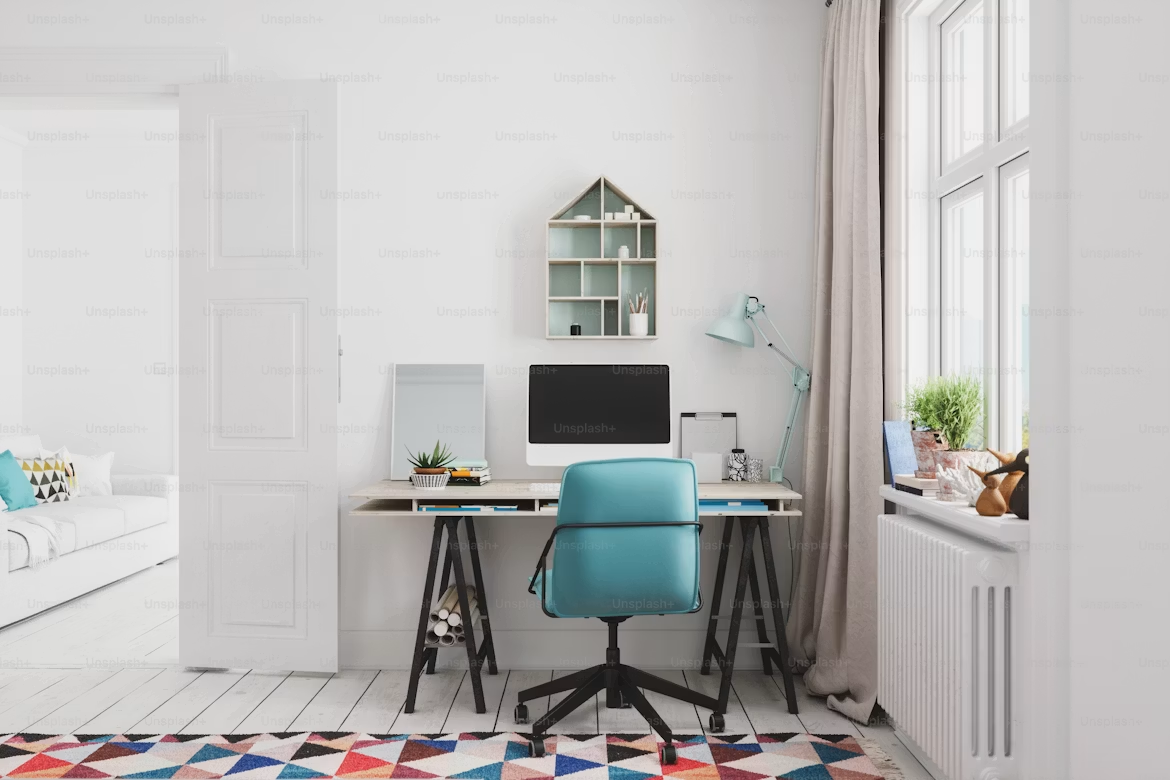
These are not storage problems. No basket or shelf or under-bed drawer fixes them.
I worked with a client a couple of years back in a studio near King West. Organized person. Labeled everything, had a whole bin system going. The place felt suffocating. We moved the bed to a different wall and rotated the sofa roughly forty-five degrees, opened up the area near the window. She messaged me the following week saying the apartment felt twice the size. No new furniture, no new storage. Just the layout, corrected.
Studio Apartment Setup covers how layout affects daily experience across a lot of their content, and it keeps coming up because it keeps being true: the furniture decisions you make first are the ones that determine whether everything else works or doesn’t.
The layout issues that kill a studio’s livability usually come down to predictable things. No clear zones. Blocked traffic paths. Furniture that fights the natural light. Furniture that’s simply the wrong scale for the square footage. If your king bed takes up sixty percent of the floor plan, the remaining forty percent is not going to improve with a better closet organizer. That is not what’s wrong with it.
3. Layout Problem or Storage Problem: How to Tell
This is where I ask clients to be genuinely honest with themselves. Harder than it sounds.
A storage problem looks like this: you have more stuff than places to put it. Surfaces pile up because there is genuinely no home for those items. The closet overflows because what’s inside it is legitimate and you simply need more capacity. The fix is either reducing what you own or increasing where it can go.
A layout problem looks different. Surfaces feel overwhelming even when mostly empty. Moving through the space is awkward. You avoid certain spots because something about the arrangement just doesn’t work. The room occupies the right square footage on paper but still feels cramped. You reorganize and it helps for a week or two, and then it doesn’t.
Here’s a quick way to diagnose which one you’re dealing with:
| Symptom | More Likely Storage | More Likely Layout |
|---|---|---|
| Surfaces always piled with items | Yes | Sometimes |
| Space feels wrong even when tidy | Rarely | Yes |
| Reorganizing helps and stays solved | Yes | No |
| You avoid certain spots in the room | Rarely | Often |
| Traffic paths feel blocked or awkward | No | Yes |
| Chaos returned two weeks after a deep clean | No | Yes |
| You feel unsettled but can’t name exactly why | No | Almost always |
The last symptom is the real tell. When a layout is off, people feel it before they can describe it. There’s an ambient wrongness to the space they’ve been interpreting as a storage crisis, because that’s the more concrete-looking problem. You can buy a shelf. It’s harder to articulate that your sofa is simply on the wrong wall.
The 3 Signs a Studio Apartment Layout Will Make You Miserable Later piece gets into this from a pre-lease perspective, which is useful if you’re still apartment hunting. But if you’re already in your space, the table above is a faster place to start.
4. Fix the Layout First, Then Think About Storage
This requires sequencing things differently than most people do, whether they’re moving in fresh or trying to fix a space they’ve been living in for two years.
Start with your zones. A studio needs at least three distinct functional areas: sleep, living, and work or eating. They don’t need walls between them, they need clear boundaries. A rug anchoring a seating arrangement. A bookshelf acting as a visual divider. Enough physical and visual separation that one area doesn’t blur into the next. Creating those zones intentionally changes the experience of a studio more than almost anything else, and it doesn’t require buying a single new piece of furniture.
Then look at your traffic paths. Can you walk from the front door to the kitchen without stepping around something? Can you get from the bed to the bathroom at 2am without bumping into a storage cube? If the answer is no, that’s a layout fix. No storage product clears a blocked path.
After that, look at where natural light comes in and whether your furniture is working with it or against it. A tall storage unit in front of a window doesn’t just block light. It changes the entire room. The space contracts around it. And people often respond by adding more storage elsewhere instead of simply moving the piece.
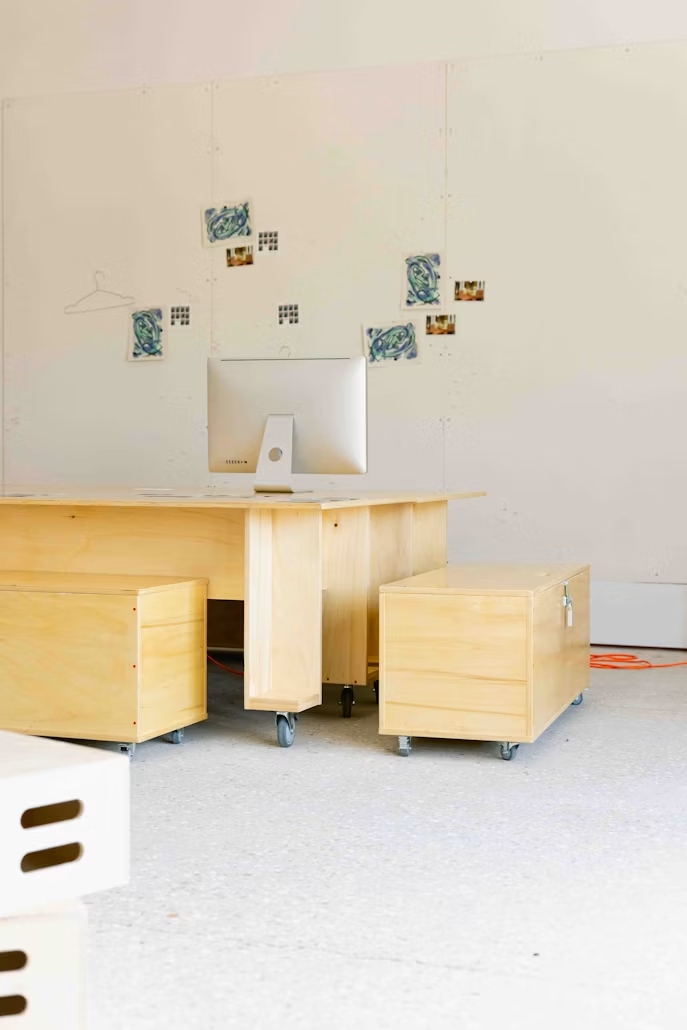
If you go through all of that and realize the furniture is the wrong scale for the space, that’s still a layout problem. Actually, that’s one of the more common ones. An oversized sofa or a bed that’s too large for the room creates the illusion of a storage crisis, because the remaining floor space becomes essentially unusable. One correctly scaled piece of furniture can do more for a studio than three months of storage overhauls.
The layout principles that interior designers actually use first are worth going through before you purchase anything else. The sequence matters more than most people realize.
5. Where Storage Does Help, and What Kind
None of this means storage is irrelevant. Once the layout is working, targeted storage is what keeps it working.
The under-bed storage that felt pointless in a chaotic room? In a well-laid-out studio, it’s genuinely useful because you know exactly what belongs there and you can access it without moving three other things first. The floating shelves that looked cluttered when added to a disordered wall? In a clear zone, with a purpose behind them, they function and look right.
But the sequence is: layout first, then storage.
The mistake Studio Apartment Setup sees come up repeatedly is people buying storage furniture before they’ve committed to a layout. The result is storage that doesn’t work within the final arrangement, or worse, storage that becomes the default layout because it’s already there and too heavy to move. The room gets designed around the storage rather than the other way around.
Decide where things go first. Then figure out what storage makes sense for each zone. A storage ottoman belongs in the living area. Under-bed drawers belong in the sleep zone. A narrow rolling cart belongs tucked into the kitchen. But only once you’ve actually defined where those zones are.
If you’re starting from scratch and feeling overwhelmed, this guide on where to begin when you have nothing is worth reading before you buy a single piece of furniture.
And if you’ve been living in a space that doesn’t feel right and you’ve tried every organizational fix you can find, consider whether you’ve ever actually assessed the layout seriously. Most people haven’t. They settled into whatever arrangement seemed easiest on move-in day and layered storage around it for years.
That’s where the problem starts. Not with what you own. With where everything is.
Frequently Asked Questions
I have a lot of stuff and a layout that doesn’t work. Do I tackle both at once?
Start with the layout. Get the zones clear and the traffic paths open, then look at what needs to go where. Trying to solve both at the same time usually means buying storage furniture that doesn’t fit the arrangement you eventually land on. The sequence matters more than the speed.
How do I know if my furniture is the wrong scale for my studio?
The clearest sign is that you can’t move through the room freely. A well-scaled studio has clear walking paths from every entry point to every zone. If you have to turn sideways to pass the sofa, or you can’t fully open a cabinet because the bed is too close, scale is the problem. That’s a layout fix, not a storage purchase.
Can I fix a bad layout without buying anything new?
Often, yes. Rearranging what you already own is always the first experiment to run. Pull furniture away from the walls slightly, try the bed on a different wall, rotate the sofa. A surprising number of layout problems get solved entirely through repositioning. If you’ve genuinely tried every configuration and the space still doesn’t work, then it’s worth looking at whether one key piece needs to change.
My studio is organized and I have good storage. Why does it still feel chaotic?
Almost certainly a layout issue. A tidy space with a poor layout still feels unsettled, because organization lives inside a layout. It doesn’t replace one. If your zones are undefined, your traffic paths are blocked, or your furniture scale is off, the room will feel wrong regardless of how well sorted your closet is.
What’s the single most impactful layout change in a studio?
Bed placement, more often than not. The bed is almost always the largest piece of furniture in the room, so its position dictates how everything else gets arranged around it. Moving the bed to a different wall can completely change the traffic flow, the zone definition, and the visual balance of the entire space. It’s a disruptive experiment, which is exactly why most people never try it. And why most studios never quite get fixed.