
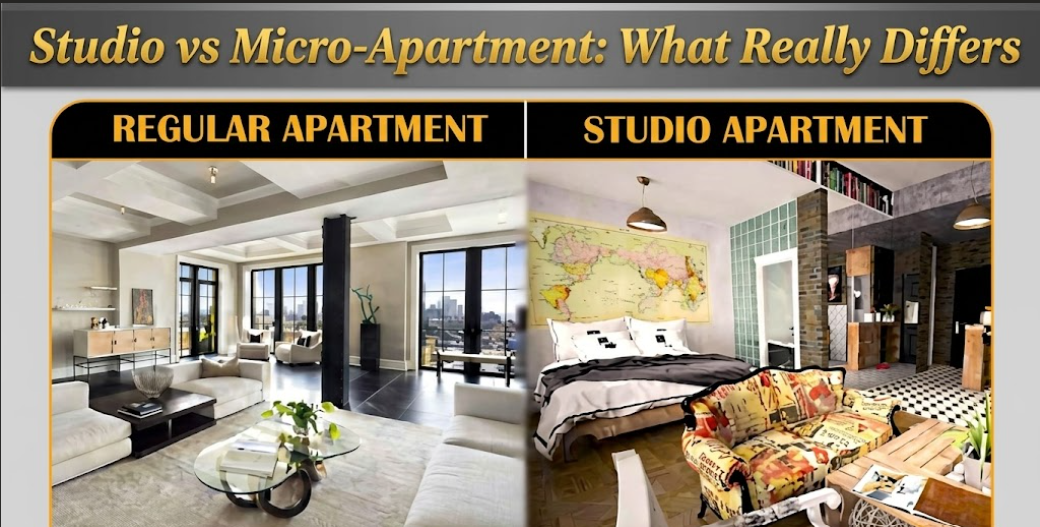
People use these two terms interchangeably, and they are not the same thing. Not even close.
I’ve been working with small-space clients in Toronto long enough to watch the confusion play out in real time. Someone signs a lease on what a listing calls a “micro-studio,” moves in with the wrong furniture expectations, and spends the next six months rearranging the same four pieces and wondering why nothing feels right. The floor plan type mattered. They just didn’t know there was a distinction to care about.
A studio describes a floor plan. A micro-apartment describes a design philosophy. That’s the core of it, and everything else follows from there.
1. What a Studio Actually Is
A studio is an apartment where the sleeping area, living area, and kitchen share one continuous open room. No wall separates them. The bathroom is its own enclosed space. Everything else is one long, open layout.
That definition says nothing about size. Studios range from under 300 square feet to well over 550. Some are genuinely generous. I’ve worked on studios in Toronto’s older condo stock that were roomy enough to zone properly, fit a real sofa, and still leave breathing room between the bed and the kitchen.
The word also says nothing about the shape of that space, which is where people get caught off guard. A studio can be a lovely open rectangle with good natural light and logical flow. It can also be an awkward L-shape with a galley kitchen shoved beside the front door and a window that faces a concrete wall. Both are studios. The floor plan type doesn’t filter out the bad configurations, and before committing to any unit, knowing what to check before you sign a studio lease is genuinely worth your time.
The studio is, essentially, a blank canvas. What you do with it is entirely on you.
2. What a Micro-Apartment Actually Is
A micro-apartment is defined by two things: size and intent.
Size first. The threshold varies, but most people working in the housing industry put micro-apartments at 350 square feet or under, with many units running between 150 and 280. In Hong Kong and Tokyo, this category has been standard for decades. In North American markets, it became a serious typology around 2013 to 2016, driven largely by urban housing pressure and rising land costs.
The intent part is what separates a micro-apartment from just a very small studio. A true micro-unit is designed from the architectural bones outward to function within its constraints. The Murphy bed isn’t something a tenant found on Wayfair and bolted to a wall. It’s structural, positioned with clearances accounted for, integrated with storage above and beside it. The kitchen is compact by design, not by accident. Fold-down surfaces, built-in desks, under-bench storage, these aren’t afterthought additions. They’re the architecture.
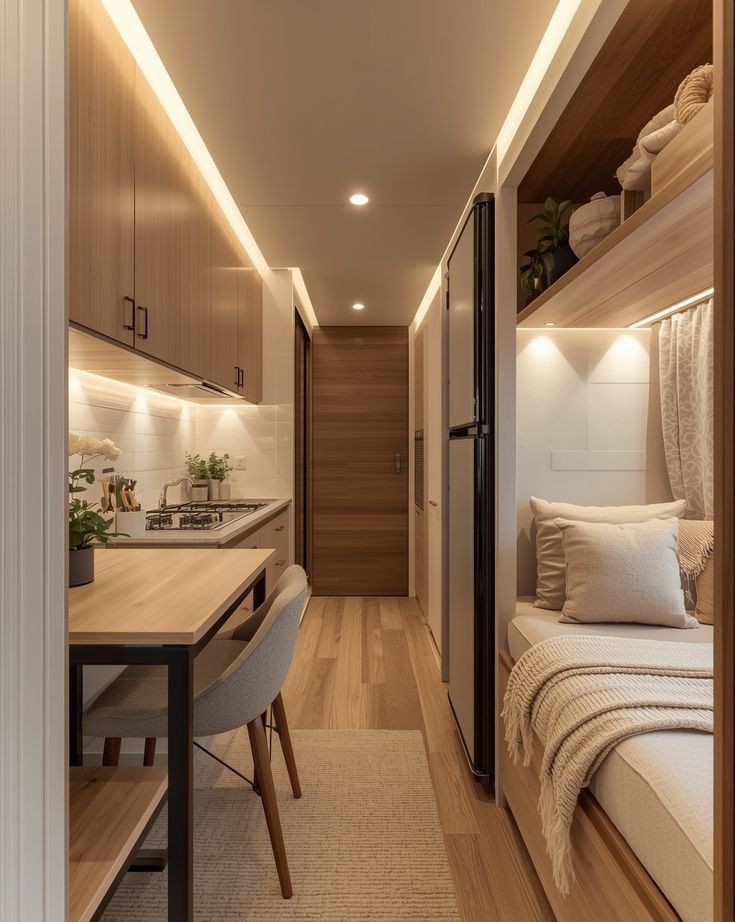
That’s the honest distinction. When you move into a micro-apartment, the space has already done a significant portion of the organizational thinking. Someone, hopefully a decent architect, solved the problem of where things go before you arrived. Your job is mostly to live within those decisions.
3. The Real Differences, Side by Side
The gap between these two types becomes obvious when you put the actual features next to each other.
| Feature | Studio Apartment | Micro-Apartment |
|---|---|---|
| Typical size range | 300 to 600+ sq ft | 150 to 350 sq ft |
| How it’s defined | Floor plan type | Size threshold + design intent |
| Built-in furniture | Rarely standard | Murphy beds, fold-down surfaces common |
| Storage approach | Tenant’s responsibility | Often integrated into the architecture |
| Layout variety | High — quality varies widely | More controlled, purpose-built |
| Decorating flexibility | High | Limited by fixed elements |
| Who usually thrives | People who want to customize | People who want turnkey efficiency |
| Location advantage | Spread across building types | Often in dense urban cores |
That row about built-in furniture is the one that changes the most about daily life. A studio gives you latitude. A micro-apartment gives you a system. Both can work well. But they require genuinely different approaches to furniture, storage, and how you use the space on a Tuesday.
The price row is worth a separate note. Micro-apartments often have a lower sticker rent than comparable studios in the same neighbourhood, which makes them look like obvious value. But “comparable” is doing a lot of work in that sentence. A 220-square-foot micro-unit is not comparable to a 420-square-foot studio. Compare them honestly, including what you’d spend customizing a studio to function as well as a designed micro-unit, and the gap narrows.
4. Where People Get This Wrong
The most consistent mistake I see is applying the wrong mental model when moving in.
Someone finds a micro-apartment in a good location for a reasonable price, feels like they’ve scored, and then immediately starts buying furniture. A floor lamp, a small bookshelf, a decorative tray, a side table. Within three months, the space is overwhelmed. The problem is that a properly designed micro-unit is calibrated to work with almost nothing added. The built-in bench is the seating. The wall unit is the storage. Adding pieces doesn’t personalize it. It breaks the spatial logic the architect built in.
The reverse happens with studios. Someone moves into a 380-square-foot studio, figures the space will “work itself out,” and arrives with a bed and a couch. Then they live for months in a space that has no clear zones, no functional logic, no sense of different areas having different purposes. The space doesn’t solve itself. Creating zones in an open layout is a real design task that takes deliberate choices. Square footage doesn’t substitute for that thinking.
And the question of who each type suits is worth being specific about. Micro-apartments tend to attract people who are optimizing hard for location. They’re out of the space more than they’re in it, they travel, they keep very little, they’re using the apartment mostly for sleeping and changing clothes. Studios attract a broader range of people, including people working from home, couples figuring things out, and anyone who values being able to move the furniture when they feel like it.
Two people sharing a 210-square-foot micro-unit is a very particular kind of arrangement. It can be done. But going in without clear eyes about what actually happens when two people share a small space tends to end in a conversation nobody wants to have by month four.
5. Choosing Between Them
There are two questions that actually matter here, and neither of them is “which one is bigger.”
The first: do you want to design the space, or do you want the space already designed? Studios give you more creative freedom and more responsibility. Micro-apartments give you a solution and less room to deviate from it. Neither is objectively better. But knowing which type of problem you want to have is the honest starting point.
The second question: what does your actual daily life look like? Not the aspirational version. The February version, when it’s cold and you’re tired and you’re making dinner and you have work open on your laptop and there are dishes in the sink. If that version of your day needs room to sprawl, a micro-apartment is going to feel like a daily negotiation. If that version of your day is mostly one activity at a time in a calm, minimal environment, a micro-unit can be surprisingly peaceful.
I always tell clients that the layouts which make people miserable aren’t always the smallest ones. Some of the most functional small spaces I’ve worked on were under 300 square feet. And some of the most stressful were mid-sized studios with awkward proportions where every furniture configuration felt like settling. Understanding what makes a studio layout genuinely unworkable before you sign saves a lot of grief.
Studio Apartment Setup has gone deep on both types, and the difference in approach between them runs through almost every guide on the site. Square footage is the starting point. Design intent is the conversation that actually matters.
The conversation I keep having with clients who are in the middle of apartment hunting isn’t about furniture or colours or light fixtures. It’s about getting honest about how they actually live. Not the life they’re planning to start. The one they’re already in.
That’s the space that has to work.
FAQs
Is a micro-apartment always smaller than a studio?
Usually, yes. Micro-apartments are generally under 350 square feet, often considerably smaller. Studios can be much larger, sometimes over 500 square feet. But in the 280 to 350 square foot range, the two categories genuinely overlap, and what separates them there is design intent, not size alone. A purpose-built micro-unit in that range will feel and function differently than a small studio of similar area.
Can you tell the difference between the two from a listing?
Not always, and that’s a real frustration. “Micro-studio” gets used as a marketing term for small studios with no special built-in design. And sometimes a thoughtfully built micro-unit gets listed simply as a “studio apartment.” Look for concrete clues: mentions of Murphy beds, fold-down furniture, and integrated storage suggest purpose-built micro design. If the listing doesn’t mention built-ins at all, it’s likely a standard studio regardless of the size.
Are micro-apartments actually worth the lower rent?
For the right person, yes. If you travel frequently, keep very little, or primarily use your home as a place to sleep and get ready, a micro-apartment at a lower price point in a better location can be excellent value. If you work from home, cook regularly, or simply need room to spread out, the rent savings rarely compensate for the daily spatial stress.
Which type is better for someone who wants to customize their space?
A studio, almost always. The open, unfurnished nature of a standard studio gives you more freedom to choose your own furniture, create your own zones, and reconfigure things as your needs change. Studio Apartment Setup covers this kind of setup thinking in detail because most tenants underestimate how much creative control they have over an open layout. Micro-apartments, by contrast, are built around fixed elements that typically can’t be removed or repositioned without major effort.
What questions should I actually ask when viewing either type?
For a micro-apartment: ask where the Murphy bed sits when it’s fully open and whether it blocks the bathroom door. Ask what’s included as permanent built-in storage versus what you’d need to add yourself. Ask whether there’s a real workspace or just a ledge. For a studio: ask about natural light across different times of day, where a bed and a sofa would realistically both fit, and whether the kitchen has any counter space worth using. And in both cases, ask yourself honestly if you could cook an actual meal in that kitchen without immediate regret. That one question tells you more than the square footage number ever will.