
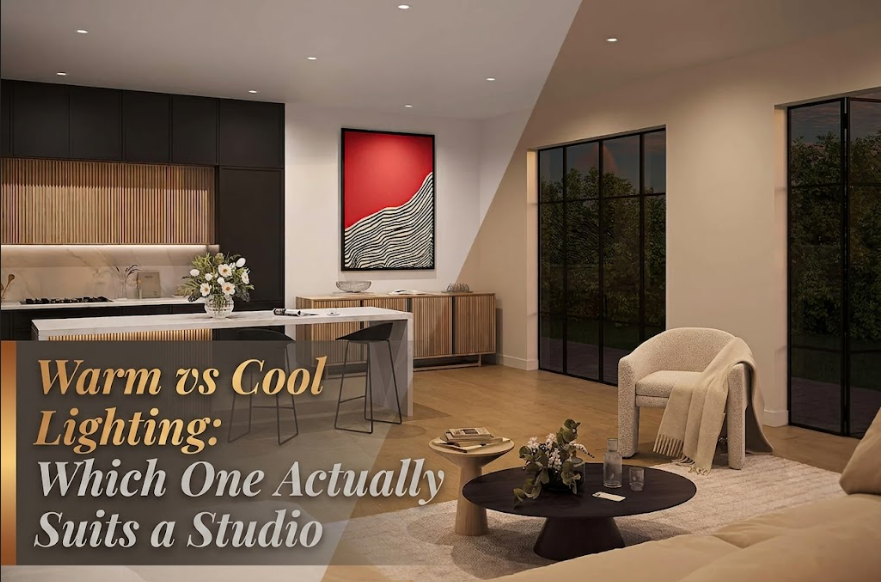
I moved a lamp four times in one apartment before I figured out what was actually wrong. It wasn’t the lamp. It wasn’t the spot I put it in either. It was the bulb. A cheap 5000K daylight bulb sitting in a corner that was supposed to feel like a reading nook, making the whole thing look like a waiting room at a walk-in clinic. Swapped it for a 2700K bulb and the room changed completely, same lamp, same spot, same everything else.
That’s the thing nobody explains clearly when you’re setting up a studio. Lighting temperature does more work in a small space than almost any other single decision, and most people either ignore it entirely or treat “warm” and “cool” as a matter of taste rather than function.
1. What Warm and Cool Actually Mean
Light temperature is measured in Kelvin, and the number tells you almost everything you need to know before you even see the bulb.
- 2700K to 3000K — warm white. This is the orange-tinted glow you get from old incandescent bulbs and most candlelight.
- 3500K to 4100K — neutral white. Not quite warm, not quite cool. Common in offices and kitchens.
- 5000K to 6500K — daylight or cool white. Bluish, crisp, closer to actual daylight at noon.
In a studio apartment, you’re not choosing lighting for one room. You’re choosing it for every room, because there’s only one. That’s the part people miss. A cool white bulb might make perfect sense in a dedicated home office. In a studio, that same bulb is also lighting your bed, your dinner table, and the corner where you’re trying to relax at 9pm.
2. Why Cool Lighting Struggles in Small Spaces
Cool white light does two things that work against a studio specifically. First, it flattens depth. Studios already read as smaller because everything is visible at once, and cool light tends to expose every surface evenly, which removes the shadow and contrast that make a room feel like it has layers. Second, it reads as clinical. There’s a reason dentist offices and 24-hour pharmacies use 5000K lighting. It signals efficiency, not comfort, and most people are trying to build the opposite feeling at home.
Why Cool Lighting Struggles in Small Spaces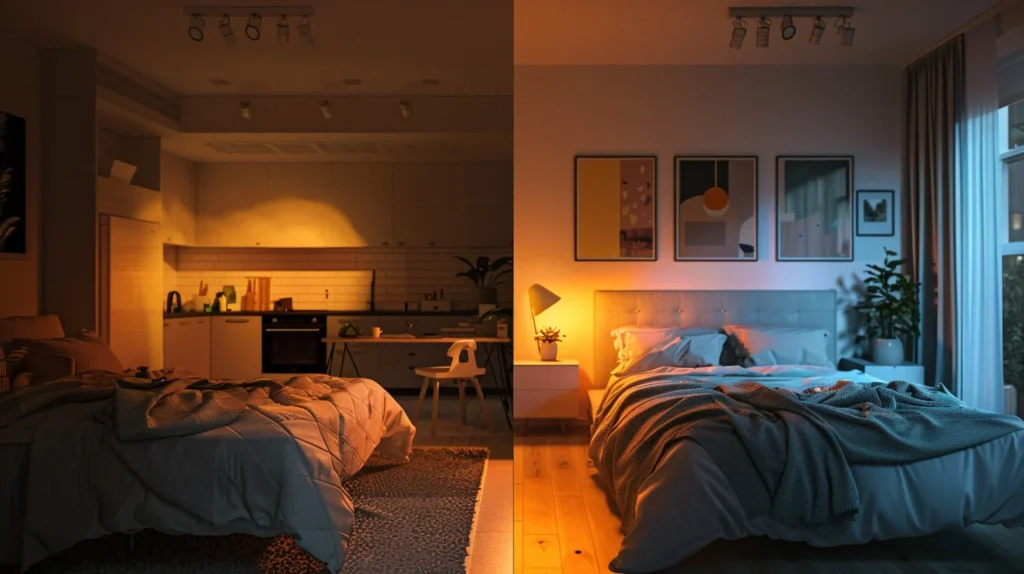
Here’s where people usually go wrong. They pick cool white because the packaging says “daylight” and daylight sounds like a good thing. But daylight through a window and a 5000K bulb overhead at 10pm are not the same experience, even if the color temperature number is similar. Natural light shifts throughout the day. A fixed cool bulb doesn’t shift at all, so it holds that same flat, slightly sterile tone for every hour you’re home.
That said, cool light isn’t useless in a studio. It has a real job. Task areas benefit from it, closer to 3500K than full daylight. If you’ve got a kitchen counter doubling as a prep space, or a desk where you’re doing detail work in the evening, a neutral or slightly cool bulb there actually helps you see what you’re doing.
3. Where Warm Lighting Earns Its Reputation
Warm lighting, generally 2700K to 3000K, is closer to firelight, and there’s a physiological reason it feels more relaxing. It doesn’t suppress melatonin the way blue-heavy light does, so your body doesn’t get the same “stay alert” signal it gets from cooler tones. That matters more in a studio than in a house, because your bed is never more than a few steps from wherever you’re sitting.
Warm light also does something cool light can’t: it hides. Small imperfections in a wall, slightly mismatched paint, a corner that’s a bit dusty, warm light softens all of it. Cool light exposes texture. Warm light smooths it over. If your studio has any of the usual rental-unit quirks, patchy paint jobs, visible seams, a radiator that’s seen better days, warm lighting is doing you a quiet favor every single evening.
The tradeoff is legibility. Warm light isn’t great for reading fine print or matching colors accurately. If you’re someone who does close work at home, sewing, drawing, detailed cooking, a studio lit entirely in warm tones can actually slow you down.
4. The Layering Approach That Actually Works
Neither warm nor cool wins outright, and treating it as an either-or decision is where most studio setups go wrong. The better approach is zoning by function, not by preference.
| Zone | Suggested Temperature | Why |
|---|---|---|
| Sleep/lounge area | 2700K warm | Supports winding down, forgiving of wall imperfections |
| Kitchen prep counter | 3500K neutral | Accurate enough to judge food, not harsh |
| Desk/work corner | 3500K–4000K neutral to cool | Keeps you alert, reduces eye strain on screens |
| Entryway/general overhead | 3000K warm | Welcoming first impression, works for most activities |
| Closet/storage | 4000K+ cool | Pure function, you want to see clearly, not linger |
If you’re working through your first few weeks in a new place, this kind of zoning is worth doing early. We put together a broader walkthrough of what actually matters in that first stretch in our guide to setting up a studio from nothing, and lighting temperature is one of those decisions that’s much easier to get right before you’ve already hung everything and settled in.
One practical note: smart bulbs that let you adjust Kelvin on the fly solve a lot of this without buying multiple fixtures. You can run a lamp at 2700K in the evening and bump it to 4000K for twenty minutes while you’re cooking or answering emails. It’s a small upfront cost that removes the need to commit to one temperature for a space that’s doing five jobs at once.
5. The Overhead Light Problem
Most studios come with a single overhead fixture, usually a builder-grade cool white bulb chosen for cost, not comfort. This single light source is doing an enormous amount of damage to how the room feels, and it’s often the first thing worth changing, before furniture, before paint, before anything else.
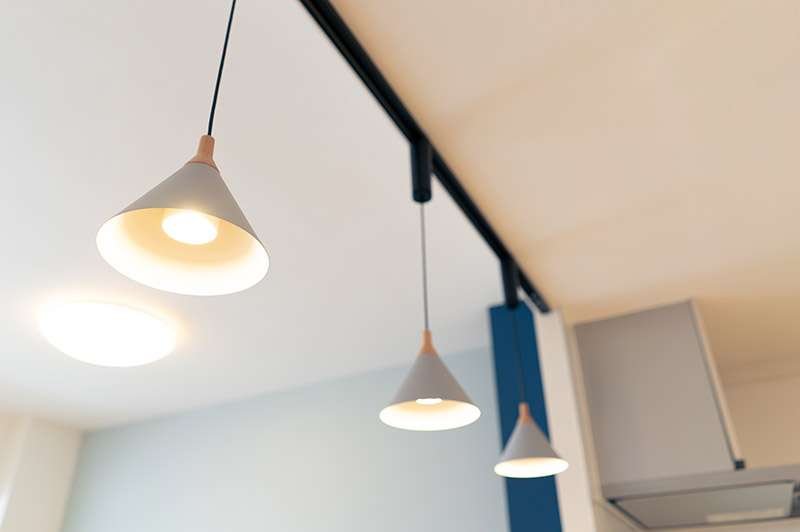
We’ve written before about why relying on one ceiling fixture ruins the feel of a studio no matter what temperature it’s set to, and that piece goes deeper into the layering side of things if you want the fuller picture. But temperature alone, even with just that one fixture, makes a noticeable difference. Swapping a stock 5000K bulb for a 2700K one in an existing overhead fixture is the single cheapest lighting change you can make in a rental, and it takes about ninety seconds.
And a small tangent here, because it trips people up constantly: dimmable and adjustable-temperature are not the same feature. A dimmer just reduces brightness at whatever fixed Kelvin the bulb already runs at. Dimming a cool white bulb down low doesn’t make it warm, it just makes it dim and cool, which is somehow a worse combination than either extreme on its own.
6. Matching Lighting to Layout
If your studio uses a room divider, curtain, or bookshelf to separate zones, lighting temperature can reinforce that separation in a way that’s more subtle than furniture placement alone. A warmer light on the sleep side of a divider and a slightly cooler, more neutral tone on the living or work side creates a psychological boundary even without a wall. This is a trick we’ve used when writing about zoning a studio without permanent walls, and it works particularly well because it costs nothing beyond the bulbs you were going to buy anyway.
Color palette matters here too. A studio painted in cooler grays and whites can handle slightly warmer lighting without looking mismatched, since the wall color balances the light temperature out. A studio with warmer wall tones, terracotta, cream, warm beige, pairs oddly with cool white bulbs, since the two fight each other rather than working together. It’s worth thinking about paint and lighting temperature as one decision rather than two separate ones.
Common Mistakes
The most frequent mistake isn’t picking the wrong temperature outright, it’s picking one temperature and using it for the entire apartment because it’s simpler than buying different bulbs for different fixtures. The second most common mistake is chasing whatever temperature looks best in photos online without accounting for how a space actually gets used at night, at 6am, and everywhere in between. A bulb that photographs beautifully at noon with natural light pouring in can feel completely wrong at 11pm with the blinds closed.
I’ll admit I made this mistake myself early on, going all-in on cool white because I thought it would make the apartment look bigger and more modern. It did, in photos. In person, at the end of a long day, it felt like living inside a fluorescent tube.
Not every studio needs five different bulb temperatures. If your space is genuinely one open zone with no real functional divide, picking a single warm-neutral temperature around 3000K is a perfectly reasonable compromise, and simpler to maintain.
A Final Note
Lighting temperature is one of those decisions that costs almost nothing to fix and gets ignored constantly, mostly because it’s not visible in the same way a couch or a rug is. Nobody walks into your apartment and says “nice Kelvin rating.” But they’ll say the room feels warm, or calm, or oddly harsh, without knowing why, and half the time that reaction is coming straight from the bulbs.
FAQs
Does warm lighting make a small studio look darker? Not in terms of actual brightness, since that’s controlled by lumens, not Kelvin. Warm light can feel dimmer psychologically even at the same brightness level, so if you’re worried about a space feeling dark, pair warm bulbs with slightly higher lumen output rather than switching to cool white.
Can I mix warm and cool bulbs in the same room? Yes, and in a studio it’s often the better approach, as long as the fixtures are separated enough that the two tones don’t blend directly on the same surface. Mixing them within one lamp or one small cluster of fixtures usually looks like a mistake rather than an intentional choice.
What Kelvin is best for a studio apartment overall? There’s no single correct answer, but 2700K to 3000K works for most general living areas, with a neutral 3500K reserved for task-specific spots like a kitchen counter or desk.
Do smart bulbs actually help with this, or is it a gimmick? For studios specifically, they’re genuinely useful rather than a gimmick, since one fixture often has to serve multiple purposes throughout the day. Being able to shift from 2700K in the evening to 4000K while cooking or working solves a real problem without buying extra lamps.
Will changing my bulbs actually make a visible difference, or is this overrated? It’s one of the more noticeable, lowest-cost changes you can make in a rental. Swapping a stock cool white bulb for a warm one in your main overhead fixture alone tends to change how a room feels within the first evening you try it.
For more on getting the basics right before you start decorating around them, our complete day-one moving guide covers the groundwork that makes decisions like this one easier to get right the first time.