
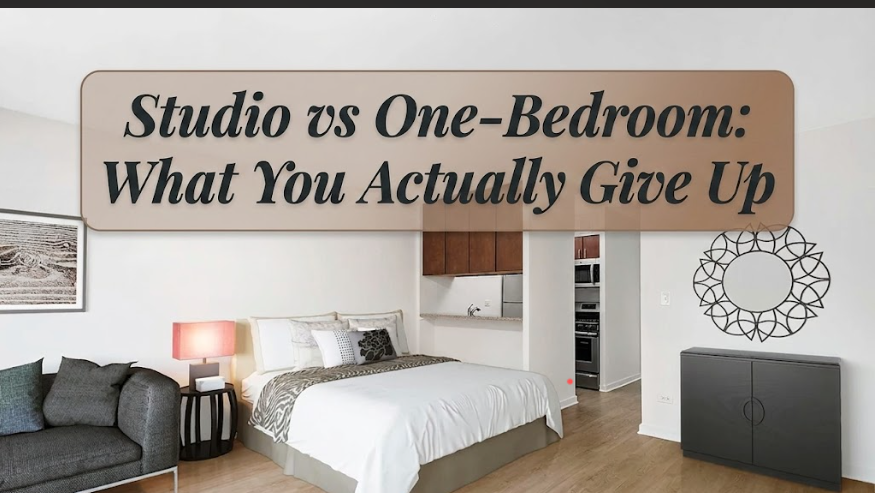
A reader wrote in last month asking something pretty specific. She had two offers on the table, a 480 square foot studio for 1,450 a month, and a 620 square foot one-bedroom for 1,800. She wanted to know if the extra 350 dollars was “worth it,” like there was a clean yes or no answer sitting somewhere.
There isn’t. But the question is worth answering properly, because most comparisons between studios and one-bedrooms stop at square footage and price per square foot, and that’s the least useful way to think about it.
1. The Wall You’re Actually Paying For
A one-bedroom’s extra cost isn’t really buying you square footage. It’s buying you a door. Specifically, a door between where you sleep and where you do everything else.
That sounds small until you’ve lived without it. In a studio, your bed is visible from your kitchen, your desk, your couch, and usually your front door. Some people don’t mind this at all. Others find it quietly exhausting in a way they can’t fully explain until they’ve had a one-bedroom and gone back.
If you work from home, this matters more than almost any other factor on this list. A closed door means your brain gets a real signal that work is done for the day. An open studio layout means your laptop is always visible from bed, and for a lot of people that blurs the line between “off the clock” and “still kind of on.”
2. What You Actually Lose in a Studio, Itemized
Here’s a more honest breakdown than “less space,” because the losses aren’t evenly distributed.
| What You Give Up | How Much It Matters |
|---|---|
| A closed door between sleep and living zones | High, especially for remote workers |
| Separate storage for out-of-season items | Medium, solvable with vertical storage |
| Privacy when hosting guests overnight | High if you host often |
| A dedicated space to leave a project mid-way (puzzle, sewing, work papers) | Medium, more relevant for hobbyists |
| Sound separation between activities | Medium to high, depends on your habits |
| Resale/rental flexibility later | Low short-term, higher if you’re an investor |
Notice that “square footage” isn’t even the headline item. Most of what people actually miss about one-bedrooms is functional separation, not raw space. You can lose 140 square feet and barely notice if the layout is good. You’ll notice a missing door every single day.
3. Where Studios Actually Win, and Nobody Talks About It
I don’t want this to read like a one-bedroom sales pitch, because studios win on things that matter and get ignored constantly.
Utility costs are lower, sometimes by a meaningful margin, since you’re heating and cooling one open volume instead of two separated rooms with their own thermal load. Cleaning takes less time, which sounds trivial until you’ve spent a Sunday afternoon doing it for both. And there’s a layout honesty to studios that one-bedrooms sometimes lack. You can see your entire home at a glance. Nothing is hidden in a bedroom you forgot needed vacuuming.
There’s also a financial angle nobody mentions enough. A studio at 1,450 versus a one-bedroom at 1,800 isn’t just 350 dollars a month. Over a year that’s 4,200 dollars, and depending on your city, that’s real money toward savings, debt, or just breathing room. The question isn’t whether a one-bedroom is nicer. It almost always is. The question is whether that particular kind of nicer is worth what it costs you elsewhere.
4. The Layout Trap That Makes This Comparison Unfair
Here’s where people usually go wrong in this specific decision: they compare a badly laid out studio against a well laid out one-bedroom and conclude studios are the problem. They’re not. A studio with good zoning, a proper room divider, and furniture chosen for the space can genuinely outperform a poorly designed one-bedroom with an awkward hallway eating ten percent of its square footage.

Before you write off studio living, it’s worth seeing what a well-zoned one actually looks like. Studio apartment zones and how to create separate spaces without walls gets into this properly, and it changes the comparison quite a bit once you’ve seen it done well.
And if two people are involved in this decision, not one, the calculation shifts again. Can two people actually share a studio is worth reading before assuming a one-bedroom is automatically the couple-friendly choice. Sometimes it’s not, depending on schedules and work habits.
5. A Few Questions That Cut Through the Noise Faster Than Price Comparisons Do
Instead of running the numbers first, answer these:
- Do you work from home more than two days a week?
- Do you regularly host overnight guests?
- Is your city’s studio-to-one-bedroom price gap under 20 percent or over 30 percent?
- Do you already own furniture built for a larger footprint?
- Are you likely to move again within 18 months?
If you answered yes to the first two and the price gap is under 20 percent, a one-bedroom probably earns its cost. If the gap is over 30 percent and you’re not hosting often, a well-organized studio will likely serve you just as well for a lot less money, and studioapartmentsetup gets messages from readers regularly who say the studio ended up being the better call once they actually lived in it for a few months.
None of this means one option is objectively correct. It means the decision is more specific than “more space is better,” and treating it that way is how people end up overpaying for a bedroom door they use twice a week.
If you land on the studio, the next real decision is layout, not furniture shopping. 4 studio apartment layout principles every interior designer uses first is a solid place to start once the lease is signed, before you buy anything.
FAQs
Is a one-bedroom always worth the extra cost if I can afford it? Not automatically. Affordability isn’t the same as value. If you rarely need the separation a second room provides, that money is often better spent on savings, a nicer studio in a better location, or furniture that makes the studio function well.
Do studios feel smaller than their square footage suggests? Sometimes, mainly because closets, door swings, and kitchen zones eat into usable floor area more than people expect. A well-laid-out studio at 450 square feet can feel roomier than a poorly laid-out one at 500.
What’s the biggest regret people have after choosing a studio over a one-bedroom? Lack of a closed door for work calls or sleep separation comes up most often, particularly among people who started working from home after moving in and didn’t originally plan around it.
What’s the biggest regret people have after choosing a one-bedroom over a studio? Budget strain shows up a lot here, especially when the extra room ends up underused or becomes a storage dump rather than a functional second space.
Is it cheaper to furnish a studio or a one-bedroom? Generally a studio, since you’re buying fewer pieces and often multi-purpose furniture like a sofa bed or storage ottoman instead of duplicating items across two rooms.
For anyone still undecided, it’s worth reading the deeper comparison over on studio apartment vs one bedroom, which one is actually worth it, which walks through a few real budget scenarios in more detail than fits here.